Archives

The Nature of News

This entry was posted on by .

Dear City Friend,

It’s 6:45 on June 20th, and while the temperature is dropping, there are still hours of daylight left. I felt moved to write you a letter and tell you about the snowball bush in full bloom right now and the little worms we found on a curled leaf, presaging the annual devastation that blights this intrepid feature of our yard.

I want to tell you about the lilacs, French and Korean, that are sending out their unmistakable perfume into the evening air, and the huge yellow iris that burst forth this week, and the much smaller wild blue irises that we rediscovered today blooming on the rocks just a few feet from the Bay of Fundy.

I know that you would love the foamy white bridal wreath spirea (an anniversary gift to us the year they legalized gay marriage, remember?) and the dozens of upright pink and purple lupines, signature flower of Nova Scotia, in full and glorious bloom right now. And so much more. Like the little raccoon who has started raiding our hanging bird feeder, all on his own, two months after we chased him and his mother and siblings away.
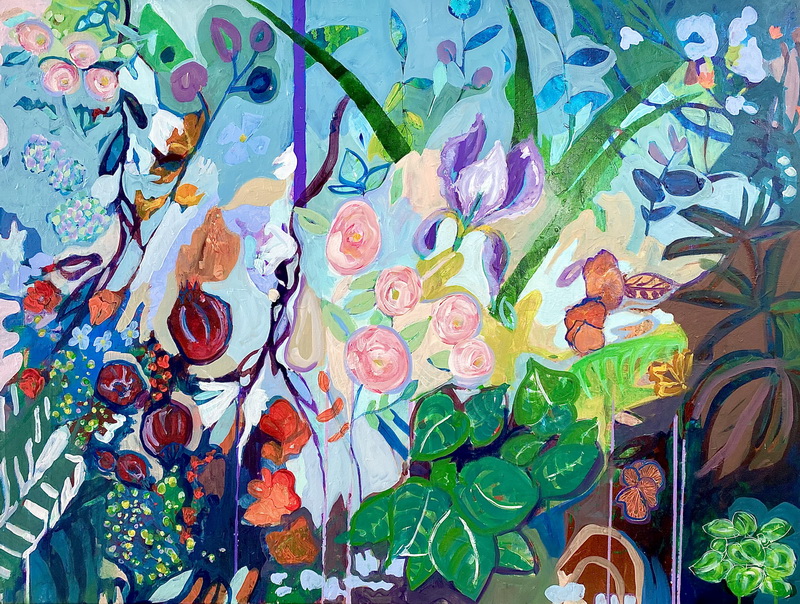
colourful abstract painting of a flower garden

Fantasy Garden by Jessica Ruth Freedman

All of this feels like news to me, although probably not to you. I remember living in the city, being engaged with social life and constant action, working on important issues, attending theatre and dance productions, films and events. Going out, keeping up, meeting up, on the go, living the life, living the news. That has continued to be your reality, at least up until this pandemic stalled city life in a way that suddenly brought your pace much closer to ours—although without our natural benefits.

Decades ago, when I lived in the city, I met a woman who did not. Her letters schooled me in a more rural kind of news. For her, news was when the chickadees that she’d been watching for a month stood aside and let their fledglings fly free from the nest. News was when the onions she’d planted were ready to pick. News was fresh snow in the nearby woods and seeing an animal, mink or marten, just living its life out there.

And now I live out here too, in rural retirement. At first, back in the eighties, we didn’t even have a phone and my partner, the owner of this tilted plot of land on the shore, was content to occupy a mere ten percent of it. Her wheelchair was totally incapable of navigating the rest, despite keeping everything mowed in a grand illusion of flatness. It’s all grown up with trees and gardens now, and retrofitted with accessible pathways, landings and decks, so she really can get just about everywhere she wants to go.

Change started with basic telephone, soon followed by internet, cellphone service, and then Netflix. Suddenly, it seems, we are no longer remote. Rural, yes, but not remote. This pandemic year, we “attended” the Toronto International Film Festival virtually. My inbox is full of alarming news of fires, floods, drought, and the oppressive conditions in which people live around the globe. Not to mention the plight of animals, large and small. Rural news and urban news are no longer so far apart.

Sometimes out here in our lush surroundings, we struggle to stay connected to the wider crises but we do notice things. Fewer birds this year, yes. And although we know that insect populations are declining, we still get bugged. Ticks are plentiful. We do miss our bats, all of whom succumbed to white-nose disease a few years ago. We notice far fewer fishing boats in the water. No whales. No gypsum boats. Still no tidal power. A major wind power project defeated by timid souls worried—justifiably?—about bird strikes and brain effects. Still talk of big fossil fuel projects as the solution to economic depression. Still outright war at times between settlers and Indigenous fishers. But still no noticeable change in tide levels on our doorstep, or the basic facts of what happens when seeds go in the ground.

It’s later in the evening now, on this longest day of the year, also our thirty-first anniversary. We had a delicious seafood dinner, watched a whole movie, then marvelled at the fact that it was still not fully dark at 10:30. A waxing gibbous moon contributed its reflected beams, lengthening the day even further. So enough for now, dear friend. I do hope you’ve stayed well. I hope the pandemic has spared you and your loved ones, and if not, I’m so sorry. We are easing back into social interaction and, as we do, we hope that maybe we’ll have occasion to welcome you for a visit out here once again.

In love and solidarity,
Your Rural Friend
 

Rural Creative

This entry was posted on by .

Greetings from the Adirondack chair on the sunny side of my porch, on the outskirts of a small town, on the coastal edge of that province waaaay over on the eastern edge of the country….

There are no other buildings in my view right now, just the afternoon light on the harbour, yellow leaves falling from birches, a few bees foraging the last of the black-eyed susans. By evening, it will be so dark I’ll need a flashlight to visit my neighbours (you don’t notice streetlamps until there are none). By the end of October, seasonal businesses in town will have closed and by mid November, streets will be deserted at dusk. Any stray tourist would say this place is dead.

But rural and quiet—even officially closed—should not be confused with lifeless. Lack of high-profile events or line-ups outside venues does not mean lack of workshops, performances, readings, or exhibits. It doesn’t mean things aren’t happening. You just need to know where to look.

There’s a band playing Thursday night at the microbrewery and a film screening at the parish hall. A quilting class started up in the building next to the feed store. That new shop on the main road will special order canvases in any size you like. The bookstore closes at five—but the readings start at seven. Just wait, ask, search. And if you don’t find the events, supplies, mentors, or audience you need, make it happen anyway. Outside big cities, you have to be creative about being creative.

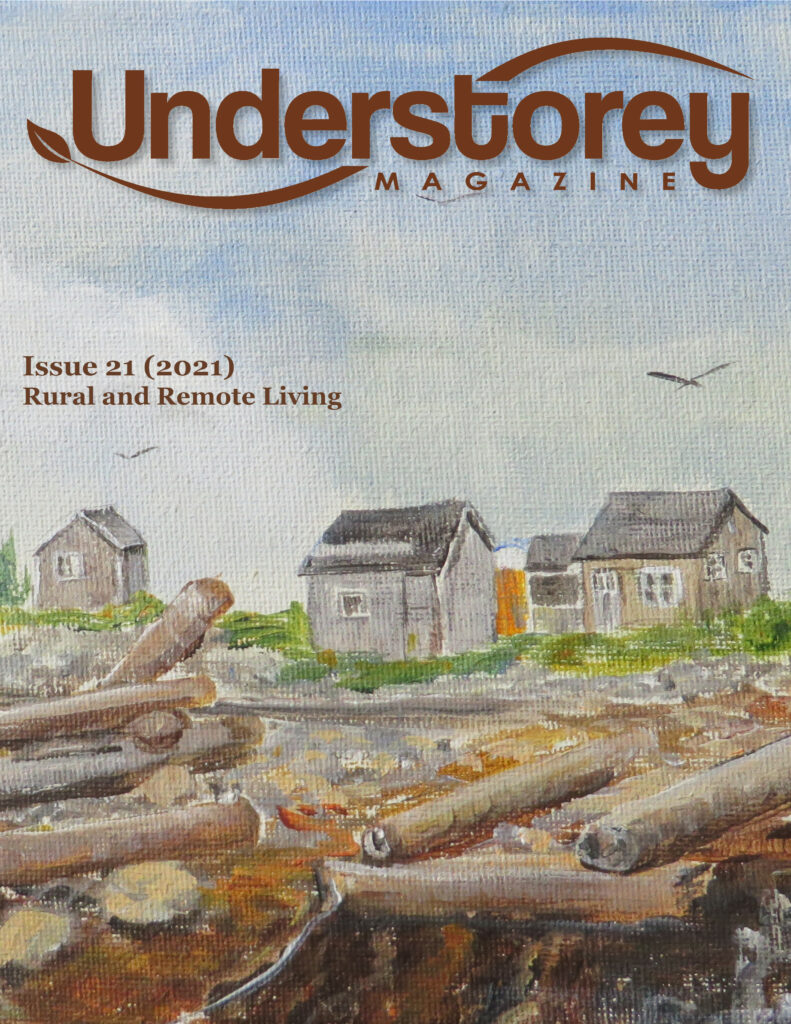
cover of Issue 21 with painting of small wooden structures on a shore

Cover art: Storm Tossed by Marg Millard

In the submissions for this issue, all from “creatives” who live outside large urban centres, I read about the beauty of rural and remote lands and how the natural world provides constant inspiration, through awe as well as an urgent compulsion to protect. I read about the less frantic pace of rural life and how this often provides the means and will to create. I also heard about deep connections among rural people, the interdependence of communities and their inhabitants, whether separated by a field, an inlet, a long snowy road, or intermittent internet.

There was ambivalence in the stories and images submitted to this issue, too. A love-hate relationship with rural living. Out-of-the-way does not mean unspoiled or uncomplicated. Rural and remote areas can be dumping grounds for urban waste, testing grounds for half-baked business ventures, forgotten grounds of abandoned homes, clear cuts, mine pits. And sometimes, unfortunately, they support an insular thinking that can feel judgemental if not suffocating.

But I also found downright frustration in the voices of writers and images of artists, either hidden between the lines or stated explicitly. Not frustration with insular thinking in rural communities but rather with insular thinking about rural communities: The sense from urban dwellers that rural is where you go when something bad (or nothing at all) happens, or rural is where you’re from before something good (or anything at all) happens. The feeling from city creatives that all rural people—and therefore all rural stories—are the same. The failure to recognize the unique challenges of being a writer or artist far from urban centres.

The shift to Everything Online has been a mixed blessing. It has blurred the urban-rural divide, allowing a writer in Canning, Nova Scotia, for example, to attend TIFF and a street artist in Twillingate, Newfoundland, to share work at a festival in Milan. It has also, for better or worse, offered those in urban centres a glimpse of rural constraints and forced us all to be even more creative about being creative.

Of course, there is no substitute for in-person experience. As venues open up, let’s hope that events, audiences, and opportunities move in both directions, from downtown to farm gate, from inner-city to outport, and back again. Let’s hope that everyone, everywhere has the opportunity to appreciate the extraordinary diversity and talent of “rural creatives”—perhaps beginning here, with contributions to this issue of Understorey Magazine.
 

About our cover artist and print edition

Our cover artist for this issue is Marg Millard. Marg has been an enthusiastic supporter of Understorey for many years, “liking” and sharing almost every single social media post we publish. Her painting Storm Tossed shows the area around Coffin Island, Liverpool Bay, Nova Scotia, after a major storm.

Understorey Magazine has been published in rural Nova Scotia—near E’se’katik or Lunenburg—since 2013 (in partnership with Mount Saint Vincent University in Kjipuktuk/Halifax). We are primarily a digital magazine but will be creating a limited-run print edition of the Rural and Remote Living issue. Also produced and printed in rural Nova Scotia, this edition will be made available to all contributors and their communities, partly in recognition of unreliable internet service in many rural and remote areas. For inquires about the print edition, please email [email protected]

Bear with Me

This entry was posted on by .

One of my favourite stories is about an old hunter who wishes to die because he feels lonely and useless. He has outlived his family and friends. He plans to give himself to the bears so at least he can serve some purpose at the end of his life. But when he lies down on the bear path near his village and encounters a bear and his companions, he realizes he’s not ready to die.

When I heard this tale from a storytelling colleague at a Winnipeg coffee house, it spoke to my heart. I researched long and hard and spoke with many Indigenous elders to find a way that I could begin telling this story myself.

Bears were not something we planned on dealing with when we moved from the city to this 130-acre farm ten years ago. It was soon after we took possession of the land that we heard about the bear path. Old-timers say the bears have been coming along the river each spring and summer since before settlers came into the region. Ancient burials have been found where the river pours itself into the larger Winnipeg River at Seven Sisters Falls, exposed when land shifted or water levels changed. The bear trail is worn parallel to the river as the bears travel along its banks.

That first summer I had noticed the narrow path of beaten grass and told my husband, “Oh, it’s likely deer or those coyotes we hear in the night.” But when I walked down to the river, I saw a mama bear and three cubs. The cubs were asleep in the high branches of two ash trees and the mother was asleep at the foot of one of the trees. I didn’t come any closer. Now I could imagine lying on the path waiting for the bears to come and eat me and could empathize with the old hunter’s change of mind.

Every spring and summer since, I have looked for the bears’ return to the riverbank and the woods nearby. Now, when I tell the story of the old hunter, I bring to it my own experience of living very near the annual bear sightings. Being an oral storyteller means gathering stories, listening to tales of people’s lives, and often teaching them how to fashion their own stories. Because of my rural living experiences, I can help others express that combination of fascination and dread that a bear sighting often brings.

I tell stories whenever I am asked to come to a school, library, or community event. I now know so many stories that I find myself telling them even in gatherings with friends or family. “That reminds me of a story,” I begin. My rural neighbours will often comment, “I bet you could tell a good story about that.”

One neighbour, a trapper, taught me about the use of old trappers’ cabins in the bush, and I was able to include this teaching in my story of a man who was saved by a wolf. I last told this particular story at an international storytelling festival, taking place over Zoom, and I was struck by how listeners in India and Britain were enchanted by my tale of the bush in winter, and enthralled by the actions of the wolf leading the man to safety.

Moving away from the city to this land has also enriched my visual art practice. All of the land is an art form that I can work with. Who needs a water feature when we have butter yellow marsh marigolds blooming along the watercourse in the ravine every spring? Who needs a planetarium when the night sky is carpeted with stars or lit by a full moon? The land is so ever-present, unimpeded by concrete and traffic noise, that I am compelled to express my feelings for it rather than faithfully render it. I am conscious of a settling in, a rootedness, and so my paintings have become more abstract, reflecting emotions and a sense of wonder instead of recognizable details.

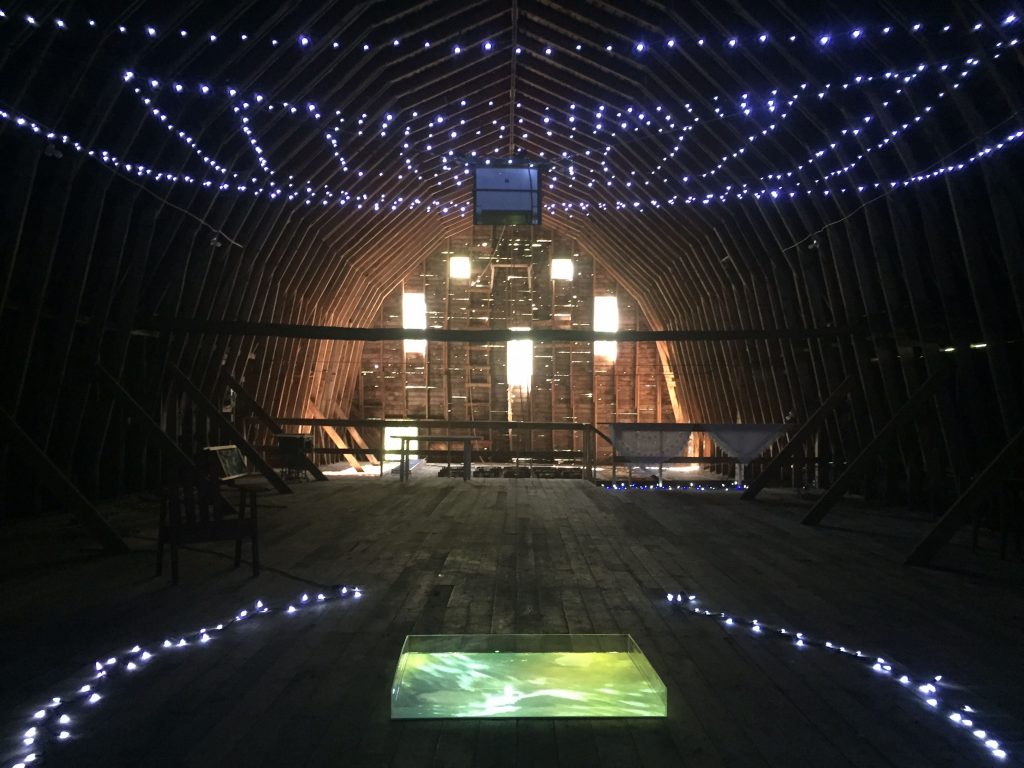
The huge barn has also been a source of inspiration. Once housing a herd of dairy cattle, it is now completely empty. House concerts, bus tours, and art shows have filled the space over the years. One summer, when I was particularly concerned about climate change, I mounted a video installation about planet earth in the loft. Over two hundred people viewed it in one month. The barn itself was as much an attraction, truth be told, as my storytelling and my art pieces, it’s upper loft reminiscent of a cathedral.

installation showing lights and water in an empty barn

Skin of this Planet by Mary Chown

I have dismantled the barn installation but the effects of climate change are felt here every season. Some summers, there hasn’t been enough rain, while at other times the land is soaked so much that you could ring it out like a sponge and the water rushes down all the little gullies and ravines into the river. Lately we haven’t had enough snow cover and many of our perennials have not made it through. Up until now we’ve had a rich variety of insect life and bird life, mostly because the ravine and riverbank are forested, wild grasses and thistles grow on the hillsides, and we planted many additional trees and shrubs. Winter is usually full of chickadees and nuthatches with a visit every year from the pine or evening grosbeaks. Not so the last two or three years. Fewer birds come to our feeders or visit the fields.

Our small apiary of bees is constantly confused by the changing weather patterns, and we have to keep a close watch on them to make sure they are dry enough, warm enough, cool enough, or have enough to eat. When it’s unseasonably mild in March, the bees fly out looking for food, and may start to lay eggs too soon. But when it’s too cold in April, the bees may die if we don’t feed them. Two years ago we lost ten hives in the early spring.

Which brings me back to the bears. Some years they are thin and mangy, other years sleek and round and chubby. They’re always looking for food and they will eat anything.

One year a big male bear managed to climb through the window into our honey house; I don’t know how he squeezed in. Our extracted honey was sitting in an interior chamber keeping warm, and luckily for us Raven barked that night and the bear somehow managed to get away, but the interior wall of our honey house will forever carry the mark of the bear claw well over six feet high. When children come to visit, I relish taking them into the honey house and showing them the bear claw on the wall.

The bear returned more recently and hit pay dirt. Five fifty-pound bags of chicken feed were stored in the old garage and we were never able to close the door properly. In the morning, three bags were missing. The first bag of poultry feed was lying near the fire pit at the edge of the ravine. Feed spilled out of it where the bear’s claws had raked it open. Following a trail of trampled grass, we found the other two bags at the bottom of the ravine. They were partly covered with dried grass as if the bear had tried to cache them. We were almost reluctant to retrieve the feed, but our hens needed it too.

Bear stories have multiplied since moving to the farm. Many of my city friends comment that my husband and I seem to be living an adventurous existence out here, and of course this is true. All the plants, trees, and insects we see daily have enriched our lives beyond measure. We aren’t in nature; rather, we are part of nature. Sometimes, I am aware of a great longing in people who visit us from the city. You can tell by how they look around, breathe in, relax. They may come to buy honey or they may be a friend who sleeps over and comments on how quiet it is at night, how settled they feel. I really believe that our hearts seek a union with earth, sky, and water.

When the old hunter, lying there on the path meets the bears, he has a change of heart. On a whim he invites all the bears to a feast at his house. When they arrive the next day, he has prepared trays of salmon and wild cranberries for them. The oldest bear tells the hunter that he too is often lonely, and whenever the old hunter feels that way, he should remember the bears’ visit. The hunter doesn’t really understand what the old bear is saying but the story tells us that “he listened with his heart.” The following day, a young bear returns to the hunter’s house to tell him what the old bear had said. This time, the hunter understands: the young bear can speak both human and bear because he was once human. I think that is my favourite part of the story, that fluid boundary between species that exists in the world of stories—and just possibly in our waking world too, if we listened with our heart.


Finding the Bizarre in the Mundane: On Environment and Memory

This entry was posted on by .

“You’re brave to go in that water,” the woman said. In one hand she held a convenience-store bag of snacks and in the other a cigarette. “It didn’t always look like this, though. I used to swim here as a kid, but I wouldn’t do it now. You could step on anything in there.”

Little did the woman know: it had taken me three trips to this beach to muster the courage to don my wetsuit and explore this water. Perhaps I was as much of a fool as I looked.

It was the summer of 2020, the pandemic summer. I had only recently moved to Nova Scotia, and was still getting used to life as a rural artist. Under normal circumstances, I would be very busy. Earlier that year, I’d planned workshops for June through to October. I had a part-time job as a studio assistant, regular work that sold on consignment to seven different shops, and two exhibitions in the planning stages. Within weeks of the pandemic shutdown, all workshops were cancelled, I was laid off from my studio assistant job, the shops closed, and the exhibitions were postponed. I suddenly found myself at home and out of work in the quiet of my rural town.

To cope with the uncertainty and anxiety, I drove to beaches, any beach that didn’t have the status of “park.” This was necessary for social distancing, but it also satisfied my longing and curiosity. I grew up in northern BC and spent my childhood summers on a remote lake. The Atlantic ocean was unfamiliar to me, but I still longed for water and trees. So I followed dirt roads, logging roads, out-of-service highways. I learned that, unlike landlocked northern BC, water could be found in pretty much any direction in Nova Scotia.

That day, I drove down an old highway and turned onto a road you wouldn’t think to follow if you didn’t know it already—but I’d been twice before. There was once a paved road but it was now overgrown with weeds and full of holes. At the end, the beach was a mass grave of plastic, barrels, machine parts, and a strange number of old traffic cones. It was as if someone had a town-hall meeting with all the garbage in the North Atlantic and said: “Only go where tourists won’t find you, okay?”

The woman with the convenience-store bag was the only person I’d seen there, but up to that point we hadn’t walked close enough to speak to one another. That day, she told me that she grew up in the area, and still came for walks along this shoreline multiple times a week.

“I was one of the last to leave,” she said. I asked what she meant by that. “The land was expropriated to build a superport,” she said. She offered me a pop from her bag; I declined but thanked her anyway. Before we parted ways she told me the names of her former neighbours and gestured to their former yards, where heaps of plastic now live.

I waded into the water with more caution after she left, her words—You could step on anything—still fresh. The water was full of slippery kelp; it was hard to see what was rock and what was something else. A marine propeller scraped my leg. I found cigarette butts, tampon applicators, plastic bags, drink containers, and many car and truck engines.

A local fisherman has since told me that these engines are often used as cheap, makeshift anchors. Tugboat crews buy them from auto wreckers and drain out any fluid, then thread a chain through. The engine-anchors are used in bad weather or dangerous seas when there’s a high chance of losing a real anchor, which is much more expensive.

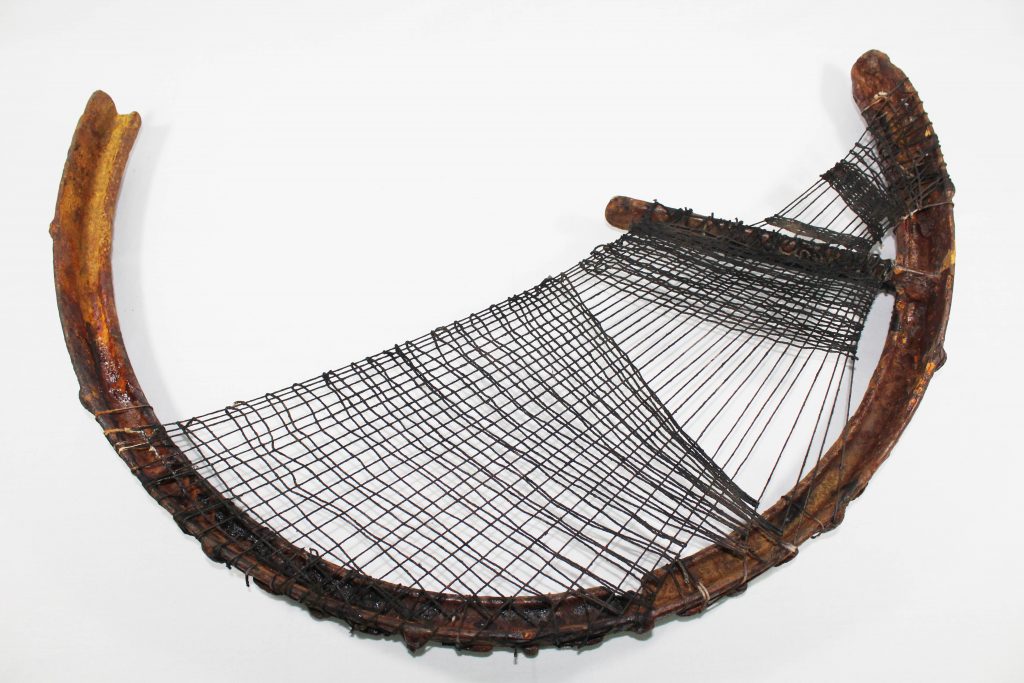
Sculpture made with an old tractor wheel and string

Fracture by Josephine Clarke

So that explains some of the debris. But no one knows where the rest of it comes from or how it gets to this beach.

After my swim, I followed the road back to the highway. Up on the the hillside, I saw the fading sign for the superport that was never built. I felt a rush of sadness. I wondered about future generations of kids, and if they will ever have a childhood like mine. The whole summer of 2020, I went back to that beach, took photos of the debris in the water, and mourned a life that now seems impossible.

As a child I would jump into the water without a second thought. Summers at the lake came with a sense of freedom and happiness, almost an urgency. After all, summer only lasted so long. As soon as the lake thawed, you jumped in. It was a childhood rite of passage.

Now, in this age of peak consumption and climate change, that carefree mindset seems far away—but I feel a new sense of urgency. That beach has taught me just how curated our trash is, and therefore that our experiences with climate change and ecological destruction are also curated. It’s a paradox: waste is ever-present but intentionally hidden. Where you live—and that often depends on your social class—affects what you see. The pace of consumption hasn’t slowed. We are just moving trash to places the affluent don’t visit.

I grew up as part of a rural, working-class family. I remember picking glass bottles out of the river sandbar with my dad, but never questioning how bizarre it was to find so many bottles in the river. When I moved to the big city for university, I assumed things would get better. But here I am as an adult salvaging even more garbage from the water, now to make pieces of art.

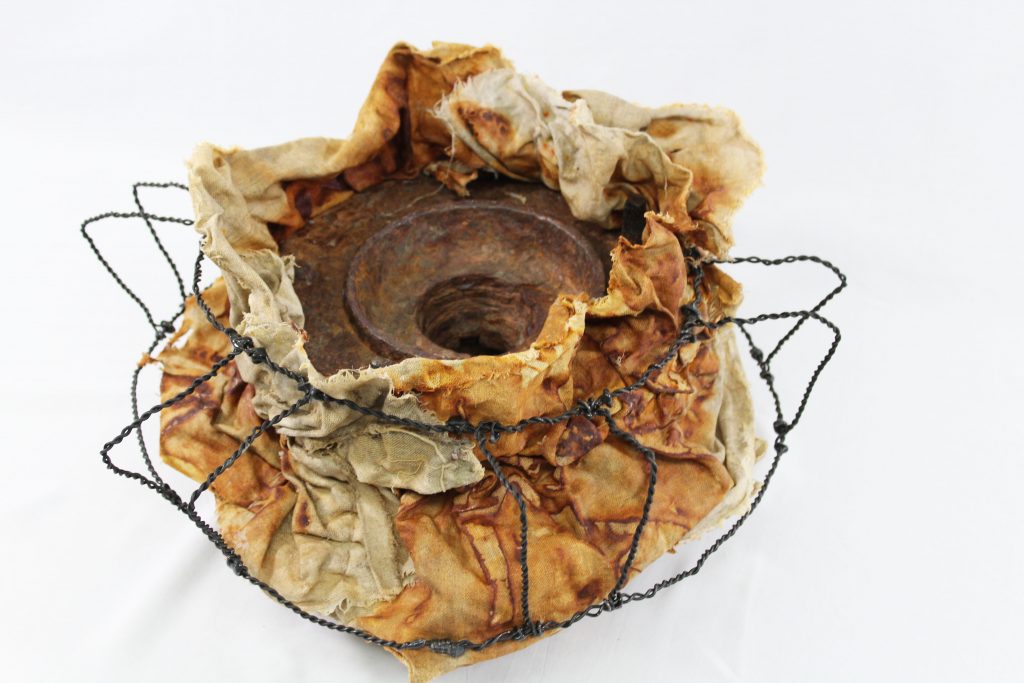
With the works I’ve made since visiting that beach, I aim to “bizarre-ify” the mundane. I take something many people, especially rural people, have become desensitized to and present it in an unfamiliar way. For example, Fracture is assembled from a broken tractor wheel and dyed with natural dyes I made from foraged wild sumac. With this piece, I wanted to play with the existing asymmetry but also make use of the negative space. Orbital is made with a braking mechanism from a locomotive. I wanted to add flowy organic shapes to contrast the heavy angular rigidness of the metal core so I rusted the linen cloth outdoors and manipulated it with stitching. The whole piece is encased in braided steel wire.

Sculpture made with old brakes, linen and wire

Orbital by Josephine Clarke

In everything I do with these found pieces, I aim to distort. I make them “more” than they are to grab people’s attention. By doing this, I’m in some ways combating the industrial starkness of the found object but this distortion can also break through nostalgia. If a tractor wheel is just a tractor wheel, people will attach their own meanings. But if I can make it strange, people think about it longer. Suddenly, there is space for conversation: “It’s what? And you found it where?!” (It’s like me with the glass bottles in the river of my childhood. I needed some degree of separation or abstraction to understand how bleak that scene actually was.)

Over the last two years, I’ve aimed to have my work either digitally accessible to rural communities or actually installed in rural locations. For example, I’m currently undertaking a Canada Council-funded exploratory project to make public art outdoors in remote locations. Rural communities are often left out of vital conversations but are often hardest hit by environmental changes, especially through the boom-and-bust cycle of industry. When industry packs up and leaves, it reveals the promises it doesn’t keep, and the local people are left to deal with the consequences. This is what I saw at the abandoned superport site that day. Through all of my work, I hope to create space for critical dialogue about the impacts of climate change and over-consumption, especially among rural audiences.


Lucky Strike

This entry was posted on by .

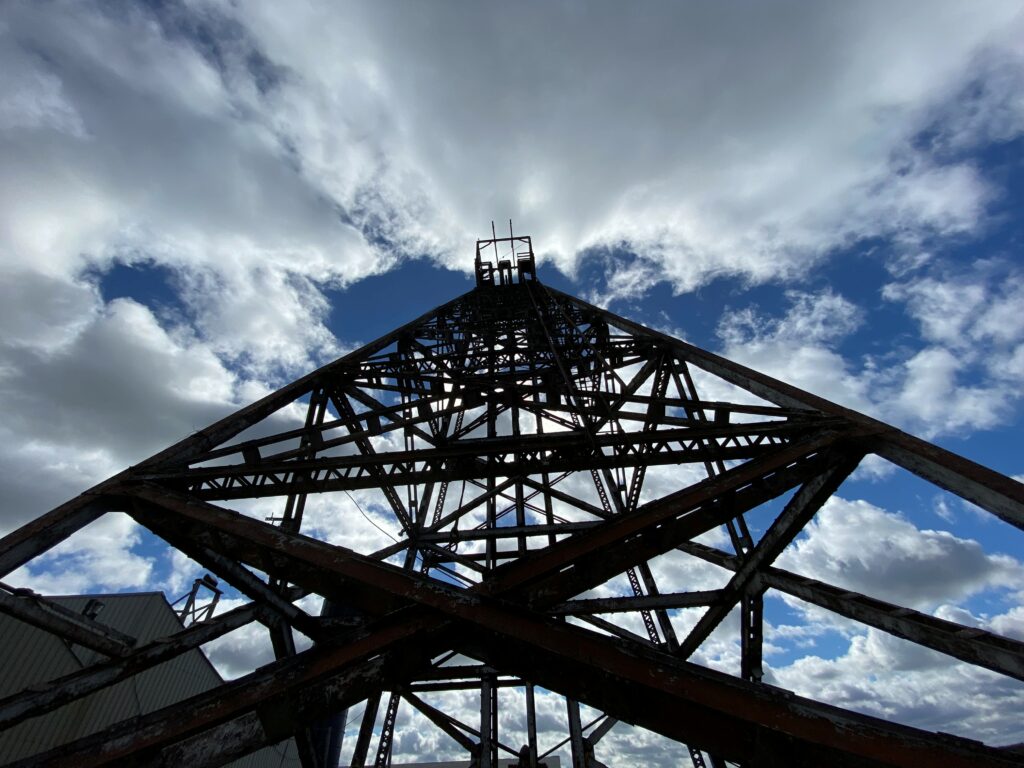
Everyone in Buchans lived in the shadow of Lucky Strike deckhead. Steely crisscrossed supports locked the legs of the towering triangular headframe in place, a Jenga of girders and I-beams atop a 700-foot mineshaft. It crowned the top of Main Street from the beginning, and I expect it will outlast the human desire to take up space on the barren plateau my grandparents and parents made home.

Its rust-streaked silvery steel shone with an allure like gold in the not so roaring twenties and the very dirty thirties, the dying decades of Newfoundland’s colonial history. The mine in Buchans offered a rare opportunity to work for wages. My grandfather’s family moved from the west coast; my grandmother moved from the east coast.

My grandmother had been raised on a subsistence farm with a few animals, gardens, a lake nearby and the ocean within smelling distance. The boys she knew chased girls with eels and her Catholic parents punished their children for walking on the same side of the street as Protestants. I wonder how lucky she felt when she eyed the steely bones of Lucky Strike. The wheel of a giant pulley sat at the top, turning as the cables lifted and lowered cages of men to different levels of the mine, like ants in an ever-expanding ant hill of industry.

photo of the Lucky Strike deckhead against a blue sky with white clouds

Lucky Strike deckhead by Tara Harris

I can imagine my grandmother standing on the corduroy road that was Main Street, eyelids pressing together at the clatter and grind of Lucky Strike. I think she would say it had delivered on its promise. My grandparents had work and a company house, and raised a family. They had church and community. “This is a perfect place to raise children,” she still says, even though there are no jobs and there is barely a child left in town. “It’s paradise,” my mother replies, winking in my direction.

My parents were the transition generation, growing up in a town with jobs and amenities, then raising a family in a town with layoffs and cutbacks. Do we stay or do we go? The house is paid for. No one would be crazy enough to buy it in a place like this. We stayed. Home was a word with uncertain meaning in the years they shuffled around the country chasing seasonal work, always tethered to a house in a place where work had ceased to exist. Retired, they live the consequences of their decision everyday as they look out the window onto a street where nothing ever happens. Most of my mother’s family moved to the other side of the country, still connected to us, but only by threads.

I think my mother would say that Lucky Strike doesn’t look very lucky to her. The giant hole beneath it has been capped and the moving parts taken off before they fell off. “How are things in paradise?” I ask over the phone. “I’m glad you don’t live here,” she says. Her voice trails off. I know that she wishes she didn’t live there either. We both wish that wherever we lived, we could be closer together.

I remember Lucky Strike in silence, though it likely had a tired motion in my childhood. I imagine it hoisting in slower and slower motion as the fathers of my friends were laid off, found work in other provinces, and eventually moved their families. The rows of students in my class at school were like rows of damaged teeth—some already missing, others hanging loosely, about to have their roots pulled up and be gone forever.

The company buildings at the top of town were slowly dismantled and the deckheads at MacLean’s and Rothermere mines pulled to the ground and scrapped. Yet Lucky Strike remained, a peculiar piece of derelict scrap metal oddly preserved to define and unite us, demanding we set aside our desperation and hold out hope for the next big discovery that would save us. My hope could not find breath on its steely frame; my identity aligned with the truth of my future.

Leaving Buchans only looked like a decision because action was required. With barely a handful of jobs in town, my graduating class was escorted to the Trans Canada Highway and given the choice to turn east or west. Like my grandmother, I turned west, leaving everyone and everything I knew behind. Images of ore sheds, train tracks, deckheads, buildings with sheet metal siding, they all faded, victims of memory as the rich red mud of the Bay of Fundy sifted through my fingers. I believe I was the lucky one, though I too will always live in the shadow of Lucky Strike.
 

Listen to Tara Harris read “Lucky Strike.”