Archives

On Being Remote (& Saying Good-Bye)

This entry was posted on by .

Why are you moving so far away?

That was a question family members kept asking hubby and me, in the early years of our marriage, as we moved, and kept on moving, to Newfoundland, to Labrador, to the Madawaska Valley, to Northwestern Ontario. By “so far away” they meant so far from the golden horseshoe, from the 401 and all its pit-stops, Autotown, (de)Forest City, Steeltown, and the Megapolis one longs to go T-O.

The movers said it would take them a week to deliver our stuff to Thunder Bay. You’d think we were moving to another country.

Yet, it was a long, long drive to our new home. Twenty hours over two days. Urban density gave way to sprawl, to industrial wasteland, to farmland, to north-town Ontario. Main streets nestled between swaths of bush, which stretched longer and longer as we drove further and further north and west, till we were nothing but a little grey beetle crawling through a vast forest beside a great sea.

We refilled for gas whenever opportunity arose, road signs warning us not to wait until nearly empty. A little path behind a gas station took us to a riverbank where we watched a blue heron spear frogs from the water. When we stopped for a pee along a burnt-over patch of forest, a moose cow and her calves looked up from their blueberry browsing to study us with as much curiosity as we them.

Why did we want to go to such a remote location? And was it really remote? After all, we arrived at a hub with plenty of stoplights, all the major fast food restaurants and department stores, including two Canadian Tires (one for each of the twin towns that amalgamated into one city), a multitude of hockey arenas, and a college and a university (either of which we could readily bike to). What more could we want?

What does remote mean?

The most common meaning of remote is “far away.”

But far away from what? In Thunder Bay, the word “remote” is usually heard in a newscast or weather report in reference to communities in the upper half of the province: end-of-road communities or First Nation communities without road access, whose residents visit Thunder Bay to access health services, secondary education, and box-store shopping. We were not at all remote in that sense. We were surrounded by people and stores and schools, although not by extended family. Since it is generally recognized that it is much further to go from a centre than to it, we’d regularly take trips to visit our families. At the end of a visit, my mother-in-law would stand at the door, waving and crying. Why must we live so far away?

Yet, I wasn’t the only person in our families to move “far away.” My own parents, retiring at their earliest possible opportunity, went to live at their summer cabin. They became the most westerly residents on Manitoulin Island, on a bush acreage they called Far Point. Why did they go there? An eight-hour drive to Toronto, a thirty-minute walk to the nearest neighbours, an hour drive to a grocery store. Well, they wanted to be away from it all, away from the city they had always hated, with its traffic and crowds, parking restrictions, parking tickets. They wanted an unregulated township, fewer constraints. They wanted to be alone to do their own thing.

“When we want culture, we eat yogourt,” my parents would joke. “Cultivation is pushing a rototiller down a garden row.” On the outstretched arms of a scarecrow, my parents set a radio at an unstable setting so that the stuffed head would erratically erupt in song, news, or weather reports. And they lined their garden with electric fencing to keep out the more insouciant marauders.

They couldn’t come to visit us, because we lived much too far away.

To be remote can also mean to be emotionally distant.

Physical distance can offer self-protection from relational difficulties. In my high-voltage family, we needed space from each other. Yet we craved connection, too.
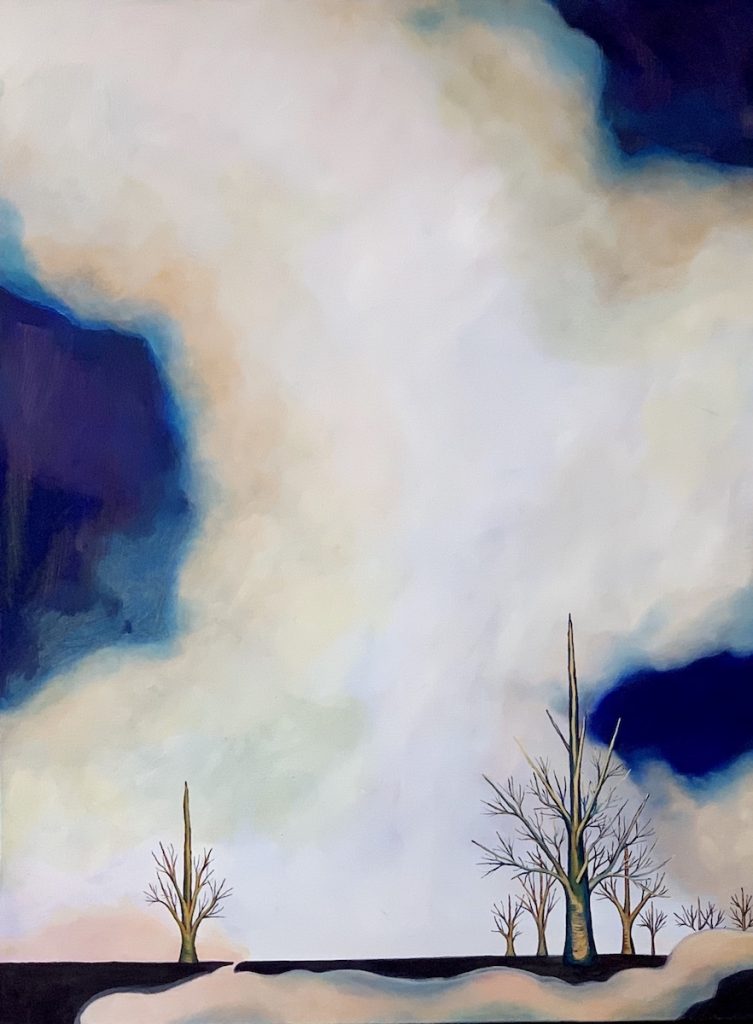
Painting by Jacqueline Staikos showing a large sky and two stark, separated trees

Untitled by Jacqueline Staikos


On my very first day in Thunder Bay, waiting at a traffic light, someone in the next lane signalled me to roll down my window. “Something’s trailing from your side door,” she advised. This struck me as a small-town, care-for-your-neighbour kind of thing, something that didn’t often happen in the big cities where I’d lived. Growing up in Toronto, everyone seemed remote. Big city ethos: Don’t show me your feelings and I won’t show you mine. Once I thought I saw my Grade 8 teacher on the subway, and I stared repeatedly, as much as urban-ity would allow, but I didn’t dare say anything. Growing up in this big city, I never knew who’d be in my class one year to the next; some may have moved to another planet as I never saw them again.

So be it.

I live, now, in a hilltop neighbourhood. If I stroll to the perimeters of the hill, I can see to the borders of the city and beyond: Lake Superior (Gichigami) to the east, the Nor’Wester Mountains (Animikii-wajiw) to the south, and to the north and west, trees, hills, trees.

Roses are difficult here. But chipmunks, ravens, and one lone snowshoe hare enjoy my vegetable garden: rhubarb, chives, zucchini—just the hardy stuff. My vegetables have to be tough because my unweeded perennial beds have gradually transformed our yard into boreal forest.

Many rivers wind their way through the city on route to the great lake. Every spring melt, I see anglers, bankside or waded in, trying to catch a spawning trout. Bears will also follow this trail to fish, or to the city’s intriguing odours. Letters to the paper remind us that a recently closed outdoor pool was originally built as a safer option to the city’s unguarded rivers. National journalists tell even darker stories about the waterways.

Thunder Bay reminds me that “far away” is still a “here” and “here” is always an “us.”

The word remote comes from the Latin verb removere, from which we also get the verb “remove.” Used reflexively, it suggests a self-willed action.

To remove oneself is a choice. My husband and I chose to move here. And now, two of our children, grown up and graduated from local post-secondary institutions, have removed themselves from this northern city, with their spouses and families, for jobs not found around here. When we get together, we gather in a big circle around a table and eat and drink and chat and laugh and argue. We philosophize about human rights, freedoms, oppressions, privileges, responsibilities, the government and the individual. Often, we don’t agree. Between visits, video technology keeps us connected. But a video cannot give the weight of baby on hip; neither tennis ball nor cake can be passed through a computer screen, even though we pretend: “On the count of three, let’s all blow out the candles.” So, at the end of a visit, I’m the one at the door now, tearfully waving goodbye.

Remote can also be a transitive verb. Though rarely used this way, it refers to the moving of something or someone to something or someone else. The action is willed by the mover.

For some, re-motion or re-moval is not a choice. I think about my Slavic grandmother, mentally unwell, deported under Canada’s War Measures Act as an undesirable citizen. I think about my father, renamed, rebirthed, reparented. I think about my husband’s Irish great-grandfather, forced from family and land by famine. I think about all my great remote grandmothers, whose names are lost to me, filles du roi, voyageur wives, whose children were lost to them, for the sake of assimilation or education or societal expectation of betterment.

We all experience “remote” in some way or other. To be remote is to be far away from others. If those others are your kin, remoting is a leave-taking. We all have a time of standing sadly at the door.
 

Listen to Holly Tsun Haggarty read “On Being Remote (& Saying Good-Bye).”


Entangled in Yarn(bombs)

This entry was posted on by .

I stumbled into art by being a bit bored. I suspect that’s how all good ideas emerge: there is space in your mind to fill and while you’re not paying attention your imagination runs away. During my training as an Occupational Therapist, I did placements in St. John and Fredericton, New Brunswick, and because I didn’t know anyone in those cities, I filled my spare time with crafts. I even convinced myself that watching TV was productive—as long as I was making something as I watched. I now have a beautiful hooked rug to show how much reality TV I consumed during the summer of 2008.

I moved to rural Newfoundland in 2012 to work at the local hospital. My husband and I had been living in England while he completed law school and he had secured an articling position in his home town of Gander upon graduation. Twillingate, a town of 2500 people, an hour’s drive from Gander and five hours from the provincial capital St. John’s, had a newly opened rehabilitation unit with a position for a lead Occupational Therapist. The post also included housing so we made Twillingate our home base. It didn’t take long for me to turn to craft for comfort and entertainment. I soon discovered, however, that there are only so many hats a girl, her friends, and her family need. Briefly, I tried my hand at selling my hats but wasn’t satisfied with the effort and subsequent return.

Then, while scrolling the internet, I discovered yarn bombing. It was a relatively new art on the block and struck me as accessible, harmless, and a little bit mischievous—a very enticing blend.

“Yarn bombing” is attributed to American textile artist Magda Sayeg. In 2005, she knit a door-handle cozy for her yarn shop, and knitters and crocheters worldwide went wild. They began covering statues, park benches, and trees with yarn. Canadians were right in there, too. Mandy Moore and Leanne Prain wrote Yarn Bombing: The Art of Crochet and Knit Graffiti (Arsenal Pulp, 2009); Jessica Vellenga and her team, Yarn Bomb Yukon Collective, knit over a plane and a statue of a woolly mammoth; and Joann Matvichuk invented International Yarn Bomb Day, first observed in 2011. Over the years, the practice has evolved and dedicated artists have emerged, knitting and crocheting over buses, billboards, and even a house!

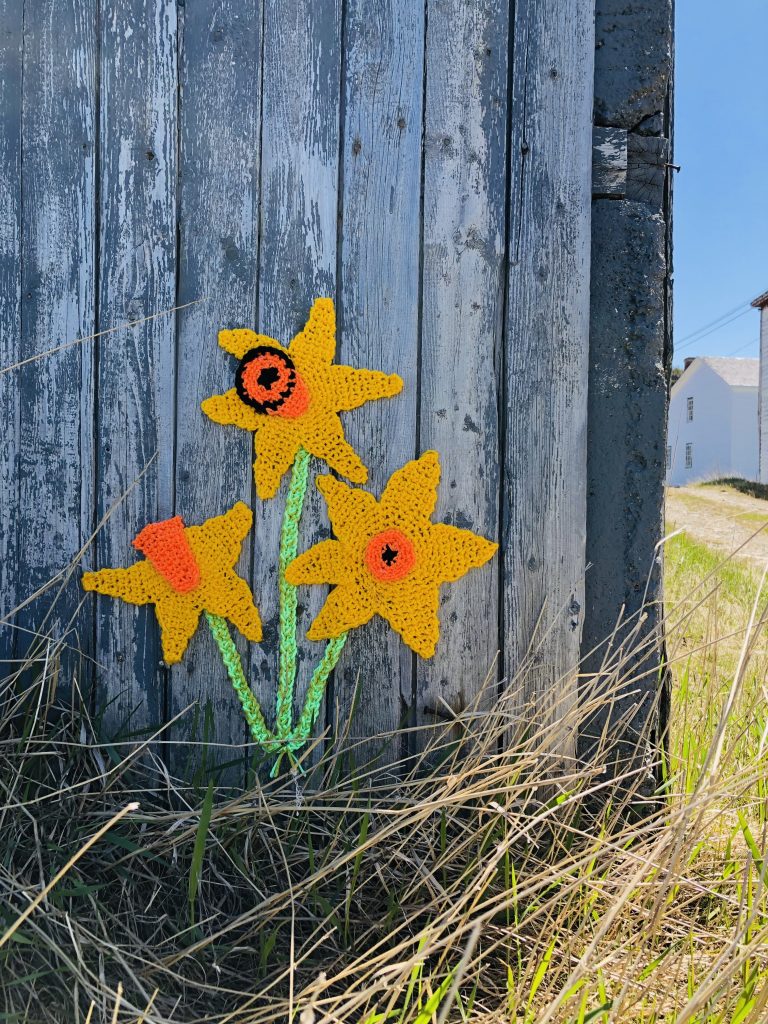
photo of knitted daffodils against an outdoor wooden structure

Daffodils by Nina Elliott

Yarn bombing now references any fiber used as street art as opposed to just knit- and crochet-wrapped pieces. It can include doily-wrapped trees, crocheted images affixed to fences, and yarn tied to spell words or create an optical illusion. Like other forms of street art, it’s difficult to know the artist’s intention but it’s safe to assume there is an element of fun. Despite the expanded practice and broader definition, it’s still rare to spot one in real life.

Except, thanks to me, in the small town of Twillingate, Newfoundland.

Just about every month now, and much more frequently in the summer, I install a yarn bomb. When I look back at my “portfolio,” it tells a story about my life and thoughts. In 2015, before leaving on a thirteen-month backpacking trip through Southeast Asia with my husband, I knit a mouse holding a sign saying “End the Rat Race” and left it in the Gander airport. When I returned to Twillingate in 2017, I installed Home is Where the Art Is. I embroidered this message onto a doily and affixed it to a nearby abandoned house to represent my feeling of being home. When I became pregnant with my son, I installed Always Choose Love. This piece included a big heart that spelled out “love” and was accompanied by an embroidered doily. It was my mental and emotional preparation for motherhood.

When the pandemic hit, I was working at the hospital and pregnant with my daughter. I was feeling overwhelmed so I launched my first solo “show” on the streets of Twillingate. I called it Newfoundland’s First Outdoor Art Gallery and installed nine pieces along a two-kilometer strip of Main Street. The theme was Uplifting, because we all needed some uplifting at that time. This past summer, I launched another yarn bomb gallery, playing with the theme A Time in Twillingate by making yarn bombs with local historical references.

In reflection, I can see that my art serves as a journal of my values, opinions, and mental state. Yarn bombing is how I manage stress and express myself. In the moment, it feels simply like creative energy that needs an outlet; it’s only with a bit of space that I can see the connection to my life. And now that so much has shifted online, art and creative connections are easier than ever. I can befriend yarn bombers in Germany, see London Kaye’s yarn bombs in Los Angeles, and partake in the yarn bombing festival in Milan—all from the comfort of my couch. At the same time, more people are taking an interest in my art and I’m getting invited to yarn bomb businesses in Twillingate and further afield.

Still, my practice is entirely tied-up with living in rural Newfoundland. The clapboard buildings are my canvases and the winter storms serve as creative retreats. The pace of life in the outports allows space for dreaming and time to dedicate to my art practice. I feel fortunate that Twillingate has accepted and even encouraged this passion. When I first began, I worked anonymously and was constantly expecting someone to tell me to stop. But now, I’m all in and I see it as an essential element to my contentment. As my practice has evolved, Twillingate has been right there with me, blossoming and growing in its own way. Now that it’s a tourist destination, buildings have been repaired and turned into businesses and I’m invited to install art on the storefronts. It’s a dream come true: the opportunity to cover my town in art.

A Pinch and a Wiggle

This entry was posted on by .

Shannon runs her fingers over her upper lip and chin, her way to tell when two weeks have passed. With the esthetician closed in Queen Charlotte, she wonders how long she’ll last before she will pluck her chin hairs, one at a time. Only a select few friends know what grows below her mask. The same is true for her red tunic-like sweater. Daily meetups with recipe books and the refrigerator haven’t only added to her cooking skills but also an inch to her waistline. She squeezes her legs into her pants, feels the pinch of the jeans’ button.

The phone rings and it’s Roz, one of Shannon’s few in-person contacts. Twelve years her senior, Roz is fearless when it comes to sharing her opinions, most of them well-founded. So, when Roz asks Shannon to come over, Shannon looks forward to tea and conversation, but doesn’t expect to hear: My freezer quit working.

Shannon grabs her license and her raincoat and goes to her car. Empty spruce cones squish below her soles; the squirrels have been busy all winter. When she turns the key in the ignition, she gets the same warning as a few days before. The cooling fluid is almost empty, although she filled it just yesterday. The heater isn’t working, but the radiator might be overheating. She calls the auto repair shop, but they are all backed up, and her car will have to wait for a month. William, one of the owners, says he’ll swing by on his way tomorrow to help Shannon bring it to the parking lot. Best not to have the car stall midway between hers and Roz’s house, so she decides to walk the mile along the highway by the inlet.

Raindrops pelt her nose and cheeks. She lowers her head, pulls the hood’s drawstring closer, her eyes focused a few metres ahead. Spray from oncoming traffic lands on her jeans, grey-brown speckles on dark blue: lingcod colours. No one will offer her a lift, masked or unmasked. Five years ago, she would have run to Roz’s in all kinds of weather. Some aches and pains now take longer to heal.

Rivulets of rain stream from her hood when she knocks on Roz’s door. She fishes for her mask that is now all damp and ineffective. The door is unlocked and she shouts “hello” but no one answers. Shannon walks around the house to the well-insulated basement. She finds Roz bent over; it looks like the freezer might swallow her up. Boxes and totes are piled up by her side. When Roz lifts her torso carefully, strands of hair that are usually tied up in a neat bun look like an assemblage of bull kelp washed up on a basalt shore, the colour of her undereye circles.

Roz fixes her stare at the freezer until Shannon says, “Let me help you,” and lifts out two large turkeys, deer meat, and fish. Shannon has never seen Roz waffling about a decision, becoming immobile. Roz finally says, “My neighbour inspected it, he thought I could try to order a new capacitor and starter relay, but what if that isn’t going to work?” Roz stares down at the freezer.

“I can store most of the meat in my freezer. All you need is to call one more friend.” Shannon carries the half-full totes up to the house, suspecting that Roz’s arthritis may be bothering her today. Then Roz tells Shannon that Annie already agreed to take some of the frozen food.

Shannon says, “But I walked here.”

Roz reaches for her purse, pulls out a set of keys, and hands them to Shannon. “Take my car.”

Indigenous art showing mirror images of a fish

Split Fish by Shoshannah Greene

When Shannon returns from her freezer run to Annie’s, she notices two more totes of fish that will need to be re-homed. Roz has done up her hair again and served lunch from a casserole of Greek pastitsio that Shannon eats with gusto.

“I phoned Kiebert’s, but they don’t have a freezer in store, and shipping one from Prince Rupert will take more than a month.” Roz looks at her lap. “Unless there is a storm.”

“At least we’re used to that,” Shannon says. Groceries in winter may not arrive on Monday, everyone’s shopping day. That is why putting away deer, fish, and fowl is still so important.

Shannon scans Roz’s living room and kitchen. A statue from one of Roz’s African trips sits on a counter, woven hats line the walls with paintings and prints from Southeast Asia. Shannon herself has seen three provinces and travelled once to Mexico before the kids left home. Unlike zipping off a wax strip from her chin, Shannon was slow to remove herself from two relationships, resulting in protracted pain as well as substantial legal fees. Even so, Shannon doesn’t believe that marriage contains a planned obsolescence; Sylvia, her oldest daughter, talks about the institution of marriage in those terms. Take Roz and Ben, Shannon loves to tell her, a couple who met in their twenties are still together in their seventies.

“How is Ben doing?” Shannon asks.

“Okay, he has taken on a lot of his father’s personal care. He’ll stay in Kingston for now.” Roz pours Shannon some more jasmine tea.

“Remember last summer when we were talking about smoking and canning fish?” Shannon says. “We didn’t want to bother with flies so sipping wine on your deck won the day.” Shannon had moved her smoker and canner to Roz’s place in anticipation of a work-bee.

“Good idea,” Roz says.

“Glad you’re in.”

Shannon goes to fetch the totes full of vacuum-sealed fish and cuts them open. She admires the intense crimson of sockeye. Then she carries the two canners up from the basement, one matte-grey like the sky, one a shiny aluminum, and finds canning jars. When the fish has defrosted, she starts a brine. She checks out the smoker on the deck, gives it a quick wipe down. She inhales the faint smell of smoke and salmon—a smell she loves, and one that will ooze from her skin over the next couple of days. At least her fingers won’t be covered in fish scales; that part belongs to last summer’s cleaning and gutting.

Roz winces as she settles into her armchair.

“How is your shoulder?” Shannon asks.

“Some days worse, some days the usual. Thanks for taking the food to Annie’s. I couldn’t have done it.”

“No problem,” Shannon says. “Did they give you a date for the specialist yet?” She immediately regrets her question. So many appointments have been postponed: flights from Sandspit to Vancouver have been cancelled and flights out of Masset are touch and go.

Roz says, “No, everything is on hold,” and she turns her face and pulls up the blanket she got from her last trip off-island. Even a hospital stay would have meant that Roz could connect with her city friends.

Roz suggests a movie, but the download is slow. The twirling symbol reminds Shannon of squirrels chasing their tails. Everyone is zooming and streaming, resulting in low bandwidth. Roz switches to the news and they see a Brazilian woman looking upon a row of dug graves. Roz covers her face briefly then says, “We are so fortunate here.”

Shannon doesn’t respond but goes to put the fish in the smoker; she guesses that Roz is embarrassed over her helplessness. Little by little the old Roz reappears: the Roz who until three years ago caught all the fish herself, who is a skilled cook and makes entertaining look easy. Roz is now on social media, sending pictures to her family, discussing the best lox recipes, best restaurant meals. Roz scrolls through her phone and says, “Martha Brown passed away. She had an aneurysm.”

“This is so hard with only one person allowed in,” Shannon says and thinks about the family-sized palliative care room at the hospital, how no one will go over to sit with the family before the funeral, how numbers for burials will be restricted to the immediate family, and how there won’t be a tea at the community hall with Haida women bringing out plate after plate of salmon salad sandwiches on homemade bread, along with three kinds of chowder and pies.

Still, Roz makes a few calls and announces that this evening there will be a drive-by procession: people can gather by the roadside to show their respect for Martha and their support for the living. Roz places her phone on the counter. Shannon watches as Roz cuts the fish, adds salt and oil, and stuffs them into the jars. “Just like when you’re catching them: a pinch and a wiggle,” Roz says. Shannon laughs and laughs and Roz chimes in.

Listen to Astrid Egger read “A Pinch and a Wiggle.”


Deep Pool Bridge

This entry was posted on by .

When Clara was eight, her mother asked her if she ought to leave her father. She did not say that Clara would go with her, though they both assumed it.

“We could live in the country. The little cottage at Deep Pool Bridge. We had fun there, didn’t we?”

“Yes,” Clara said, not fully committing.

“Can Daddy come?”

Her mother said no. If Daddy was involved, they wouldn’t be going. They’d be stuck in this miserable apartment forever.

The apartment was miserable, full of dark corners and walls in the wrong places. There were gloomy cupboards that Clara would rush past, singing loudly, and a room she would not sit in unless the cat did too. Her mother peeled the curtains away from the windows as far as she could, but it was never bright enough for her to paint and, she said, her work suffered.

They had visited Deep Pool House that winter. It was not a little cottage in Clara’s memory, but an imposing grey stone and slate house, set in a valley of skeletal beech trees. A river rushed past at the bottom of the garden and poured away under a hump-backed granite bridge. Her father drove too fast over the bridge, with a bounce that made Clara squeal.

When she had taken her rain boots off in the large farmhouse kitchen, her toes curled against the cold of the flagstones. There was a glass conservatory that looked out over the river and would make a perfect artist’s studio, her mother said. The couple who lived there were going away for a year because the woman had a job in America.

They went to look at the river. The man said there was a deep spot under the bridge and you could jump off when the water was high. Clara said she’d like to try, but the man said it was the wrong time of year and everyone laughed. She hadn’t been serious about jumping and wished she hadn’t said anything.

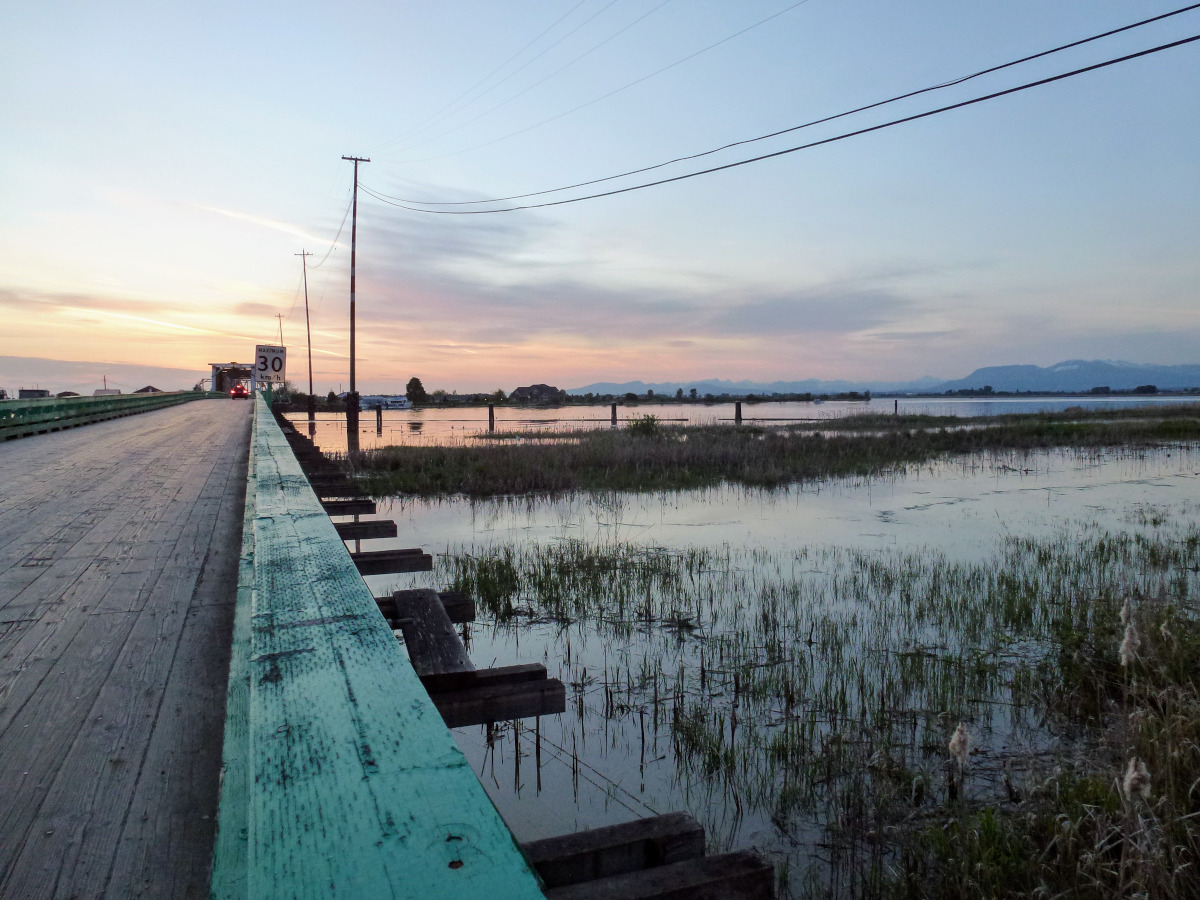
photo of a long wooden bridge over shallow water at twilight

Twilight Bridge by Karin Hedetniemi

There had been arguments after that day and then, a few months on, the question. The marriage had run its course, her mother said, but everyone still loved everyone and no one was angry.

Aunty Val drove them. She came and went from the apartment a few times before they left. After each visit, the rooms got barer. Clara barked and squeaked to hear the sound bouncing off the walls until her mother told her she was being annoying.

Eventually, on the last trip, they piled into Aunty Val’s car. Daddy was at work and there wasn’t time to wait for him to get back. Clara had already said goodbye, her mother insisted. That was goodnight not goodbye, Clara tried to explain, but her mother was putting on lipstick in the visor mirror with sharp, jerky movements. Clara feared there might be a row, and in the end there was. About the cat. Her mother said Marlow would come with them, but it turned out he wasn’t.

“You’ll see Marlow when you visit Daddy,” Aunty Val said, leaning round and thrusting a handful of Werther’s toffees into her lap.

It wasn’t just Marlow. Daddy was even ground. Clara wasn’t sure what would happen without him there to moor them, to shore them up and tie them down. Deep Pool was a long way out of town and her mother didn’t drive. Aunty Val promised she would be there nearly every day, though her mother had grimaced at that.

Their things were scattered through the house when they arrived, but there were not enough of them and it felt like they were living in someone else’s house, with her toys and her mother’s pictures and ceramics plopped in.

Over the summer, her mother painted in the glass extension. Clara swam in the river when Aunty Val was there, but she wasn’t allowed to jump off the bridge. Once, she dared herself to wade out to the deep spot to see if she could touch the bottom. Water shadows licked the underside of the bridge and a roaring sound bellowed off the granite bricks, so loud it hurt her ears.

The pool was still, as if darkness had sunk to the depths like rocks, and all the sparkling, rippling water was flowing carefully around it. Aunty Val sat on the bank with two glasses of lemonade and Clara pretended she couldn’t hear her calls to come back. Aunty Val worried too much about everything, her mother said. Suddenly, the gravel bed fell away, and Clara bobbed down over her head. Cold, peaty water rushed into her nostrils and she was flying, kicking out into nothing. Breathing out fast, as Daddy had taught her to stop her nose stinging, she imagined hungry eels snapping at her toes. She shoved at the current with her arms wide and scrambled back to the safety of the gravel.

Aunty Val was running along the bank now, shouting. Clara waded back as if nothing had happened but when she tried to call, her breath stuck in her throat, so she waved instead.

Her mother was happy. She spent her time painting in the glass room and when Clara went in, she was dreamy and sweet, in a far-off kind of way that made Clara feel that nothing she could do would upset her. When she visited her father and Marlow, she asked when they would come to Deep Pool House: “We’ll see.”

In the autumn, Clara was to be sent to a local school. She cried when she found out and it was this, she believed, that shattered her mother’s peace. She heard arguing downstairs in the big kitchen. “Of course she’s upset. She won’t know anyone,” Aunty Val said. They often talked about her. Clara knew from the sh-sh sound of She this—, She that—. Like a flurry of ripples breaking against the bank, sometimes building to waves. Aunty Val was shouting, which was unusual. “Alright, alright,” she said, but her mother was too angry by then and screamed at her never to come back. Clara watched from the window upstairs as Aunty Val drove away. She wanted to run after the car so badly it hurt, like something thorny clasped tight around her chest.

When Clara went into the glass room, she was interrupting. Screwed-up papers spread across the floor like a fall of rocks. The light was bad now the sun was lower, her mother said, and there were too many trees. She had painted them at first but now they got in the way and the paper rocks kept tumbling.

Clara walked alone to the school bus stop. She always lingered on the humpy stone bridge. Sometimes the river glistened like spun gold, at others it was dull and made a whispering noise that shivered against the trees. The deep spot was almost black, with crumpled leaves spinning slowly. She was scared to jump from the bridge now, though she had wanted to all summer. Clara didn’t like being scared and the more she thought about it, the more she felt she had to, or would go on all winter with this breathless, prickly feeling. She imagined jumping every time she crossed the bridge until one day, when the water was particularly sparkly and golden, she dared herself.

She put her bare feet in the river at the bottom of the garden first. It wasn’t too cold, so she took off her coat and sweater and went back to the bridge. The big splash would frighten any eels away, she reasoned. She clambered up onto the low block wall and jumped quickly, like Daddy had taught her, before she changed her mind.

Clara curled herself cannonball-tight and hit the water with a satisfying smack. But plunging down through the surface, she felt something sharp, something crack. She thought she’d jumped straight into the teeth of a lurking eel and everything went red and black.

Cold water crashed in, not just to her nose and ears, but into her mouth, like she was being swallowed. There was no bottom, just sinking, but then stones came up fast and thumped into her back. Clara’s eyes opened and to her surprise, she saw light. The pool was not black and eel-ridden. It was clear as day and when she looked up, she saw a shimmering mosaic of trees and leaves and sky.

Aunty Val came. They drove to the hospital in silence. When Clara came out, with a big cast on her foot, her dad was there. Her mother was quiet and said, “Yes, yes.” She and Aunty Val drove back to Deep Pool and Clara went home with Daddy. Marlow wound around her legs as if trying to trip her up. Daddy said, “You can’t break it again,” but Clara knew she could. She knew how easily things broke by then.

 
Listen to Louise Dumayne read “Deep Pool Bridge.”


still

This entry was posted on by .

/ when i was small my mother used to perch up on the chesterfield in the living room /
mirror asleep along the top of the cushion / the sun's blood caressing her face / bleeding
through the panes while she plucks her eyebrows / she still does it sure /

                                                     YOU DO YERS D'ERE NOW

\ this is the first time i've been in lawn in fourteen months \ didn't realize that much time
has gone by \

                                           MY JESUS YOU GOT TO COME HOME!
                                IT'S CHRISTMAS B'Y, YER FADDER & GRANDMUDDER
                                          HAVEN'T SEEN YOU IN OVER A YEAR

/ i didn't bother trying to explain / how i was in a depressive state /

\ 3 and a half hours scrunched up in the van over the trans canada highway \ 2 masks
glued to our face so we don't bring corona back to the bay \ 1 piss on the side of the road
between marystown and st. lawrence \

/ on our way back / to the house / where i had the cops called on me / when i was 16 / for
being overwhelmingly out of control / can't say i completely disagree /

\ i was somethin' fuckin' else \ besides what my crowd knew how to make a home with \
same spot where i sat at the table with my very first social worker \ doing anger
management i thought i didn't need \

/ it's a mystery to me / how CYFS can force kids between mandatory therapy and juvy /
while the parents are free to quit after one session / how surprising /

\ when i got through the door \ by the christ the whole house was spattered in red green
silver and gold \ ornaments all over the place streeled across every ledge my dear \
snowmen stickers sprinkled along the windows \

/ i have nothing at my apartment / nar decoration nor tree except a whirlwind of ADHD /
how fitting /

\ not a speck of snow on the ground outside \ neither leave on the trees either \

/ i wonder how many christmases will look like this / now that the island has heat records
in august / while the sea level rises /

\ i remembers when judy foote first built the new school \ sure it was closed half winter
long \ couldn't even run a truck through the lot of snow we got \ swallowed the whole
fuckin' guard rail \ and don't even go there about the roads from here to st. lawrence \

/ god love the b'ys who drove the flyers / they were the only thing / that kept us alive
back then / not that i knew the difference anyways / i was only a youngster / glad i had a
week or so off school to spend on the sled / how shrewd /

\ i spent the last year buried in bed or in front of my tv \ trying to find some semblance of
peace \ nearly let myself rot sat criss cross month after month \ something i later found
out you're not supposed to do \ if you plan to walk anywhere anytime soon \

                                                      WHEN YOU FEELS BETTER

/ you'll have to make up for it / at the spasmodique clinique / somewhere i didn't know
existed til i pushed my body far too far / bonsoir mr. pm&r / one more white coat to join
the team just for me / not in crisis but clean up from where i used to be /

\ the nesting place for two giant mats of depression hair \ a recent species of suffering to
me \ beginning with a half hour bent over the tub starting to solve a puzzle i had no idea i
started \ til it was far too gone for me or mom to do anything about \ besides cover my
whole head in conditioner and hope for the best \

/ shampoo'd 3 times prior cause neither of us knows how to read a fuckin' bottle /

                                                  LARD JESUS ITS NOT MY FAULT

\ screams to laughter \ our new normal \

/ and she's still there / holding the shower head / and mine /

                                                   WELL IT NEEDS TO BE DONE

\ it's the first time she's washed my hair \ like this since i was a child \ tugs and all \

                                                           I'M SORRY B'Y
                                               I DON'T MEAN TO HURT YOU

/ long overdue /

\ wash \ rinse \ repeat \


black and white abstract self-portrait (photograph)

over+over by Violet Drake