Archives

Whale Song

This entry was posted on by .

Author’s Note: This 15-minute play was written for Women of the Arctic at the UArctic Congress 2018 and presented in Helsinki, Finland, on September 6, 2018.

*

WOMAN

Hello. Good evening. I hope you’re having fun. I found out about this conference on Twitter and wow…. I just had to be here. I won’t take too much of your time, I promise—I know you have important things to do. Like saving the world. Or saving the Arctic…. Can we actually do that? Save the Arctic?

(Checks her phone)

Oh, that’s my husband. (Dictates) Reply: Screw you, period. (To audience) Sorry.

(Pause)

Is anyone here named Harvey? No? Good. (Or “Oh, I’m sorry” if the answer is yes.) I don’t like Harveys. Harveys suck. First it was Harvey the hurricane. When it hit Texas, I spent days glued to the TV, obsessing over the news. I don’t live in Texas but for weeks afterwards I dreamt of Biblical floods, floating furniture, and wet cats. Then it was Harvey the Hollywood producer. When it came out that he had been assaulting women for decades, I was overwhelmed with hashtag MeToos on social media and ate nothing but ice cream for weeks. That’s how we deal with crises in America. I highly recommend Ben & Jerry’s. But it was the third Harvey, my husband, who finally broke me. Actually, what he broke was my cheekbone. The only thing I remember is fist, floor, and then I was magically on a bus headed North. Though I have no recollection how I got to the bus station. My father used to say, “When in doubt, go North.” He never explained his logic but I always assumed he liked the North because there are less people there. People weren’t his thing. Anyway, the most North place I could think of was Alaska.

(Pause, she surveys the audience)

Can I just say: It’s so nice to be here with all of you. And I’m hoping you can help. Since Trump, we’ve been desperate for help. Actually, speaking of Trump….

(Takes out her phone, dictates) Tweet: Screw you @realdonaldtrump. That’s his Twitter account.

(The phone refuses to do it)

I shouldn’t go there anyway.

(Puts her phone away)

Alaska is where my friend Teri lives. Teri is fierce. She’s a Raven. In her culture, you’re either a Raven or a Wolf and she’s definitely a Raven. Her people come from Glacier Bay. Teri is a traditional weaver who fights to keep her culture alive. She weaves these amazing robes and she always calls me girlfriend. “Hi, girlfriend!” I love Teri. Alaska is also where my friend Allison lives. She’s an Inuk social worker from a tiny town in the Canadian Arctic. She has lots of traditional tattoos on her chin and on her hands. Allison is a powerhouse of a woman who keeps her community together and she has the biggest warmest smile ever. I love Allison. I don’t remember much about the bus ride. I mean, I remember staring out the window but I can’t tell you what I saw. Rain, fields, industrial wastelands…. I was staring out to try to see what was inside of me but there was nothing so I just kept staring at emptiness.

(Pause)

Excuse me for a second. (Takes out her phone, types) Note to self: Try—the—Finnish—saunas. (To audience) They’re supposed to be very healing. Though I don’t know how I feel about getting naked in front of a bunch of strangers. What if there are Harveys there?

(Pause)

Harveys are very clever. By the time you realize what they’re up to, it’s too late and your only option is to get out. Or, as I like to call it, to migrate. Which means to go from one place to another. Or to empower yourself by adapting to changing circumstances rather than being victimized by them. The opposite is to remain. Do not remain. Under any circumstances. Because you can’t fight a Harvey. Look at what happened in Texas. Look at what happened in Hollywood. Look at what happened to me.

(Pause)

(To Think Corner’s staff) I don’t suppose you have Ben & Jerry’s here, do you? Oh, well. Allison met her Harvey when she was a teenager. The melting Arctic attracted a mining company to her town, the mining company brought in a bunch of workers—mostly men—and that became a breeding ground for Harveys. Because what else is there to do up there but to prey on young women and sell them to your friends? By the time Allison migrated to Alaska, her Harvey had made enough money off of her to buy a fancy sports car. Animals migrate too. They migrate for food, better climate, to escape predators, or birth their young. Whales in particular are expert migrators. These big mamas kick ass, excuse my language. I mean, you gotta hand it to them—they can evolve faster than you can say hyppytyynytyydytys.

(To audience) Isn’t that the craziest Finnish word? I don’t know if it’s real. I found it on the Internet. Say it with me: hypytyynytyydytys … hypytyynytyydytys. It means “bouncy cushion satisfaction.” (Laughs) I mean, how do you put that in a sentence? “Honey, today while you were at work, I experienced bouncy cushion satisfaction.” Or “Thank you so much for having us over! Your couch has such good hyppytyynytyydytys.”

(Pause)

Whales used to be land animals. Fifty million years ago, they had four legs and huge teeth. Then the ice sheets melted, the oceans rose, and when it became clear there wasn’t gonna be enough land for everyone, the big mamas were like: “We’re outta here.” And they migrated to the ocean. How’s that for a winning strategy? “Shrink those legs and grow some fins, ladies! We’re diving in!”

(To an audience member) Have you ever heard a whale sing? It’s amazing, right? (Or “It’s really amazing” if the answer is no) Listen.

(She plays whale song on her phone. Listens for a while)

I wish I spoke Whale…. Or is it Whalish, like Finnish? Or Cetaceanese? I’d ask them: “How did you know?” Because, think about the people in Texas who didn’t leave until the water was up to their second floor. Think about the women in Hollywood who didn’t walk out of that hotel room until he had gotten his way. Think about me and Teri and Allison and all the beautiful wonderful women out there who have found themselves in the same situation. Why didn’t we know? Why didn’t we migrate before it was too late? Is there something wrong with us?

(End whale song)

For Teri, it was different. Her Harvey came from upriver, from a place she had never been where they decided to throw toxic industrial waste into the water, so how could she have known? The doctors called it “cancer,” which, if you ask me, is just fancy medical talk. A Harvey is a Harvey is a Harvey no matter what name you give it. It’s fed and fattened by money and power and preys on vulnerable people. Particularly women. But whales are smart. They didn’t wait until it was too late. And some of that migrating was tricky: they had to move their nose up to the top of their head, develop a communication technology that would work under water, and grow baleen for filtering food. Me? Nothing that elaborate. I’m still trying to grow a thick skin so I have a long way to go.

(Her phone rings)

That’s him calling…. (Hesitates) I’m not answering.

(Puts her phone away)

Harveys will follow you everywhere—I have learned that by now. It’s in their nature. Ignoring them doesn’t work. Confronting them is not exactly recommended. But preventing them—that’s the answer. You have to defeat a Harvey before it becomes a Harvey. Can you help?

(Pause)

You know, I did make it to Alaska. And when I got there, something really beautiful happened. Me and Teri and Allison and the whale from 50 million years ago—we all converged in one place. It was the most amazing thing. Four warrior females on completely different journeys and, somehow, our migration paths magically converged. Like what’s happening right now in this room.

(Pause. She holds the moment)

Well, I have to keep moving before Harvey catches up with me. Before I leave, here’s a song. It’s kind of a whale song. Not really but let’s just say it is. At the very least, it’s a migration song. “To go from one place to another.”

Amazing Grace, How sweet the sound
That saved a wretch like me
I once was lost, but now am found
Was blind but now I see.

No more Harveys, OK? For me. For Teri and Allison and the whale. For all of us. Please. No more Harveys.

(Pause)

Oh, and if you have time, it’d be great to save the Arctic.

Elapultiek (we are looking towards)

This entry was posted on by .

Author’s Note: Set in contemporary times, a young Mi’kmaw drum singer and a Euro-Nova Scotian biologist meet at dusk each day to count a population of endangered Chimney Swifts (kaktukopnji’jk). They quickly struggle with their differing views of the world. Through humour and story, the characters must come to terms with their own gifts and challenges as they dedicate efforts to the birds. Each “count night” reveals a deeper complexity of connection to land and history on a personal level. The full version of Elapultiek is published by Pottersfield Press (2019).

*

Scene Three: Wi’klatmuj


BILL: I wasn’t sure you were coming back.

NAT: Tet.

BILL: Ready for another count night?

NAT: E’he. Katu ki’l?

BILL: I assume ay-hay means yes.

NAT: E’he.

BILL: There, I’ve learned a word in your language.

NAT: As you should. It’s the first human language of this land.

BILL: Cloudy, 100 percent cover, but not raining.

NAT: I don’t see or hear any swifts.

BILL: No.

(Silence)

BILL: I brought a video camera tonight in case you did come. I thought maybe you could be in charge of getting the video for me. I’ll check the count on slow-motion later. (Hands her a video camera.)

NAT: Sure. I’ll verify your data.

BILL: Well, I’ll take it home and watch it.

(Silence)

NAT: I had a few youth out here last night. They had a great time.

BILL: You came an extra night?

NAT: Ya. It was really wonderful.

BILL: Did you count them?

NAT: No. We just enjoyed watching them. And then we sang a friendship song.

(Silence)

BILL: Geologists say that these hills of the Appalachian were once as high as the Rockies. And since, over all that time, they’ve slowly eroded, worn away so that they’re now only hills. Incredible. Just think: we humans have been on this earth for such a short amount of time by comparison. What’s great about talking about the science of the landscape is that it renders cultural differences moot.

NAT: The mountains and rocks are the oldest and wisest. That’s why our Elders teach us to call them grandfathers and grandmothers.

BILL: I’m not sure how wise a mountain is.

NAT: Why do you have to be so oppositional to everything I say and believe?

BILL: It’s you who is being confrontational. You’ve been passive-aggressive since the day we met.

NAT: I’m here for the swifts. I still don’t see any.

BILL: There’s a chance that the swifts didn’t even leave the roost this morning if it was raining, or they went in early today because of it.

NAT: They might be in the roost right now?

BILL: It’s possible.

NAT: Then why aren’t we going over to check?

BILL: I’m starting with protocols first.

NAT: I’ll go over and check. Oh, and please don’t touch these things here.

(Nat EXITS. Bill shuffles, looking over at Nat’s things)

(Nat ENTERS)

NAT: Yup. They’re in there already. I heard them chattering like when they’re flying. I wonder what they’re telling each other. Maybe where the good food is or tips on where to go tomorrow.

(Bill puts his things down)

BILL: I’ll go have a listen and be right back. Please watch the sky, just in case.

NAT: Obviously.

(Nat watches sky and hums while Bill EXITS briefly. Bill ENTERS)

BILL: Yup, they’re in there already. The count is over tonight. (Examining his things.) Hey, where’s my clipboard?

NAT: You know, that reminds me of a joke I heard.

BILL: What?

NAT: What do you call a deer with no eyes?

BILL: What?

NAT: No-i-deer.

BILL: What?

NAT: Koqowe?

BILL: You want me to go away?

NAT: Mo’qwe. Koqowe means what.

BILL: Are we having a conversation?

NAT: I know I am. I’m not sure about you.

BILL: Back to the beginning. Do you know where my clipboard is?

NAT: Mo’qwe. No-i-deer.

BILL: I must have dropped it.

NAT: Etukjel. Or a wi’klatmu’j might have taken it. Probably thought you were writing down forest secrets.

BILL: A what?

NAT: A wi’klatmu’j. A little forest person.

BILL: Like fairies and leprechauns?

NAT: Similar, yeah.

BILL: So you’re telling me the Little People took my clipboard?

NAT: Not little people. Person. One. It just takes one to run off with something like that.

(Bill looks around.)

BILL: Did you see anyone?

NAT: Mo’qwe. I was looking for renegade swifts. (Silence) Hey, what do you call a deer with no eyes and no legs?

(Silence)

NAT: Still no i-deer.

BILL: This is ridiculous. Fairies don’t exist and you singing to the trees or speaking in code talk doesn’t do anything to help protect these species. I’m just trying to get my observations. It might just be a game for you but this is my life’s work here.

NAT: Good luck with that.

(Nat EXITS)

*

In scene four Nat begins a ceremony which makes Bill blurt out his plans for buying the property. In the middle of the argument a raccoon appears on the chimney before going into it.Many swifts still descend into the chimney, most coming back out, though some didn’t. Both Bill and Nat decide to come back the next night to check if the raccoon is there again.

*

Scene Five: Roost Check


(Bill ENTERS and prepares. Nat ENTERS with extra gear)

NAT: I’m ready for you tonight, Amaljukwej!

BILL: Hi Nat. Let’s not argue tonight.

NAT: I’d like to tell you what I’ve decided.

BILL: Yes?

NAT: You say you’ve been working on species at risk for many years but from what I can tell the situation isn’t getting much better. It seems that all you do is measure things. I sat and talked with the fire, which is my methodology

BILL: That’s not a—

NAT: I’ve decided that I won’t count the swifts with you tonight. You can do that with your mainstream eye, but what I need to do is use our cultural teachings.

BILL: That’s what I’ve been saying: let me do the biology work.

NAT: I’ll need you to count in your head because I need silence.

BILL: Fine.

NAT: Good.

(Both look to sky. Some birds are trickling in, Bill makes notes. Silence)

BILL: How do you think we know when to list species as being at risk?

NAT: You pay attention.

BILL: No one is observant enough to know all the species and their relative abundance and relationship to threat.

NAT: My family still spends a lot of time on the land.

BILL: You still live in houses and drive in vehicles, I assume. We all live a little less connected. We count them. Biologists count the population, map them, and then make recommendations when they seem low. Like these birds. There they go.

(They watch the birds funnel in chimney. Nat is in an active listening stance)

BILL: I think that’s all of them.

(Nat comes out of her stance. Bill counts his tally.)

BILL: We’re down 17.

NAT: They’re in crisis. They need two things.

BILL: Oh yeah?

NAT: We need to offer tobacco to the fire to send them hope.

BILL: That’s not a recovery action.

NAT: If you take time to humble yourself and talk to the fire, you’ll find it helps the work. Try it. You’ll see.

BILL: What’s the other thing they need?

NAT: We need to hold a public meeting in town to get everyone involved.

BILL: We just need to stick to the count and make recovery plans. Stewardship and citizen science are blown out of proportion. “I Love Swifts” buttons aren’t going to help.

NAT: I’m going to organize it.

(Silence)

BILL: If there is going to be any kind of discussion about the species, then I should be there.

NAT: Ok, then come.

BILL: I still didn’t find my data sheets from the beginning of the season. I need to send them in to Maritimes Swiftwatch.

(Silence)

BILL: You don’t know what happened to my clipboard, do you?

NAT: Mo’qwe. Of course not.

BILL: Just asking.

Shake

This entry was posted on by .

It was day two of the festival and we were already running on more adrenaline than sleep. The dusty air was cooling as the sun nestled downward, the aromatic changeover from sunscreen to bug spray just beginning. We had gotten used to the constant jostling it took to stake our claim in front of the mainstage. I had heard of Alabama Shakes, but they weren’t one of the bands we had come to see. So, my gaggle took the opportunity to remove ourselves from the chaos and perch up on a grassy hill overlooking the cavernous Gorge, whose majesty always threatened to outshine whoever was playing. We needed the break, all of us saturated by music and happy to turn our attention elsewhere. But when the bluesy melodies started, they pleasantly surprised me.

Breaking through the social buzz, I looked to the stage and everything around me became still. There she was: Brittany Howard, front and centre, bursting with exuberance. And shake she did. She belted, bouncing and moving wherever the music took her body. Her electric guitar jiggled along, nestled under her chest. She was un-contained in a way that I’d always thought was reserved for thin women. How was she making this look so good?

I had spent my entire music-obsessed life idolizing women with big voices and tiny frames, convinced that I needed both. I always tried to make myself as small as I possibly could when I was on stage. And here was this woman in low-rise jeans and a fitted button-up, stomach un-camouflaged, curly hair pulled casually into a ponytail, unabashedly taking up all the space in the world. The Gorge didn’t have shit on her. It made me uncomfortable: I felt exposed, like the sort of unease that accompanies wearing pajamas in public. Something shifted. Beside me, my friends were re-hashing the pros and cons of Eryn’s relationship with her on-again-off-again boyfriend. How were they not see what I was seeing? I was mesmerized. Shaken.

*

It was the spring of 2012. Sunshine had finally awakened the West Coast. I was nineteen, and the wave of my aspiration to become an indie-folk frontwoman was cresting. It only made sense to take the road trip to my first ever music festival. I’d been performing as a folk duo with my bandmate, a lifelong friend, for a couple of years. With her and three other friends, I took my parents’ old Toyota Forerunner down from Vancouver to Washington, GPS set to the edge of the infamous Gorge. We covered the truck with window markers, “SASQUATCH 2012” scrawled along the sides and “JUST MARRIED” on the back, which both distracted from the rusted-out bumper and made us some curious friends along the way.

Thanks to messy festival traffic and an overly optimistic sense of time, we’d arrived well after dark. The evening air was still warm; it teased us with rain and carried several varieties of smoke around the grassy campground. We were barely able to find a spot that would fit our musty old ten-person tent, which boasted missing poles and duct-taped canvas seams. Making what we affectionately named “The Burrow” structurally sound by flashlight (with the help of some kindly neighbours whom alcohol had made very generous) was a feat that formed an unbreakable bond. We spent the rest of the cell-serviceless weekend weaving through hot crowds and dirt clouds, hands held tight in a train so we wouldn’t lose each other.

For my friends, the trip spawned new best friendships and roommate arrangements. For me, it began my pursuit of chasing down whatever secret it was that Brittany Howard knew on stage that day that I didn’t. Because while I loved (and still love) performing with my dear friend, I could never shake this feeling that lived in the pit of my stomach, right beside my nerves: that I didn’t quite fit on stage with her. I could feel every audience we walked out in front of reviling or pitying me, standing there at least twice her size. I obsessed about my body before every show, squeezing into my tightest tummy-shaping underwear, despite their hindrance on my breath.

Meanwhile, my friend was pursuing a modelling career alongside music. I pretended not to notice the different ways we were received by people in the industry. It wasn’t her fault, after all. I didn’t want it to affect our friendship, for her to think I was jealous. But when she once tried to get us signed through a talent agency that had hired her for modelling, I hesitated in queasy silence, not wanting to state the obvious. It didn’t matter how talented I was. Once they saw my body, they would want her and not me.

*

In 2018, the two of us had moved across the country, her to Montreal to pursue music and me to Toronto to focus on writing, each of us following our own uncertain paths, as you do in your twenties. The better part of my path had been spent training my brain to accept the fact that my body isn’t to blame for all the shame and insecurity it carries, or the lack of space society makes for it. Maybe this was Brittany’s secret, or maybe it wasn’t. But I had learned that my body exists in a paradigm premised on a bold-faced lie: that if we all try hard enough, we can be small, and if we are small, then we are good. And then I’d realized that this paradigm was one that I had the chance to shift.

I was thrilled when my friend invited me to get the band back together for a mini-tour through Ontario: we would open the show as a duo with the songs off of her upcoming EP, and then join the headlining band as backup singers. This is how I found myself performing on a festival mainstage for the first time. The two of us were back side by side; and this time, it felt different.

It was our last show after a string of nights in pokey small towns. We’d spent our days driving pin-straight roads through flat fields of wheat and corn, the Louvin Brothers and Dolly Parton taking turns keeping us company, preaching Satan is Real and I Will Always Love You out the windows. We’d spent our post-show, wine-soaked nights cooling off in black lakes that showcased the stars, before turning in to our snugly shared Airbnbs. After our last long drive, we finally arrived at Hillside Festival, this time being put up in a swanky hotel with overzealous (but welcome) air conditioning and a mountain of memory-foam pillows.

I hadn’t been back to a musical festival in several years, having happily left that experience in my early twenties. Things looked different from backstage, but the texture was the same. The dusty dry grass; the mingling scents of sunscreen and bug spray; the way your brain tunes out faint beats from other stages to focus on who it wants to hear; the quiet camaraderie you feel with thousands of surrounding strangers, merely because you’re all there in this chosen fray.

Night fell. Lights went up, illuminating the swarms of mosquitoes fighting for their time in the spotlight. We traipsed out onstage and took our places. The opening guitar riff floated out over the crowd and the drums thudded toward my cue. As I reached down to take a gulp from my water bottle and pick up my tambourine, I looked up and saw a train of bedraggled young women clamouring to the front, hand in hand so they didn’t lose each other.

Stage left was ours. Mine. As the set danced along, I felt myself growing bigger. Every hit of my tambourine against my bare leg sent a ripple down my thigh. I stomped, hit harder. Phones were out, filming and photographing as close as they could. I bounced and moved wherever the music took my body. I sang with all the outmost corners of myself. I breathed deep into my gut, extending it as far as it wanted to go. My arms jiggled, naked in my sleeveless bodysuit. Not once did I think about them, nor the other parts of me that move right behind a beat.

The encore ended and I stood, sweating, curly hair wild and unleashed by my movement. As I steadied my breath and beamed out at the cheering crowd, my eyes were caught by a bright moon of a face near the front. Something about it felt familiar. Was I imagining it, or was she staring back at me? Young, mesmerized. Still. Just waiting to grant herself permission to shake.

Recurring Dream

This entry was posted on by .

Recurring Dream

I’m in the wings, downstage right,
opening night. Old proscenium stage,
heavy dark curtains. Invisible
on the other side a full house, expectant,
sound waves like surf on a pebble beach
swelling, ebbing, swelling. Dust,
sweat.

House lights fade to black.
Silence.

Someone comes up behind me. Who?
I can’t see. Sudden adrenalin — every hackle
shivers alert. Oh, Christ. What’s my first line?
Who am I? Fumbling for costume cues, my hands
sweep my body, meet naked flesh.
What show is this?

Dark curtains open on a growl.
Behind me, urgent, someone hisses
Go! Go! pushes me on stage. Lights up.

Kouchibouguac

This entry was posted on by .

À propos de notre couverture

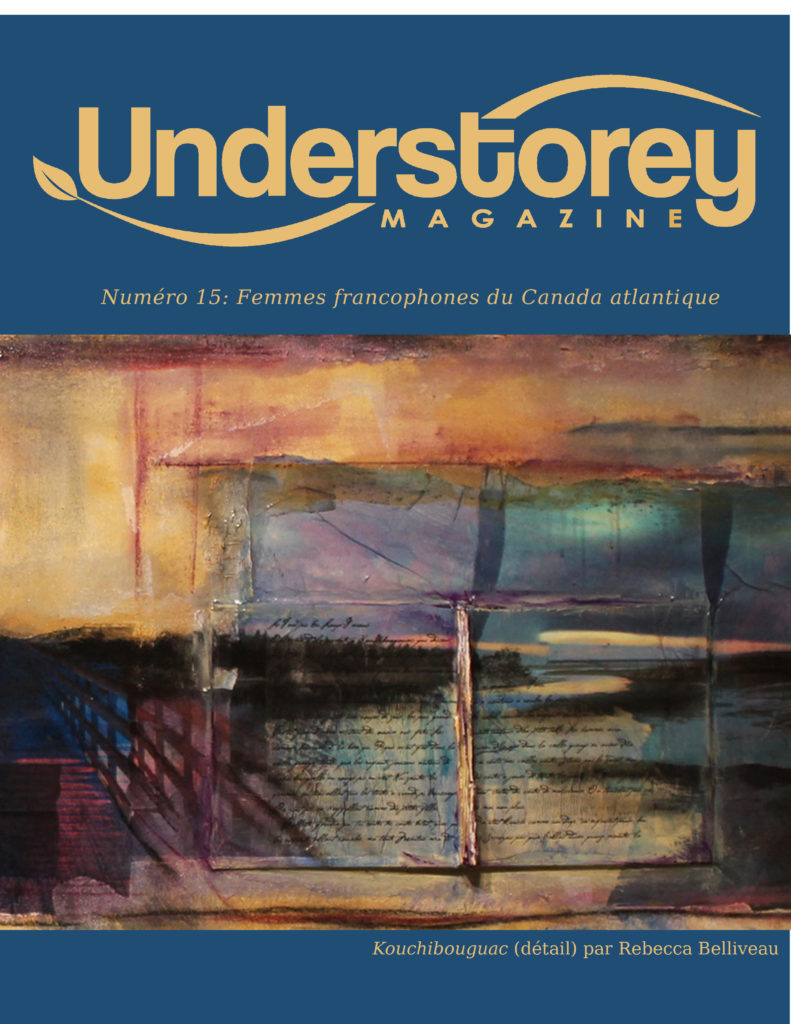
«Kouchibouguac» par Rebecca Belliveau est l’une des six légendes paranormales qu’elle a interprétées à la fois dans l’écriture et en peinture. Cette série de tableaux intitulée «Légendes de mon Acadie» a été achevée en 2015 et a été tournée dans de nombreux endroits et galeries au Nouveau-Brunswick.