Archives

Mom-Friend

This entry was posted on by .

You are the Mom-Friend. The Mom-Friend is always prepared for blood, though not in the warrior sense.

Your friends laugh because you carry a first-aid-kit worth of tissues, menstrual pads and Band-Aids wherever you go. But they’re not laughing when they get paper cuts or when the blisters on their feet burst after a hike. They’re not laughing when their runny noses drip like melting icicles onto their shirt collars. They’re not laughing when they’re trapped in a public washroom stall, calling out to you for help with their pants and undies lying limp around their ankles. Mom-Friend to the rescue.

You are the Mom-Friend. Instinct drives you on. It’s in your blood. Your Mom was a Mom-Friend, and her Mom before her. They were the oldest daughters, the watchful and protective stand-ins for their younger siblings while their parents laboured around the farm or did late shifts at work. You were the oldest daughter and it was a job you took seriously. Little kids are all the same. They scrape their knees and get nosebleeds. Like your mother and grandmother, you’ve learned to get Band-Aids on those knees quickly. You taught your siblings to hold their head up, nose pointed to the ceiling. Don’t cry, you told them. Don’t panic. Breathe. No one dies of a nosebleed, you said, as you gulped down your own rising nausea. The waste bin filled up fast with red-blotted tissues. Habitually, you started filling up your purse with packets of them. Grab a handful at the gas station. Just in case.

You are the Mom-Friend. You are absorbent. You roll up your sleeves and mop up the mucus and blood and vomit and tears. The boy across from you on the train is sneezing. You pass the tissues. Co-worker has a wet cough. Tissues. Later, you reach into your purse for tissues to dry your heartbroken friend’s eyes while you seethe inwardly. How dare he? You ask, you ask, and you ask again. You sponge up the rage your friend holds back. You demand an explanation from the world as the blood of your mother and grandmother and great-grandmother and every woman who had a part in making you boils inside. You want to see that red flow. You want vengeance. But that feeling passes, because you are the Mom-Friend, and a healer first. And right now, your friend needs healing.

Mom-Friend, keep your heart, and your purse, full. Always.

Handknit tissue case by HandmaidenBC

Scars / Murmur

This entry was posted on by .

Scars

scars silence blood
shut up leaks and spills
stitch seams on skin
where none should be

scars silence blood
open up floods
of stories
word rivers, pouring out
from throat, bird voice
melody, telling and retelling
events that skin carries
in hues that pale away
until barely seen
which does not mean
invisible, does not mean
there is nothing to see
does not mean
repair occurred

Except That It Clearly Isn’t by Monica Lacey

Murmur

In the dark of my heart
a murmur
flaccid valve
cannot quite close
instead invites
rebel rivulets of blood
to flow back into eddies
that draw quick funnels
where meaning sinks.

A valve; mouth
unfamiliar with silence
leaks secret mumblings
into absent ears.

The first one who heard the murmur said
Did you know?
You have a murmur
.
Said it not like
you have a nose, a voice
two legs, two clavicles

but like, you have extra toes
a tail or gills
.

I hear, you don’t speak loud enough
you murmur
.

You may grow out of it.

And own a silent heart?
Inside my noisy interior
lives another body dialect
that I add
to my personal nomenclature
of internal sensations
—aches, grumbles, pushes
caresses, flashes of colour
buzzing ears, crackling bursts—
that I capture
into defective word boxes
where meaning may sprout.

With my mind, I see
the murmur curl like smoke
black ink coils
spelling o and c and e
but never l or k or f
language of fluid forms
and sounds like whoosh
sibilant, round and patient
talking in vain if I don’t listen.

This little valve works hard.
How many times is perseverance
how many fall into perseveration?

Blame the valve, they say, it is weak.
We’d replace it if it was really bad.
You’re not really bad though
.

The valve is, then I am, not really bad.

Yet I, owner of the murmuring valve
—not on an automatic system—
have power to draw the uneasy line
between enough and one more time.

At every heart beat
a delinquent pool of blood lingers
a stray rivulet stumbles back inside
audible. I promise to myself
to listen more.

Twenty-One

This entry was posted on by .

This Wednesday will be the twenty-first anniversary of the day my brother was hit by a car and killed: his twenty-first deathday.

This weekend, his ghost could buy beer across the border from my hometown, in Maine; this spring, maybe graduate from the University of Heaven-or-whatever-you-want-to-call-it. Luke’s ghost has been around three times as long as he was ever corporeal, and this thought sits awkwardly in my brain, like, how could you have been so young, how could time pass, how could this, how.

He and I are very close, you know. We don’t play with Lego together, like I did with Luke, the child. But he’s been a friendly, near-constant presence these last two decades. Over time, the image of his small body splayed next to the road, a pool of waxy blood by his ear, has lost the power to horrify me—which is, maybe, its own kind of horrifying, how our traumas become a part of us, fixed like skin-on-bones, normal as a heartbeat. But we hang out together, he and I, and mostly I don’t cry anymore, which is nice. The words I-had-a-brother-but-he-died pour out of me quickly, self-consciously casual, and, before their faces have time to fall, I change the subject, as if to say: it’s okay, it’s okay, it was a long time ago, I’m okay.

But then I’m sitting on a hard chair in a doctor’s office, box of tissues conspicuously placed on the table beside me, and I’m there because my heart keeps beating, too fast, too hard, I lose my breath, and it’s not normal, it’s not okay.

What’s so funny and strange about my reminiscing, as I mutilate tissue after tissue, is how little I even remember Luke, the child. I do remember the Lego. I don’t remember the way he doted on me, and I can’t hear his voice saying, “Rae, come play with me,” which my mother tells me he did all the time. I remember the time he threw a snowball at the toddler who lived next door, and I remember him reading in bed with me and my mom, struggling over the word clock, and I remember that I corrected him, his baby sister, that I felt so embarrassed for him. I remember that he could run fast, so fast, and I remember that morning, on the way to school, how he let go of my mother’s hand, and he ran ahead. Fast, so, so fast.

Suddenly, his jacket was on the side of the road, and, in my poor muddled brain, he’d run so fast across the street that his jacket had flown off behind him, incredible! I ran ahead to pick it up.

I remember his death so much more clearly than his life.

I remember wandering down the hall of my house that day, blank, confused. My sister curled up in bed with Luke’s stuffed lion, my dad sitting on the floor in the hallway, head in hands. My mother in the blue chair, broken. I climbed into her lap. She clung to me, and I held her together.

We sat there for years.

*

The Invisible Child by Justine MacDonald

*

The hardest part is the what-if. I can’t help myself. Twenty-one years later, and I can’t stop asking that inescapable, desperately unfair question. What if you were still here, Luke? The hardest part is how goddamn real that imaginary world feels sometimes, the world in which he crossed the road, how concrete and graspable it seems to me, as I gasp for breath, sobbing, chest aching. Of course I know what it looks like. Of course I know, for an absolute fact, that it is much, much better than this world. I’m happier. My family is whole. I’m not so scared all the time.

My own son has a different name there, though I’m not sure what it is. As it stands, in this lesser world, his name is Luke. Last summer, Luke fell in the grass, hit his head on a rock. Blood everywhere.

I’m terrified. I’m always terrified.

What if.

*

But he’s scared, too. Scared in ways his uncle never was. His fear is so familiar to me, it feels almost like my own; I wonder if it is my own, then I plead silently for his forgiveness. My repentance is to bite my lip when the fear clamours to escape. Slow down. Look out. Be careful, kiddo. Every day, I try, and I try, and I fail. Please forgive me, Luke.

Curled up on my lap in the blue chair, he feels so much like mine, and yet he is his own—just as I am my own, and not my mother’s. Still so little, I want to kiss away the badness, hide under the blankets and make-believe the world will never hurt him, that it has never hurt him. He was such a colicky baby. God, he could cry. The nights we’ve spent crying together, Luke and I, holding onto each other, wishing the world could maybe be a little nicer.

This world has failed him from the start, never quite what it ought to be. Same as me.

*

Sitting in the hard chair in the sterile doctor’s office, I feel that I am coming undone. The disease is in my brain, my chest, it’s inside my heart, and every beat of it pushes the poison through my veins. The cells of anxiety grow and divide until I am made of fear.

How could it be otherwise? Once you know, you never forget how breakable everything is. For twenty-one years, the simple fact that I build my life on the edge of a knife has been lodged in my chest, and if I breathe too hard, the knife starts to turn, and I know that I’m done for.

Which of us is broken? Is it me or the world? Crippling fear often feels like the only sane response to being alive.

But still, my heart keeps beating (too fast, too hard), and still, Luke’s tiny hand is warm in mine. I squeeze it tight, and then—

I let it go. He runs ahead.

Sunset Over a Mosque in Quebec City

This entry was posted on by .

Sunset Over a Mosque in Quebec City

“You look, and soon these two worlds both leave you
one part climbs toward heaven, one sinks to earth.”
Rainier Maria Rilke, Sunset

Tonight, we ask questions of God.
The sun rose in the East this morning
and cast a long shadow to the West.

We know their hands pressed to the floor
as the sun set red over a mosque in Quebec City,
but by nightfall, they would not rise again.

Even with faith we have no answers. We try to find
understanding through our shared rituals
of mourning and remembering:

a community clasps hands around a city block,
a gathering light candles to overcome what haunts us,
a family prepares to bury their loved ones.

This sunset is a dark red stain on the aged cotton of their clothes.
We sink low to the earth drowned in the blackest of nights—
we look for stars, but with heads bowed,

we see none.

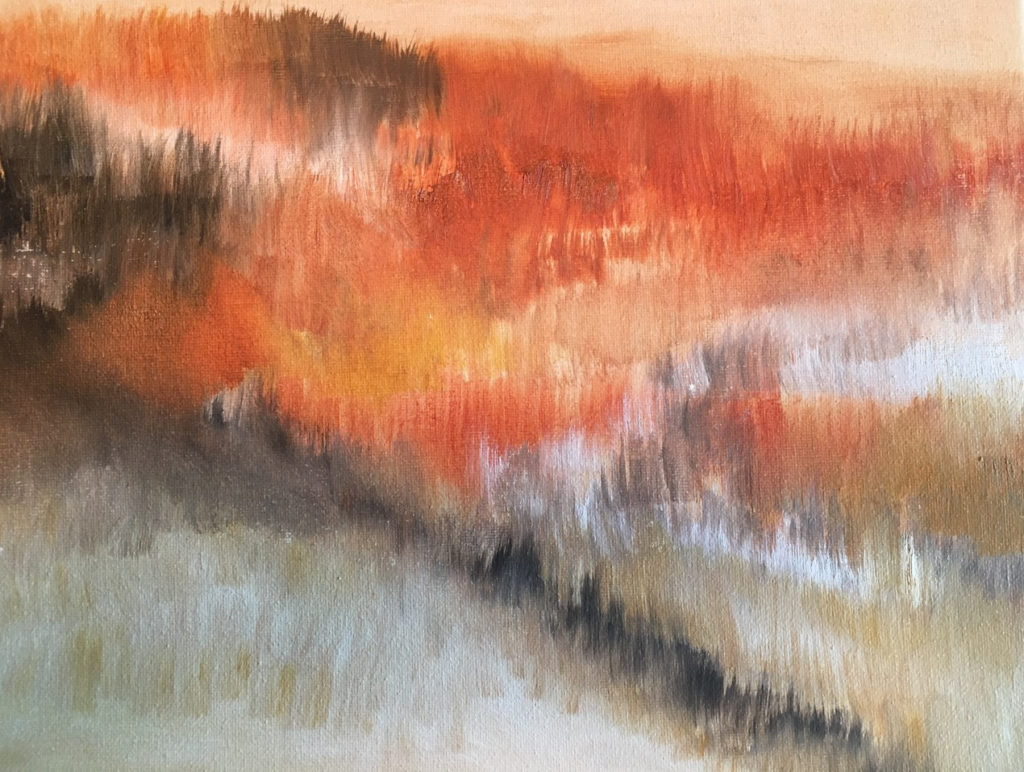
Fire Behaviour by Judith Skillman

Bringing Light to the Dark

This entry was posted on by .

My period arrived when I was fourteen, announcing our future together by settling into my pelvis on a nest of corroding nails. I spent days in bed every month, curled around a heating pad, wondering at the euphemism of “cramps” because what I felt was a deep, greedy, constant pain. Eventually I realized I wouldn’t be able to take time off work every month in the “real world” after high school so I saw a doctor. Loathe to mess with my hormones and go on birth control, with its off-label benefit of easing menstrual symptoms, I accepted prescriptions for anti-inflammatories and painkillers instead. They didn’t work though, and eventually I succumbed to birth control. My auntie laughed at the indiscretion of a home video I’d made, the pills sitting on my bedroom headboard in full view. But I wasn’t using them because I was having sex so it hadn’t occurred to me to be more discreet.

After high school, the pill and the disposable heating pad stuck to my abdomen under my uniform made my monthly pain bearable enough that I could work my serving shifts, in the way that one either slices their tender knees and hands crawling over jagged glass toward bread, or starves. The gynecologist scheduled me for a laparoscopy so she could explore my female interior for fibroids and endometriosis. The good news: she didn’t find anything. The bad news: she didn’t find anything. “Don’t worry,” she said, “most women find their symptoms get much better after they have children.” I clung to that promise for over ten years.

Then, one early morning, bracing my sharply contracting underbelly beside the bed, I told my husband it was time to go. I phoned the rural hospital and a nurse met us at emergency with a wheelchair. “I forgot what this feels like,” I told her, between contractions.

“Oh, I thought this was your first baby,” said the nurse, checking her notes.

“It is,” I told her, “but this is how I feel when I have my period.” I was six centimetres dilated.

*

The gynecologist was wrong about my symptoms improving after childbirth—they got worse. Where I’d always had physical pain before, now I had other symptoms too. I could hardly focus, remember things or process information; writing newspaper articles required immense mental energy and I was still not sure they made sense. My breasts overflowed my bra, beginning to ache a week before my period and pushing pain into me with every movement throughout the day. I developed a chronic sore throat for two weeks each month that coincided with my cycle yet with my esophagus full of camera, the ENT told me it looked fine. I wanted to dig my nails in at the temples of every person I came across and tear the flesh down their face in strips, while simultaneously wanting to weep for all the beauty in the world. I was constantly nauseated during my period. I saw black. I fantasized about laying on the asphalt in front of our house, waiting for a truck to run me over. I breathed through the uterine contractions pushing fallow blood and clotted tissue from my body, just as I’d breathed through labour. I couldn’t stand to be talked to or touched so I perched on the basement couch clutching my hair, knuckles against my scalp, rocking myself; my husband and kids stayed on the upstairs floor, just so we could survive each other.

I wore a patch on my arm to stop my period completely but had breakthrough bleeding all the time. I saw a gynecologist who promised me a solution and learned seven months later he’d closed my file. I met with the best acupuncturist in the city, unable to watch while he tapped needles into my body. I endured visceral manipulation, the practitioner flirting with me while he kneaded my naked abdomen. A pelvic floor physiotherapist probed my vagina with her fingers, to work tight muscles she couldn’t access otherwise. I met with another gynecologist who suggested I get more sleep leading up to my period. A cardiologist confirmed I’d developed a fainting condition; it was my husband who noticed the episodes usually happened during my period, probably from the loss of blood volume. I heard a chronic pain doctor tell me that I might not be able to fix my period problems and that my period was a disability for me.

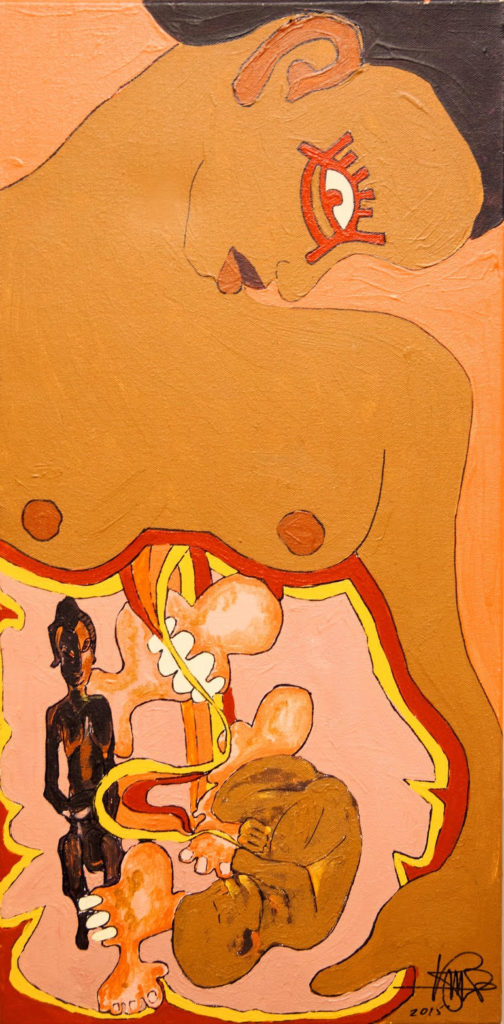
The Fetus, the Fibroid and the Fertility God by Kim Cain

We already planned our social lives around my period; on the advice of the chronic pain doctor, I began to plan other things around it too. I told my editor there was one week a month when he would get less work from me. My husband drove the kids to school and got to work late rather than me pausing every few steps on my way to the van to retch or collapsing onto the floor at the preschool entrance again. But my period didn’t always honour our twenty-eight-day anniversary and sometimes, even though I planned ahead for months, I still had to cancel work commitments or family outings when my monthly flu breezed in three days early or two days late.

More than one doctor recommended a hysterectomy but major surgery comes with its own potential complications that I wasn’t willing to undertake. And a uterus is a place-holder in a woman’s body—I had read about post-hysterectomy women whose other internal organs had squatted into the vacancy left by the former tenant, leading to other issues. Besides, the relationship between my uterus and me was far too complex to sever with a scalpel.

I scheduled an appointment with a new naturopath, made it for when I would have my monthly flu; I would have to claw my way to him with hands and nails of will instead of cells, but I knew he had to see me in that state. I had a suspicion, a theory that was more intuition than science. I had never spoken it aloud before. I was beginning to wonder: Is my uterus contracting so hard because it’s fighting the memory of something?

When my mother was a child,
she was raped in her home,
repeatedly,
over years.
Her mother was raped before her,
in a time past.

Is it possible the pain and trauma of their most intimate, feminine parts being assaulted has been passed down through their genes, so that my own most intimate, feminine parts rage against the unnatural abuse of the pleasure and life-giving purposes for which they were intended? Does my uterus cringe every month as my mother’s must have, as Grandma’s must have? Have their anguish and unheard cries echoed along twisting DNA strands into our futures since?

I gathered the energy to get out of the van and walk into the naturopath’s office, mumbling a sorry for laying my head on the counter as I checked in. Then I sagged on his office chair, depleted, aching. I told him of my symptoms and that if giving birth naturally without drugs as I had was a ten on the pain scale, I run at a seven or eight during my period.

Then, with my eyes on a poster across the room, I revealed the abuse in my women’s history, asked him if it could be related to my menstrual issues. “My God,” he said, shaking his head, “I’m so sorry.” He took off his glasses and wiped tears from his eyes, reaching for a tissue. “Of course it’s related,” he said, “we are souls first and bodies second.”

Sometime after that, in a newsfeed, I first heard of epigenetic inheritance—the genetic imprints of trauma passing from one generation to another via DNA markers—and the scientific research suggesting it exists. What if traumatic experiences can be inherited through generations, as an evolutionary adaptation, like a predisposition to the fear of spiders can be? What if muscle memory can travel the nucleic time machine into the future? My own anecdotal evidence confirms it’s so.

I think of my daughter’s uterus forming inside my uterus—the tiny cells knitting themselves together to become her uterine wall, nutrients and oxygen passing from my bloodstream to hers, directly fueling her development. But is that all that passed along, just some vitamins and good fats? Or did our bodies exchange other information in the rich, red, velvety room of the placenta, whisperings of my mom’s nervous breakdown when I was a teen, triggered by the abuse she’d endured as a child? Or mutterings of Grandma’s own breakdown, when my mother herself was a child?

My daughter is eight now, closer to getting her first period than farther. What will it be like for her? Among two generations of family members, most who know of the abuse don’t acknowledge it; some talk a little; others don’t know at all; and some feel the undercurrent that exists, even if they don’t know why. My grandmother knew of my mom’s abuse, because Mom told her.

Then Grandma ordered her never to mention it again,
spanked her,
sent her to confession
and, inevitably,
back to her abusers.

Denial and secrecy about abused women compounds the trauma. Could it be compounding cyclical pain in their female offspring too? I am not the only woman among two generations of my family who suffers each month—one imagines hanging herself, another lost a friend after too many cancelled plans, others have chronic sore throats, and on it goes. As a teen, my mother herself got very sick every month but was forced to go to school still, creeping off instead to her grandmother’s where she could at least rest.

The muzzling of women about rape suffocates their ­­­­­­­­­hearts and minds, distorts their wombs into shadowy caves. And the next generations of hearts, minds and wombs are models of theirs. But each reckoning with the truth of abuse, each telling, lightens the pain for the survivor and lessens the generational load. After all, secrets are only powerful in the dark. The trick is to carry a lamp into that velvety room, and turn it on.