Archives

Auf Wiedersehen, Pluto

This entry was posted on by .

Bursting in through the front door of our apartment, I see my mother and father in the kitchen straight down the hall. My mother is crying hard. I have never seen her cry. She wears her brown and white polka-dotted dress. The dots look like they are adrift like on a shivering, dark sea, and I start to feel dizzy. Her Tonied hair is pretty and wavy, but she is bent double over the cupboard, sobbing. Her tears gush like in the picture I saw of Alice in Wonderland. I am afraid my Mom will drown. I stand in shock. Then my own tears start to flow.

One of my father’s handkerchiefs, which my mother washes, irons and folds for his pocket every day, is wet and soggy and wound around her long fingers. The sun hits her in the small of her back as it bends through the window over the kitchen sink. My mother is like a broken thing. It is getting hot in this small space. I am frightened.

My mother squeaks out that there has been a fire in Canada—at the storage place in Camp Borden where our belongings went to live in cardboard boxes while we travelled the North Atlantic through November storms to come to rest in a small, walled German town. This fire ate everything.

I begin to think about my toys and realize that Pluto, my glove puppet, is gone. I cry harder now as it dawns on me that he is burned to a crisp, like bacon. We are all crying now, except my father who grinds his teeth and folds his arms across his chest. I can hear his teeth rolling over each other like boulders pushed on a beach by a storm. His cheeks bulge from the effort. I wish he had on his red serge uniform with the high, tight collar and medals pinned on it, because he always looks so calm and handsome in it, just like a prince. He never grinds his teeth when he has his dress uniform on.
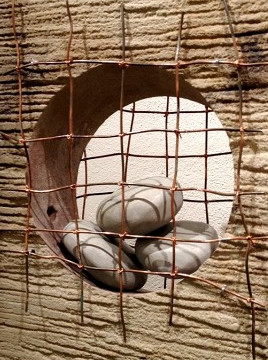
Safekeeping (detail) by Heather Lawson.
Photo courtesy of the Harvest Gallery in Wolfville, NS.

Mom said the security guard in the storage place had been leaning back in his chair having a cigarette after lunch when he just fell asleep. The guard burned up, taking our past, all ashes, with him. Coughing a little myself, I imagine big flames licking my eyelids. Then I think of the hot gases finding Pluto and setting him on fire. That tiny loose thread at the bottom of his hem must have flashed first with a sizzle. I see his hard, wooden head, his velvety, long ears and his shiny coat scorching in that blaze. My fingers itch to fit into Pluto’s paws again so I can make him talk to me.

My mother does not cry over the new swivel TV chair, the TV, or the rabbit-ear antennae that are now all burned and twisted. We don’t even have a TV in Germany. The army didn’t give us one. Mom doesn’t remember Pluto was in the fire. She can’t hear me tell her about Pluto. She talks between sobs about her parents and losing her mother’s china, and her own wartime uniforms. She sees the last few strands of her old life disappear. Mom talks about losing the photographs of her mother and father and how she would never see their faces again because they are dead and now the photographs are gone too. She touches her own cheek where she said her mother had a long, jagged scar from flying glass when the window came in during the Halifax Explosion. Her mother had been looking at the harbour and everyone was running. She couldn’t run because she was pregnant with Mom.

The tears keep coming. I can tell that Mom’s guts are in a knot. She leans over and then she talks about her father who died from lead poisoning from working on the letterpresses at the Herald newspaper. How he was everything to her. This makes her cry more.

Why doesn’t anyone else care that Pluto is missing? I think about when I first got him. He was a present from Jenny Genge, my best friend, and arrived when I was sick at home with the Asian flu. Jenny’s hair was the colour of Pluto’s, yellow. When the last crate was packed for storage, I cried. Pluto could not come with me. He was not allowed to go on our family adventure. Dad might have let me take him but he was already gone with the other fathers on a big boat rocking on the waves.

Dad told me he was going back to Germany where he fought in a war. He told me he had been hit by a bullet that went through his chest right there, right where that thick white scar is under his arm. It passed right through like it was on the Autobahn. It went so fast he didn’t know he had been shot at first—until he keeled over. He said he was going back because of the Cold War. He was going back, too, to visit graves of his infantry comrades in Italy.

When it was our turn to go to Germany, my mother, brother and sister and I had to take a train, and then a boat. My brother had a nose bleed on the train. Like always. My sister and I threw up all the way across the ocean. My mother lay in her bed with a wet cloth on her head most of the time, groaning. When we did leave our cabin we were tossed from side to side, and we had to hold onto a railing to walk.

Pluto would have liked it here in Deutschland. Now he is dead, just gone up in smoke. If my mother had let me take him he would be alive today, living on Wienerschnitzel with a squeeze of lemon. He could have played marbles with me in the playground behind our building, helping me sink the glass eyes and crystals into smooth holes I made in the dirt with my hands. I always go home with dirt under my nails.

Pluto could have gone on the swings with me. Maybe he too would have gotten some splinters from the wooden seats. We would have gone so high our feet would have touch the rooftops and blue skies over our apartment building, and Pluto would have screamed with a little thrill sound only I could hear. I think about how my bride doll was with Pluto in the fire box, but I don’t care about her. Her hair was all shiny and plastic. I don’t know who she was going to marry. Her bride clothes were glued to her.

Mom is crying still.

Pluto is nothing but ashes. I feel alone, but I can’t take my eyes off of my mother’s face. It is all twisted up and her lips are dry. She doesn’t even look at me. Her eyes are all swollen. Her nose is red. She talks only about her mother’s dishes and how hard it was to get these few things from her stepmother, who took everything that belonged to her family. She says how she only owned one threadbare uniform, which burned to cinders too. She says how she lost her dresses that my grandmother had so beautifully made for her. And then “ohmygod” and repeats how she lost the photos.

My mother holds the metal edge of the counter top so hard her hands turn white at the knuckles. The sound I hear coming out of her throat is low and moaning—and then she just lets loose with a big howl. I am scared. For a moment I forget about Pluto, and I think about my mother’s scrunched up face and all her tears. Auf Wiedersehen, Pluto.
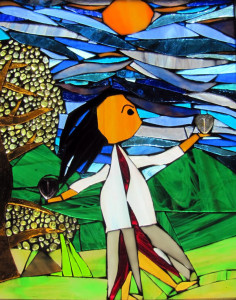
Three Decades of Silence / Wiklatmu’jk

This entry was posted on by .

Three Decades of Silence … and Counting

I remember sitting alone on the edge of the soccer field, where the land turns up, hill-ward by the school fence. I remember letting the distant cheers and loud chatter of the others drown themselves out while i daydreamed and wrote stories or poems. The freedom to wander in my mind, there alone, was intoxicating. When i was new to the next school along our many moves across the country, in finding my essential solitude i would resort to sitting in a bathroom stall over lunch period, until weeks later when i would find a secure spot outside in the yard. I needed a safe place where i would not be coerced into playground games. I didn’t want to run and play tag or soccer. I didn’t want to hop scotch with the girls talking about foolish things. I just wasn’t that kind of child. Or perhaps it was the paralyzing shyness that prevented me from being physical in such a public place.

I didn’t know then that eventually i would become so dedicated to being a storyteller that i would one day enrol into the Native Theatre School in order to be seen and heard in public spaces to share stories. Though today there is only silence, this computer, and you.

My mother reflects back on my demeanour and my need for solitude as she recounts the story of our house in Yellowknife. Even then she understood mothering three different children meant three variations of mothering styles and for me meant unpacking the storage cubby under the stairs so that i would have a private, silent, space. I had a table and a lamp. I remember creating shadow puppet shows on its walls and once, only once, opening the door for my family to watch.

Not coincidentally, two events struck ground at the same time in grade six: my mother was cautioned i needed to work on my social skills; and i became a published poet.

After the flurry of sharing my poetry and short stories with children’s magazines, my teachers, and my family for two years, i stopped writing, much to my mother’s disappointment. (It was, after all, my mother who helped me work through spelling trouble by writing children’s books together. Through her own writing, my mother taught me to use words on paper to create our art.) The truth, however, was that i simply stopped sharing my writing as it was bringing me uncomfortable attention and expectations. I let the silence suck me back into being.

If it were not for that special kind of silence that i find addictive and nourishing, i would perhaps not be a writer.

A Giving Heart by Tammy Lewis

A Giving Heart by Tammy Lewis

Without another person forcing me present, my mind wanders and in that space the words form, like a painting. Sometimes the canvas is blank when i sit down to write, while other times it comes to me half-shaped while i’m in the middle of something else, like showering, doing the dishes, or buying groceries. When i was in my early adult life this was fine: an idea would come and i would pause to take out my notebook and sketch the phrasing out. I would hold the distant chatter of a public place as static noise while avoiding talking with people until i later returned to my apartment and finished the piece.

That certain kind of silence for too long in cities became a poison, turning too close to symptoms of depression. I was overdosing in alone-ness, in the static chaos of urban life. No longer were the boundaries clear between the healthy doses of solitude for productivity and those kinds that were gently suffocating.

For an introvert and a writer it is a bit of a leap to agree to share a life with another person, however, you do. We find ways of creating balance between sharing time and space but then also retreating into oneself.

Then i became a mother.

I lost my silence, my retreat, the freedom to let my mind wander and thoughts which map out stories and poems in unexpected moments. None of that existed for me any more with a toddler and a baby. The cost of something so beautiful, such as mothering, was to lose part of the fabric of my identity.

While my daughters were little my spirit was starved for that place my brain goes to write. People would offer to take care of the girls, but there was always a mountain of things to choose from that also needed my attention. Instead of letting my mind wander among a silence, it would be sleep-deprived, making practical plans, working, and worrying about my daughters/planning for their return.

I remember a day when i stole some time to daydream. Usually, i would stifle the words wanting to be painted with. But this day the girls were at preschool and i was working on a contract file, preparing a report. Yet other words were seeping in, arranging themselves in the back wall of my thinking and so i stood up, went outside on the back step in the summer’s air, and soaked in that special silence. I stood there without calculating anything else as though i were twenty again. I believe a smirk came over my face, a feeling of infidelity with a stolen luxury.

For years it was this way: stories and poems would die just after their birth while my daughters interrupted me, i was simply too exhausted, or other real life of adulthood ceased the flow of words. Not having access to creative silence was bothersome. Slowly, bit by bit, i would steal moments and instead of sleep i would write. Just a bit. Just to stay sane.

I have more access to silence now and i’m regaining balance. There are more opportunities to finish a thought from inception, through daydream layers and back again to end cycle—completed, and leaving me climbing off the narrative ride. I think i even still giggle a little when i catch myself free-floating.

Not every parent can be away from their young children for an extended vacation. I would prefer not to, yet here i am, having said yes to their family trip abroad without me. The house is cold without their voices that have grown integral to my world. I miss even their bickering and their calls in the middle of the night.

There’s all the silence i want but it doesn’t sound right. It’s not filled with their laughter outside as i’ve ushered them out to play. There isn’t the hum of their sleep while i stay up an extra hour before bed or get up an hour early. Our routine kept me focused, kept me connected. Their voices nourished me.

Now i’m overdosing in silence in the waiting. So here i sit. With you. My story.

Good night.


Wiklatmu’jk

my daughters fold hours of work and play
as art, philanthropists preparing
goodwill offerings for the wiklatmu’jk
they know must still be there
how empty the forest is without the people
how sterile our lives

my stories were once the birthing space, improvised
teachings, meticulous but careful
how much i pressed on, the seriousness of this art
some days the veil so thin between truths
animating what only mothers can

now i sit witness on the periphery
their abounding joy focusing their hands
while i’m mourning my own belief
an unraveling that comes with age
unveiling the earth’s tricksters misplaced

i have little magic left to cause
into my daughters’ malleable world
confirming mythology’s last umbilical cord

when too many days were mute
and my children asked
i could only but take them to the trees
it’s up to you to find a wiklatmu’j
maybe they’re in a different shape

The M Word

This entry was posted on by .

The M Word: Conversations about Motherhood (Goose Lane, 2014) features essays by Canadian women writers and artists, including author Carrie Snyder, poet Sarah Yi-Mei Tsiang, and musician Christa Couture. Understorey Magazine spoke The M Word editor and contributor Kerry Clare about what makes this book unique and riveting.

Understorey Magazine: You write in the introduction to The M Word: “You might ask if the world needs another literary anthology about motherhood, and I would argue that it needs this one.” What makes this book different?

Kerry Clare: The M Word examines motherhood and maternity through a very broad lens and includes experiences of motherhood that are often invisible—miscarriage, infertility, the death of a child, giving up a child via adoption—and experiences that are still taboo—abortion, maternal ambivalence, or no ambivalence about rejecting motherhood altogether. These stories are featured along with more typical but still complex stories of motherhood. The effect of this broadness, I think, is quite radical: Women with different experiences, voices, and perspectives co-exist in one literary space. This is a lot like the real world yet such a complicated, many-sided reality of motherhood (and womanhood) is not reflected in the media often enough.

I do, however, see The M Word as part of a new wave of books that challenge simplistic ideas about motherhood and womanhood, works such as Meghan Daum’s anthology, Selfish, Shallow and Self-Absorbed: Sixteen Writers on their Decision Not to Have Kids; the anthology, How to Expect What You’re Not Expecting by Lisa Martin and Jessica Hiemstra; and One Kind Word: Women Share Their Abortion Stories edited by Kathryn Palmateer and Martha Solomon. The conversation is beginning to change.

UMag: How did you find and choose writers for this book?

KC: One doesn’t have to venture far to find a woman with an interesting story about motherhood! Many of the essays are written by friends and grew out of conversations we’d had even before the book was an idea. Approaching women I knew without children seemed like a more risky endeavour. Many of these women were friends or acquaintances too, but we’d never talked about why they didn’t have kids. It turned out that they also had stories they wanted to tell, and these stories were fascinating. So the book grew from my own community, and I then ventured further afield—approaching writers who were friends of friends and sometimes strangers—to add experiences I felt were missing. People were unbelievably generous and happy to become a part of the project. I find women tend to be like that….

The M Word: Conversations about Motherhood edited by Kerry Clare

The M Word: Conversations about Motherhood
edited by Kerry Clare

UMag: Your book blurs the line between “breeders and the child-free.” And yet, as you point out, society still tends to categorize women—often we categorize ourselves—simply as mothers or not mothers. How did the authors respond to the idea of this book, especially women who had not previously written about motherhood? What kinds of responses have you had from readers?

KC: My impression is that the writers were glad to have their stories acknowledged and included—particularly those with the “invisible” experiences I mentioned above. In particular, I found women struggling with infertility and miscarriage often feel so alienated and apart from motherhood (and sometimes from womanhood), but these experiences really are part of the same story. So too with women who choose not to have children: They’re often situated as a kind of “other,” and so I think it’s validating and essential for their voices to be heard. The response from readers has been tremendous: It seems to be a book that one reads, and then passes onto a friend. And I love that. It was just what I intended.

UMag: All of the authors for The M Word are writers or artists, some emerging, some very well established. This thread, more than any single idea of motherhood, binds the book into a whole. There is a longing throughout the essays, a need to create. How do you think that creative pull influences women’s experience of motherhood—either their own motherhood or societal expectations of motherhood?

KC: On the one hand, I would say that the creative pull complicates the experience of motherhood—an artist-mother has to make that extra space to get her work done, and that’s hard to do. On the other hand, I’m not so sure that artist-mothers are that different from everybody else. Art is work and everybody works. I once had a conversation with another writer about how perhaps we experience motherhood differently from other people—that as writers we feel the need to articulate all these impossible notions that motherhood presents—when another friend, an architect, interrupted to say that she thinks about space and design differently having gone about in the world with a child, with a stroller. I think that for any mother, there is a tension between her mother self and her other self, but there are also extraordinary ways each informs the other.

Umag: Another alluring and very reassuring theme in the book is unexpectedess, that we can’t always plan our lives—much less our motherhood—with any precision. What surprised you most about this book? What did you learn about writing, publishing, motherhood, women?

KC: The M Word affirmed to me that women are generous, supportive, and community-minded people. But I knew that part already! What surprised me about the book was how much sense it made to just let the essays flow in alphabetical order according to the writers’ last names rather than try to organize it by theme or subject. Women’s life stories really are complimentary and themes emerged in the book where I hadn’t expected. One recurring theme was doubleness, which is fitting, I think, for a project that’s seeking to disrupt binaries. None of us are ever just one thing. Nothing is straightforward.

Umag: What’s next for you?

KC: I’ve recently finished a first draft of a novel—a grown up version of Harriet the Spy—so we’ll see where that goes. I continue to do freelance writing and reviewing, to edit 49th Shelf, and to write about books and reading at my own blog, Pickle Me This. Plus, my daughters are turning two and six this year, and they’re funnier and more fascinating than ever, so I’ll be chasing after them.

Stars Did

This entry was posted on by .

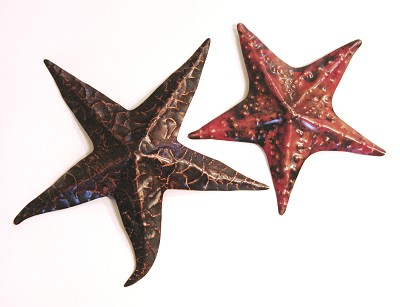
Starfish, copperwork by Marie Jardine.
Photo courtesy of the Harvest Gallery, Wolfville, Nova Scotia.

Faith has always had a place in our family, even when it has waited at the backdoor….

We lay in the back of our Westfalia camping van. My daugher, Leila, was six years old and had jumped down from the pop-top bunk to snuggle between Mitch and me. I’m sure my eyes were closed.

“Mommy, how did God make the world?” She rolled toward me and yawned, pushing her blonde hair out of her eyes. Was Mitch going to say something? Was I? Seven a.m. seemed too early for a godless world.

“Did he just… create it?” Leila asked again.

“Honey, well…” I began, fumbling toward an unknown destination.

In the fog that had enveloped our camper and all of Maine’s Acadia National Park, I saw my whole Catholic life drift by: The dark, dreary church that filled with music and candles at Christmas. The Gregorian chant my dad loved. Our family pilgrimages to St. Anne de Beaupré, to Lourdes in France. The catechism classes I attended to grade nine. Then my teenage investigation and raging disapproval of the Church’s methods of indoctrination. My turns away from a Christ who would cast me off for disobeying his rules, another man to tell me what to do.

I often think back to a childhood friend whose parents never brought her to church. She compared her family with mine and thought her parents were lazy, just bad Christians. When we pushed towards twelve and thirteen years old, my friend thought she was going to hell. She continually asked to come to our church youth group meetings, the retreats, and the pro-life rallies my parents made me attend. I’m not sure where my friend’s religious flare ignited, but I wonder if our viewing of The Exorcist had something to do with it—or maybe her Ouija board and our séances. Perhaps she needed an extra layer of protection.

I felt bad for my friend; she was confused and scared. She asked me to recite prayers so she could learn them. She scoured my house for icons, crucifixes, and rosaries to borrow. I told her she could have them. She could have them all. That constructed spiritualism was already cramping my teenage style. I told her not to be taken in by the glam, but she wasn’t the scrutinizing type.

I didn’t want this to happen to Leila, that she grew plagued by constant fear of the unknown, by a god she neither knew nor understood. She might blame us, her parents, for not teaching her the religious basics. Yes, offering her the gift of openness to all spiritual texts, hand in hand with evolution, seemed the only dignified thing to do.

But I was already talking.

“God didn’t make the world, Leila, but that’s an important story.” There was no need to diminish that particular narrative. “The universe was full of heat, it expanded, and a huge star exploded. It blew the whole galaxy into millions of pieces. It was called The Big Bang.”

I tried to make the story compelling and dramatic. She wasn’t buying it. We’d told her over and over our beliefs in evolution, but they just didn’t stick. The universe didn’t stick. Nature didn’t stick. God stuck.

“The Big Bang, “ she repeated. “That’s not what Nanny says.”

“People have their own stories, Leila, and the Bible is the story that Nanny likes best.” I rubbed the sleep from my eyes. I was losing.

I pulled the covers up and looked over at my daughter. She stretched her arms towards the roof, the sky, and wiggled her fingers. “So God didn’t invent the world?” she asked. “Stars did?

In my late teens, I moved to Montreal for university and began kinships with Muslims, Buddhists and Hindus; I casually left Catholicism behind. My parents knew this exploration would bring me the most peace in life, and they were happy to hear about my travels to meditation centres and to mountains and oceans, places where my heart was home. They had passed along their family values, kindness and equality and structure. They had done what all parents do—their best.

Sun peeked through the fog of Bar Harbor forest. Water bubbled over rocks in streams. Momma birds brought baby birds to safety. The universe seemed in perfect balance, and to me, that was enough. As an adult, I’ve come to expect unanswered questions. I light a blue candle in the morning when I begin to write because I read somewhere that blue candles make better writers. I hold the healing powers of rose quartz and yellow citrine in high regard and wear these stones on necklaces and in rings when I need energy. I’ve become familiar with the flexibility of quantum mechanics, a science that bends information depending on stances and light. I accept that; I even like it.

But maybe kids need more. Faith.

There’s a Baptist gospel church in Florida that my parents now attend when they fly south for the winter. Mitch, Leila and I visit each year and sing and clap our way to the end of a brilliant service. We shake hands with the pastor and thank him for welcoming his northern birds. Afterwards, there are hats and shined shoes and donuts served under tents in the small parking lot. Leila loves it. My parents don’t mind that it’s not a Catholic service. And Mitch and I are, for that moment at least, at peace. Our universe is expanding.

Gathering Mi’kmaq Medicine

This entry was posted on by .

Mom became ill after my baby brother Joe was born. I was young then, but later Granny told me, my sister Loretta, and Joe the story.

The midwife had arthritic hands which she rubbed with wintergreen to help ease the pain. We don’t know what happened, whether your Mom developed the infection from the wintergreen or something else. But she became very sick.

There wasn’t a doctor in our isolated community so we had to depend on the parish priest who was a medic in the army. He arranged for a helicopter to fly her to Gander Hospital; your father went too and stayed in a boarding house.

The doctors couldn’t treat your mother. She was left alone in a private room to die. She spent months unconscious and when she finally opened her eyes, she said, “I’m thirsty.”

Many more months followed and your mother finally became well enough to come home. It was a rough time with you three children and nursing your mother back to health, but we did it. Your great grandmother knew the medicines from Mother Nature and that’s what cured her.

*

I have my own memories of that time—and of the years that followed. When Mom and Dad returned from Gander, Dad went to work in the logging camps but Mom still couldn’t walk or dress and feed herself. Granny took care of us all. She fed us and loved us and many nights I cried myself to sleep on her shoulder as she rocked in the birch chair. Squeak, squeak went the rockers. I missed my mother’s loving care, but Granny sang songs and hummed while I snuggled in her arms and played with her curly hair. I felt safe and secure there.

Over the following years, Granny taught me the skills of life. I remember wiggling my fingers through the flour as we made bread. I washed clothes in an old galvanized tub with a scrub board that made my knuckles bleed. She taught me how to knit socks one stitch at a time, how to fish, and how to snare rabbits and clean them.

Most of all, Granny taught me the traditions of Medicine Gathering. When I was eleven, she said, “You are old enough to learn about the medicines. Next year you will be twelve, a time when a girl can become a woman, and you will need to know these medicines.” She braided my long blonde hair and continued, “My mother, your great grandmother, was a medicine woman. She used the medicines to cure people. Tomorrow, I will take you to the woods so you can learn.”

tba by Heidi Jirotka

In Between by Heidi Jirotka

The next morning, we left home early. The woods were cool and the sun peeked through the trees. The birds talked and sang as we entered the path that led to the medicine plants.

“There’s a black cherry tree,” Granny said.

“How do you know?” I asked.

Granny looked at the branches. “It has black, rough fungus growing on its trunk,” she said and ran her hand down the side of the tree. “We can remove the inner bark, steep it, and drink the liquid to cure a cough.”

She placed the bark in a leather bag and tied it in a knot. Then she opened her leather medicine bag that she kept around her neck. With her long fingers she removed pieces of tobacco and held them in her left hand, close to her heart. She looked to the sky and down to the ground. She asked the Creator and Mother Earth to keep the medicines strong. She offered the tobacco to the tree in thanksgiving for its medicine.

Through out that day and the many that followed, Granny taught me to find Manitou Berries under the yellow-brown moss and how those berries thinned Grandfather’s blood after his heart attack. She showed me the Golden Thread roots used for Dad’s stomach ulcers. Together, we found turpentine concealed in tree trunks and Granny reminded me how the sticky liquid mended Uncle Larry’s foot after he cut it with his axe.

When we stopped for a lunch of moose meat sandwiches and bottles of water, I would sit on tree stumps beside streams and listen to the birds and animals. Then I’d walk along again holding Granny’s hand. As we chatted about plants and trees, I could hear the pride in her voice. She loved showing me her mother’s traditional medicine.

“Did you notice the spruce trees near the brook?” she asked one day. “The needles are full of vitamin C and this beige gum will cure sickness and help keep you healthy. We will gather some for the winter months.”

“Can I chew some now?” I asked.

Granny cut the gum away with her knife and gave me a piece. “Just keep chewing it until it gets hard.”

“It’s sticking to my teeth!”

Granny laughed. “Just keep chewing, it will come away from your teeth.”

When it was time to return home, we would walk the same path. As the mosquitoes swarmed and bit us, Granny would bend down and pull a sweet fern from the ground. She’d rub the fern over her arms and legs: “The mosquitoes and flies don’t like it,” she said. At the end of a day, Granny would have filled five bags with plant medicine but the drying and steeping would have to wait for another day.

*

My mother recovered from her strange illness, and five years after Joe was born, she gave birth to my sister Betty. Dad passed away two years ago but Mom lives a good, healthy life. She is now eighty-five, walks a kilometer a day, and lives in her own home. Granny always said, “It was Mother Nature’s medicine and the remedies from your great grandmother that gave your Mom back her health and quality of life.”

I finally graduated from Granny’s teachings and become her helper as she treated the people of our community. Many years later, and many thanks to Granny, I chose a career in nursing. I now practice and share the medicines and cures taught to me by my grandmother.