Archives

A Conversation with Lesley Crewe

This entry was posted on by .
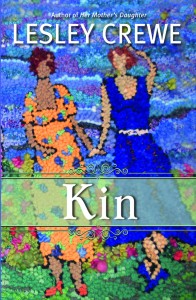
Kin by Lesley Crewe

Kin by Lesley Crewe

Cape Breton mother and author Lesley Crewe has published six acclaimed novels, including her latest, Kin. Lesley’s first novel, Relative Happiness, will be released as a feature-length film in 2014. Lesley spoke with Understorey editor Katherine Barrett about motherhood, grief, and creativity.

How did you start writing novels?
I was working as a newspaper columnist in Cape Breton when I started my first novel, Relative Happiness. I wrote that story to be with my son, Joshua. We’d lost Joshua twenty years earlier, when he was just an infant [see Forever below]. I wanted to write his name—to see his name in something other than granite. So I did, over and over again. I didn’t intend to publish the story—I wrote it for myself—but a friend suggested I send it to a publisher and I’ve been writing novels ever since.

How has motherhood influenced your writing?
It’s who I am. Motherhood has influenced my life so of course it has influenced my writing too. My children are grown and live away from home but the mothering never stops. I don’t write about my kids in my books, yet the experience of being a mother—that love, empathy and worry—shapes all of my characters and stories.

You wrote your first five novels in two years. You’ve now published six and have another due out this summer. How do you it?
Please don’t be too impressed or daunted by how much I have written! Everyone has their own process and a right time in life to be creative. I didn’t write anything when my kids were small; I didn’t have the energy. Now I write just to avoid housework…. Actually, I walk every morning and that’s when I think of my stories. I then sit down and tell those stories, usually in short bursts of intense work. I write books that are easy to read, books that can be enjoyed in the tub or on the beach. I tell the kind of stories I like to read myself, and I draw a lot from my life and from the people around me.

Although the characters in your books often leave Nova Scotia, they seem compelled to return. There’s a pull, especially back to Cape Breton. Do you feel that too?
I spent the first six months of my life in Glace Bay, Cape Breton, and then grew up in Montreal. I have always felt a connection to Cape Breton and was fortunate to have the opportunity to move back, even when so many people have had to move away for work. I’ve lived here 30 years now and everyone I know who has left can’t wait to get back. I think that pull stems from the people here and in the Maritimes in general—the people and the connection we have to each other.

What advice could you give to new writers?
I’ve given workshops in high schools in Cape Breton through the Writers in the Schools program of the Writers’ Federation of Nova Scotia. I tell my students that you don’t need to travel to some exotic place to find a good story. We have lots of great stories—and fantastic characters—right here at home. I also advise new writers to write for the love of it, not out of a desperate need to be published. Write for yourself and trust your characters, too. Sometimes they take your story in new and unexpected directions. Listen to them.

What’s next for you?
I have a new book coming out in August. Chloe Sparrow is a lighthearted novel about a TV producer. The story was my daughter’s idea so I wrote it for her. I also finished another book this winter called Amazing Grace. I fell in love with the main character of that story, Grace. I miss her now. It’s strange the way that works…. This fall will be busy with Relative Happiness, the movie, coming out and with promoting Chloe Sparrow. But I love to meet my readers. They’re always so kind to me.
 

The Length of the Court

This entry was posted on by .
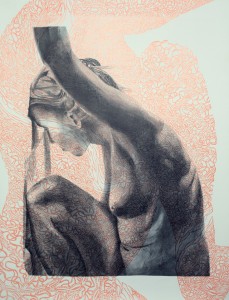
The Giant She Was by Barbara Carter

The Giant She Was by Barbara Carter

In the twisted sheet hours
I unmuffled my head
to decipher my son’s sleep talk
knees banging against his wall          uuugh (a grinding growl)

The doctor says I take notes
at every appointment
just like my mother,          maaaaaaa
a lurching as she is lost
to me, a longing like when my son
said Mama, his first word          maaaamaaaaa
when his stroller couldn’t fit
in my bathroom stall

Three days ago
I crafted a short letter
about my daughter’s health
enclosed a two page report
sealed the envelope and in cursive          fuuuuck
wrote a name

The letter passed from the palm of my hand
to my son’s and then to his father’s
at the basketball game
where my daughter ran
the length of the court
between her two parents
and poured water
from the bottle in my hand
down her throat

I saw him sink
the unopened envelope
into the recycling bin          Yuh! (with an intake of air)
as if I was sucking the words back
Silenced

The other team
a humiliating
slam-dunk.

Forever

This entry was posted on by .

I want to tell you about a moment, gone before I was able to gather a thread of thought. But once you know, its presence never leaves. It winds around you as mist, a wind that swirls, unseen but always felt. It only comes to you after losing someone you deeply love. We lost our little boy, Joshua MacKenzie. A nurse told me she liked the way his name looked on a piece of paper. I have been staring at it carved in granite for ten thousand days.

The night Joshua died, I left this place. I went with him, carrying him into the universe myself. When I returned, pieces of my exploded heart lay all over the hospital floor. I tried to gather them up but couldn’t. My breast milk dripped down the drain of a public washroom sink because my baby didn’t need it any more. My body cried for me.

This is falling over the edge of the earth.

No mother should ever know what it feels like to leave her baby in the rain.

In school we learned that when ancient Hawaiians grieved for the people they loved, they climbed the sea cliffs and smashed their teeth against the rocks. They poked their eyes out with sticks. I used to wonder why someone would do such a thing.

They do it to let the pain out.

I wanted to be with Joshua. It would have been so much easier to die. The only reason I didn’t was a four-year-old boy who said he would grow up to be Superman and save his brother.

Somehow we lived through that long lonely winter. Spring came and then summer. Early one morning, Paul wanted to be with his baby. We went to the cemetery and sat on the grass beside Joshua’s grave. The sky was a beautiful clear blue, with glorious white clouds that rose so high they looked endless.

Paul was content. He sat on my lap and we listened to the brook dancing its way to the ocean. Birds and chipmunks greeted us as they always did. We saw butterflies and bugs, ants and even a grasshopper. The two huge fir trees on either side of Joshua’s stone gave us shade from the bright sun.

I felt a flutter, as soft as silk. My girl let me know she was there too. I looked up between those towering trees and the sky split open. I had an unborn child, a living child and a dead child. And they were all with me. Whether or not I could hold him, whether or not I could see her. They would stay with me in this world, the world before and the world after.

I didn’t lose Joshua. He lives with me every day, as surely as his brother and sister. Paul and Sarah are held in the circle of my arms. Joshua lies in his garden, in the circle of the earth, under a canopy of stars.

Tiger’s Milk

This entry was posted on by .
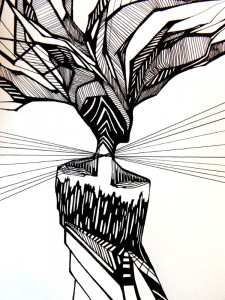
Beneath the Surface by Maria Doering

Beneath the Surface by Maria Doering

This thing always seemed
too tame or domesticated.
Beyond you with muscles & tattoos
your hitch-hiking skills and ability to tie
all seven essential knots          (the clove hitch, the half hitch)
too fecund too essential
how could you make milk:
nurse or be nursed?
(the verb, the noun)
Sadly you picture a cow.
Nothing against the dear beasts but their
symbol; the music they make in the mind’s eye.
Nothing against them but their horrifying dugs
That hang so low.          (the bowline, the square knot)

But these were ideas. And foolish ones.
All before the fact, but can’t know a thing until
you know it.          (the sheet bend, the taut line)

Suddenly your body cinches and heaves with
Preternatural force: You are in the thick of it.
This is blooded battle, tooth and claw, life and death and
There is nothing, nothing

you wouldn’t do
To succour, protect

Yes, to nurse          (the verb)

In the bleakest hours of labour the thought appears: Tigers make milk, too.

Clatters on a ticker tape ribbon in the telegraph machine in your head while contractions rule you like riptides and at the end when he arrives, beloved man first born, you get it: This is fierce. Not just the Tiger, the Cow, too
I am tiger, I am the cow, too.
I am she.

A Curse and a Blessing

This entry was posted on by .
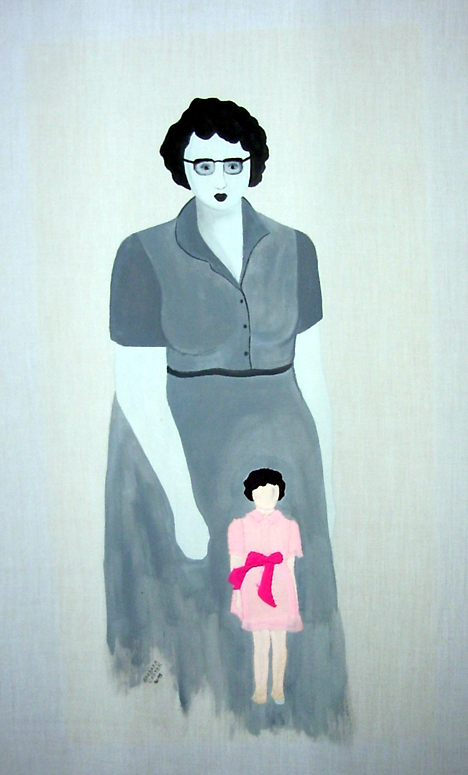
The Rural and Urban Divide by Brenna Lord

The Rural and Urban Divide by Brenna Lord

The zygote that became me was formed inside a poisoned woman. Tina’s heart was pure and strong, although it was broken by the man who provided half of my DNA.

The heart is a symbol of love in the same way a skull and crossbones signifies a poisonous substance. Sometimes the two collide. Tina’s blood kept pumping through her heart, but it was challenged by something far more insidious than lost love and being single, pregnant and Catholic in small town Cape Breton.

Maybe Tina doesn’t remember my birth on March 11, 1953, because she was in a Twilight Sleep. It sounds like a lovely dream, but it was a combination of morphine to relieve pain and scopolamine to dull the memory. Scopolamine was made from a plant called Angel’s Trumpet, but the drug has been called devil’s breath.

Our bodies are made of chemicals. We’re formed from a stew of life-sustaining proteins, oxygen, carbon, hydrogen and nitrogen. The oxytocin in my mother’s body started labour. The prolactin that stimulates breast milk production also triggers tears.

This was the modern age, however, and women deserved to spare their minds from the pain of childbirth, their breasts from the tug and pull of a hungry child. DuPont advertised “Better Living Through Chemistry” and people wanted to believe that was true. So the devil came in the form of the drugs that took away the joy my mother should have felt giving birth. He hid in tin cans disguised as the perfect substitute for breast milk. Mum fed me diluted Carnation evaporated milk.

The devil also hid in the pond beside my mother’s house. Her family lived at the corner of Ferry St. and Walker St. in an area of Sydney known as the Hoople Block. It was located beside the manmade concoction known as the Tar Ponds.

When Tina was a child, she played in the toxin-filled soup with her siblings. They chewed the gobs of black, sticky tar like it was gum. We may be formed of chemicals, but the polychlorinated biphenyls, polycyclic aromatic hydrocarbons and heavy metals that were run off from the steel mills don’t belong in the human body.

When I was a year old, we moved away from the stink and dirt of coal mines and steel mills. Toronto may have its own hazards, but they didn’t compare to the place I spent my first year of life.

Sydney was still in my mother’s blood—or maybe it was the hidden evil at the bottom of the pond. The poisonous chemicals were man’s mistake, and I say that because it was men who were the captains of industry. It was also the poor men of Sydney who worked in the coal mines and steel mills that created of one of Canada’s worst environmental disasters. But it was often women who bore the brunt of their sins.

Mum got breast cancer when I was eleven. She woke up from what was supposed to be a biopsy to find a deeply mined expanse where her right breast used to be.

My mother never committed the sin of vanity. She was a plain woman who didn’t wear makeup or jewelry, but her personality needed no gloss. At home, she rarely wore her bra, which had a prosthesis filled with something like birdseed. She said it was uncomfortable. She would leave her bra hanging on the bathroom doorknob. When I was sitting on the toilet, I’d squish it in my hand, like a bean bag.

I was also single when I got pregnant. The toxins I put into my body were alcohol, weed and nicotine. It was the early ’80s. I knew there was a baby growing inside me before I missed my first period, and as soon as I felt that call from my womb, I stopped poisoning that new life.

There was no Twilight Sleep for me, but an oxytocin drip to induce labour; nature replaced by the wonders of modern medicine. By the time my second son was born, I was careful about what I put into my body.

I watched my children grow strong and healthy as the demons hiding in my mother’s body made their presence known again. Her bones were rotted with cancer.

My two blessings were mine because my mother gave me life. When you hold your baby in your arms, you forget the pain of childbirth. But there is no Twilight Sleep to take away the memory of watching someone you love removed from this earth in a flurry of pain that no chemicals can tamp down.

The Sydney curse affected many of my mother’s relatives. The fruit of our family tree is breast, ovarian and colon cancer. I, too, got cancer. My right breast is still there, it just appears to have a bite taken out of it.

Sydney was never meant to be a Garden of Eden, but it didn’t have to be the Malebolge. The site of the Tar Ponds has been turned into a green space called Open Hearth Park. The sludge has been solidified and buried under grass where children play. It’s buried, but is the curse truly gone? Maybe, like cancer, it lies in wait.

I imagine my mother standing in Open Hearth Park. Her arms are outstretched and sparrows feed at her right breast. Her C cup birdseed breast becomes a B, then an A and disappears. Some seeds fall to the ground and where there was poison, there is now life.