Archives

Never a Mother

This entry was posted on by .
Lost Stories by Sally Warren

Lost Stories by Sally Warren

I have never been a mother to a human child. I have never tried to become one.

At one time, I thought it would be my lot in life, but this was more a gloomy conviction born in the depths of depression—I would end up an impoverished single mum—and the opposite of an aspiration, more of a resignation, even though there seemed no rational reason it should be so.

I came from a family that was supportive and comfortably off, where getting an education was held in high esteem and where we were encouraged to pursue our interests, but where my own mother was unhappy for various reasons. Among them was the fact that she had become a mother in her early twenties—a depressed one who I imagine found coping with a colicky, red-faced newborn like me as frightening and difficult as being asked to carry around a live hornets’ nest.

I love kids, even if they’re having tantrums, whining and drooling; when I am not depressed, I enjoy being around them and their noisy exuberance. I have thought a lot about the best ways to treat and educate and raise them (as so many annoying, childless people like me do). But I have never, ever, seriously considered having any myself.

It’s partly because I have a mental illness which has littered my path through life with extreme and sometimes lengthy periods of instability and dysfunction. I felt strongly during my childbearing years that I would not have been able to care for a child, as evidenced by a stint as a nanny that helped land me in hospital. I remember standing at the kitchen window of the kind people whose child I was looking after, washing dishes with the little girl on the floor beside me, and watching a grey piece of wallpaper come loose from the dark walls inside my mind. I was falling apart. I had been struggling for a while, but in that moment it was terrifyingly obvious that I was incapable of taking care of her.

My memory is that I left the house in the middle of the night and went to the hospital, with the little girl and her parents sleeping soundly in their warm beds. I was thankful then that she wasn’t my own child and that her world was safe and loving and intact when I left it. I know that little girl was fond of me, but I also know and am forever grateful, that I wasn’t the real rock of her life because I feel I would have been a shattered stone whose edges cut and scarred her.

There are plenty of people with mental illness who can be, and who are, wonderful parents. I have no doubt about that. A loving family is a loving family, and all families have their problems. But the truth is, when I was in my twenties and thirties, besides struggling with illness, I was thinking of other things. Things like getting a job, whether I needed more education, and becoming a writer. That last had been a dream of mine since junior high school. I didn’t really long for a husband and babies, but for creating and publishing novels, poetry, and essays.

Of course, some women and men find it possible to both write and raise their kids, but I am not a person who finds it easy to divide her energies. Now, however, as I enter middle age, I can envision parenthood from the point of view of a healthy person, if I’d had a stable partner and home and enough material resources not to worry about my kids while I dealt with words.

I never had that kind of partner or resources. The few guys I had relationships with were, like me, disabled in some way by illness and not on a path to becoming providers for kids. I wasn’t looking for one. I wanted to find a way to be well, be happy and move forward in my life, and to provide for myself. That seemed enough.

It still is enough. There was a brief moment of panic driving down a busy street when I realized my body would soon be unable to have children, but I realized that wasn’t because I wanted to have kids of my own, I just didn’t want to lose one of life’s possibilities—because I cherish possibility, as though it were a child itself.

The Hollow

This entry was posted on by .

I woke into a nightmare and you
were there, smiling into dark,
cavernous spaces, already calling them home,
translucent fingertips pressing my
stretching walls and me, aware of your
distant vibrations, unsettled and afraid.

I cannot conceive you as reality:
gauze hair, infinitesimal teeth,
film of flesh, aqueous eyes–my eyes,
staring back at me. I will
disengage you as my blood
creates you. I will unmake you
cell by cell as you swell
inside me; removing your need, your
wish, your want, piece by piece;
and make full again your only home
with my apologies.

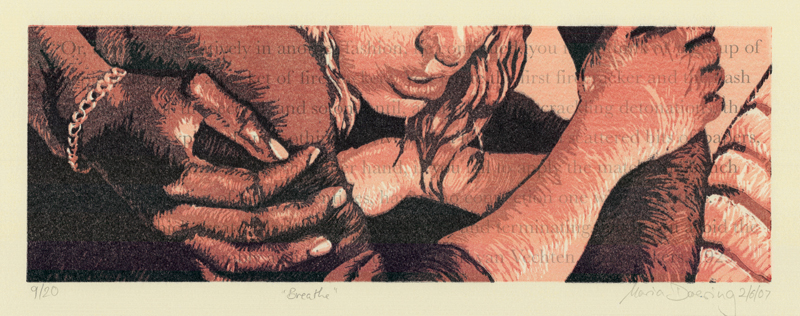
Breathe by Maria Doering

Breathe by Maria Doering

A Conversation with Alice Burdick

This entry was posted on by .

holler I met poet Alice Burdick on a snowy morning at the Biscuit Eater Café in Mahone Bay. We sat in winter sun made cozy by the scent of baking, Latin tunes on the CD player, and shelves stacked high with books, including Alice’s latest collection, Holler.

We planned to talk poetry and motherhood but first took a few minutes to enjoy lattes, muffins, and marvel of leaving the house. It has been a cold winter in Nova Scotia with a lot of storms and school closures, times Alice spends at home with her children, Hazel, aged 6, and Arthur, 4.

Alice Burdick: I usually write at home, even when the kids are at school, but I do miss those days of leisurely writing in cafés like this one.

Katherine Barrett: When did you start writing poetry?

Alice: I took an extra-curricular writing course in high school called The Dream Class. It was run the by the Toronto school board, taught by Victor Coleman, and introduced me to the major poets and poetry movements of the twentieth century. I got hooked and later started making my own chapbooks—complete with hand-painted covers and pages—and selling them at book fairs and bookshops.

Katherine: And you’ve published a lot since then.

Alice: Yes, several chapbooks, three full-length poetry collections, and poems in literary magazines across Canada.

Katherine: How has motherhood changed your writing practice?

Alice: Other than spending less time in cafés? I’m much more focused than I was before kids, I just sit down and write. I treat it like a job and that way I’ve kept writing straight through motherhood, even when the kids were babies. I have to write to feel fully human.

Katherine: Your latest collection, Holler, contains many poems about children and mothering.

Alice: More than my previous collections, yes, and readers have said Holler is my most accessible book. I’m not sure how those two points are linked but it likely has to do with the immediacy of motherhood.

Body House
(from Holler)

Hazel stands in front of me
and points to her eyes.
They are windows, her ears,
they are windows, and her mouth,
she says it’s a door.

Her body is a house,
and she’s home
for now.

Katherine: Tell me about “Body House.”

Alice: My daughter, Hazel, was about three when she came to me with these pronouncements about her eyes, ears, and mouth. I saw her trying to situate herself, her body, in the world; trying to process the information that flows in and out. Three is such an innocent age, free of insecurities about bodies but I know that she’ll one day become aware of how others see her. That’s why I added “for now.”

Ghost Feet
(from Holler)

Please make me a book
from salad and tears. I cry at condiments.
My ghost feet light up the sidewalk.
Will you forget a book or a person so easily?

Arthur makes a series of sounds
that will one day be words.
He gets his point across
the floor, straight to the cat’s dish.

Katherine: To me “Ghost Feet” is about that crazy headspace of motherhood. Why am I crying at condiments? No, my kid is crying at condiments. We’re both crying. Never mind because there goes Arthur to the cat dish….

Alice: I’d say a lot of the poems in Holler share that quality: the brain on tangents brought home by the physicality of parenting. But “Ghost Feet” actually started with Michael Jackson. A friend challenged me to write about him; a “literal” video for Billie Jean and the line “my ghost feet light up the sidewalk” stuck in my head. So the poem is a reverie of sorts: the beauty of life; our quick acceptance of its disappearance; and the everyday strangeness of kids and parenting.

Katherine: What are you working on now?

Alice: I have a new poetry manuscript in the works. I’m also trying my hand at collaborative fiction, co-writing with another author. And now that the kids are a little older, I’ve started carrying my notebook around again, taking notes. We’ll see where it all goes.


The Cling of a Cold Night’s Dreaming

This entry was posted on by .
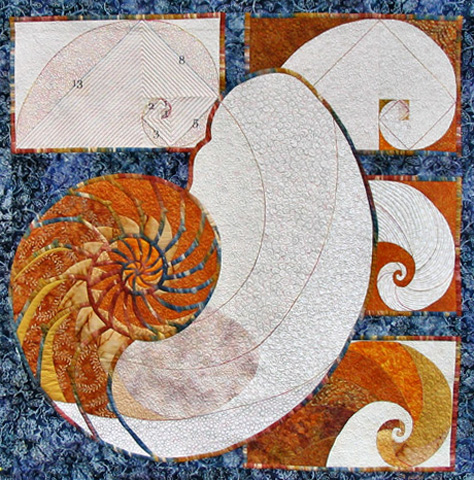
Golden Spiral by Deb Plestid

Golden Spiral by Deb Plestid

With breakfast I read
The Essential Zen
carefully ordering the morning
marshaling good energies
admiring the brush painted circles
the kiwi fruit in yoghurt
the sunflower seeds in bread
the fuzzy bear slippers

but nothing is quite strong enough
to pull me back together
as the black cat
sits on the mule post staring
with yellow saucer eyes
satisfied, it seems, to see my aura
sagged and drooping
a voodoo mound of melted me
bound with threads of the boy’s night ramblings
pierced with his fear, his rage and the cough
that turned tight like a bark
precursor to jagged images that buzzed
in and out of my cold night’s dreaming

spiked and spinning
they shivered me worse than the cold

Two Poems

This entry was posted on by .

Small Wonders

The shuffle of her feet
as she creeps to my bed,
to snuggle me awake.
Kissing my cheeks,
and whispering,
“No, I’m the lucky one.”


Leaving

Listen this evening as the quiet East train rushes
past streets, and fields, coffee cups,
and lies.

Ten Mothers say, “I have arrived.”

While in the basket,
my accidental girl pushes her pink fingers,
dreaming.

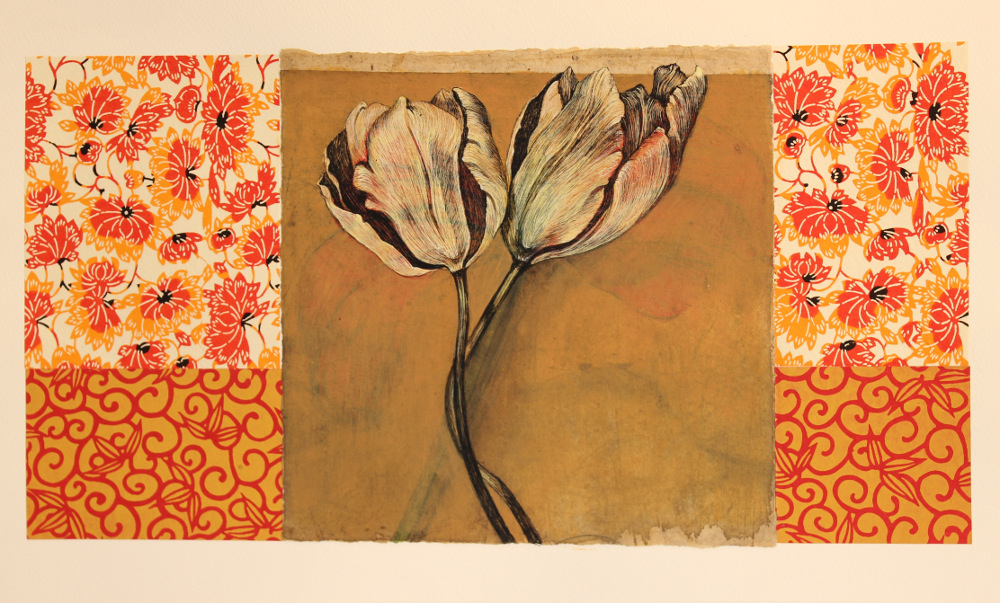
New Over Old by Susan Wood

New Over Old by Susan Wood