Article Category Archives: Fiction

Blood and Vinegar

This entry was posted on by .

It happens as Al is walking home, her hands thrust deep into the pockets of her overcoat. Usually she is on her guard at such times, wary and aware, but tonight she is high on a night out with the old crowd—Sam, Jess, Billie, Little Jo, who’s just Jo now that Big Jo is gone. The old bars may be closed, but when they get together it’s easy to forget that the past is past and the present a different animal. Her heart is full, her step is light, and she fails to notice the two men who slip out of the shadows to follow her. It isn’t until they are nearly on top of her that she hears them coming, slipping and skidding on the last of the February ice.

When she was young and full of fire, she would have been ready for them. But she is too old and they are too fast, their fists in her jaw before she can get hers up. Under the eerie amber glow of the streetlights their faces are alien and fierce. She can only pick out the odd detail, here and there: a beard, a torn jacket, a belly tight and round as a drum.

They beat her until they get tired of beating her, and then they leave her lying on the sidewalk, staring up into the night sky. A few tattered wisps of cloud blow across the face of the moon like so much trash.

Al does not call the police. She is old enough to remember the days of bar raids and paddy wagons, when anyone not wearing at least three pieces of women’s clothing would be arrested or worse. And there was always something worse. Things may have changed, but she doubts they’ve changed enough.

Red and White Series 3 by Shreba Quach

After she drags herself home, stopping every few minutes to rest, she stands in front of her bathroom mirror and surveys the damage. Her left eye is swollen and plum-purple. Her nostrils are crusted with red, although the nosebleed has stopped. Her ribs are sore, but not broken. She’s had ribs snapped before, and she remembers the way they burned when she drew breath.

She’s lucky. It being a festive occasion, she went out wearing a full suit. And a tie can be a noose in the wrong hands.

Aside from her dignity, what has suffered the most is her shirt. Blood has soaked into the collar, crimson blooming on the fine white linen. Al stares at it hopelessly, plucking at its edge. Frances would know how to treat it, what mysterious bubbling liquid to dab onto the fabric to return it to its former glory. Magic, she said once when Al asked her how she did it, smiling that wry little smile of hers. Al hadn’t pressed her. Women need their secrets. Lord knows she has enough of them herself.

The shirt will have to go. Al tears it open, wincing at the bruises already blossoming on her arms. She balls the shirt up in a wad and walks into the kitchen. A takeout carton from last night’s dinner sits on top of the garbage can and the smell of it stops her in her tracks. Her nose twitches.

Vinegar, she thinks. She remembers Frances standing over the kitchen sink with a bottle in her hand, dousing a stain and pressing it with a cloth. For the next few days the tang of vinegar had overpowered all other smells in the apartment: the potpourri in the living room, the discount flowers Al brought home from the supermarket, the dark spot on the bedroom carpet where Frances had once spilled a bottle of perfume.

That spot is what’s left of her now. The spot, and the pictures on the walls, and the potted fern on the windowsill that somehow hasn’t died yet. Even her ashes are gone, sent to a cousin out west. She counted as blood. Al didn’t.

The vinegar is hidden at the back of the fridge, between a jar of beets and an orphaned can of beer. Al brings it to the kitchen sink, upending it onto her collar. She dabs at the stain with a tea towel the way she remembers Frances doing it: firmly, gently. One of her arms is stiff where it was kicked, and moving it sends white-hot darts of pain up into her shoulder. She ignores it and keeps going.

At first nothing seems to happen. Then, after several minutes of blotting, the red seems to be more of a pink. The pink turns to blush, which turns to only the faintest sigh of colour on the white. You’d have to have your nose pressed close to her neck to notice it at all.

Al runs the shirt under a cold tap and drapes it over the back of a chair to dry. Touching the collar, she glances at Frances’s fern, lush and green against the darkness of the kitchen window. The plant looks lonely, she thinks. She’ll have to get another to keep it company. Something strong and beautiful, vibrant and sweet.

Al washes her hands. She brushes her teeth. She goes to bed and imagines the plants she’ll buy, violets and geraniums and philodendrons bursting riotously out of their pots. It will be spring soon. The winter will end.
Cardboard

This entry was posted on by .

Firefly is falling apart. “Firefly” is what Marie’s older daughter named the bed when it was brand new thirty years ago. On Sammy’s limited salary, buying the two girls sturdy army cots with strong wire flats and not-too-thin mattresses had seemed the best idea.

They’d worked fine, and then Sammy got a raise around the same time the girls had growth spurts. Marie pored over the Sears catalogue for weeks until she finally settled on beautiful maple-look bunk beds. Then Firefly and Nightmare (their younger daughter had thought of that name for her own cot) spent time folded up in the basement behind the water heater, and later in the crawl space under the roof.

Two years ago, when Sammy had his first heart attack, Marie asked her son-in-law to bring Firefly down to the mudroom where she unfolded it next to a space heater from Canadian Tire. Marie wanted to be close enough to Sammy’s bedroom door, but not in the bedroom. Sammy needed his sleep and the girls’ room—now the guest room—is always made up in case the girls come home for a visit. It was just easier to be here off the kitchen; she doesn’t disturb Sammy when she wakes up at night to read with a flashlight or gets up early in the morning to make tea in her “Best Mom” mug.

But now Firefly’s mattress is leaking through the wires. Whenever Marie manages a proper cleaning, she collects tiny swaths of cotton from under her cot—sometimes even from beneath the girls’ bunk and behind Sammy’s recliner. And the wires themselves have been letting her down. She can’t get comfortable on her right side because she feels her hip sagging towards the floor, which makes her feel off-balance and causes dreams of falling from airplanes or towers. If she turns over, a small but persistent mound of mattress thrusts itself into the right side of her lower back. If she inches to the left, her arm or leg drops off the edge.

Still, the idea of calling either girl and asking them to drive all the way to Cedar Springs and then take her to one of those massive furniture stores at the edge of town, well, it’s just too much to think about. Besides, according to the flyers, even small beds cost hundreds of dollars nowadays.

One morning, a huge truck delivers a new stove to Jerry and Susan next door. Late that evening, Marie drags the empty stove box from the curb into her backyard and covers it with garbage bags held down by stones and a big stick. She spends the next afternoon with her kitchen scissors making small cuts in the tough side seams until she can flatten one side of the box. Then she scores the bottom seam with her biggest knife and cuts the side off completely. She stomps on the leftover flaps so she can fit them into her recycling bin. That part takes the most time. Sammy is watching the sports channel and enjoying the low-fat chips and dip Marie brings in. He doesn’t even ask what’s keeping her busy in the backyard.

Marie takes the flattened side of the box and pushes it under the upper two-thirds of Firefly’s mattress. A little line of cardboard is showing; she adjusts the blanket to hide it. She lies down on her right side, sighing deeply, feeling supported, almost falling asleep.

And her daughters are just plain wrong to say she’s not coping any more.

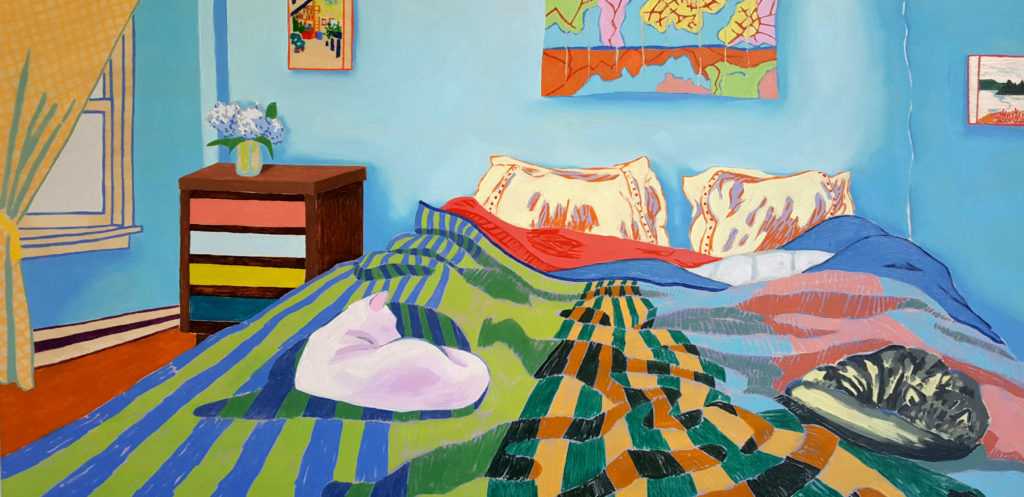
Let Sleeping Cats Lie by Caitlin McGuire

Stardust

This entry was posted on by .

A gale of wind blew across the land. Travelling over rushing rivers and unreachable mountain peaks, she looked for a place to rest. A safe haven. A home. For this wind had seen many far-off lands but never a place to call her own. Zephyr was her name. She could be a soft and gentle breeze, the kind that crosses your face on a cool spring day. But she could just as well become a roaring wind, one that sought to disfigure the face of our world and summon chaos in the fiercest form. She was a sleeping dragon, poke her, and you would be sure to release the wrath of one of mother nature’s most formidable demons. A Poltergeist of a wind, Zephyr was made to stir the waters and the branches of our great forests, to steal hats and wreak havoc as she travelled the world.

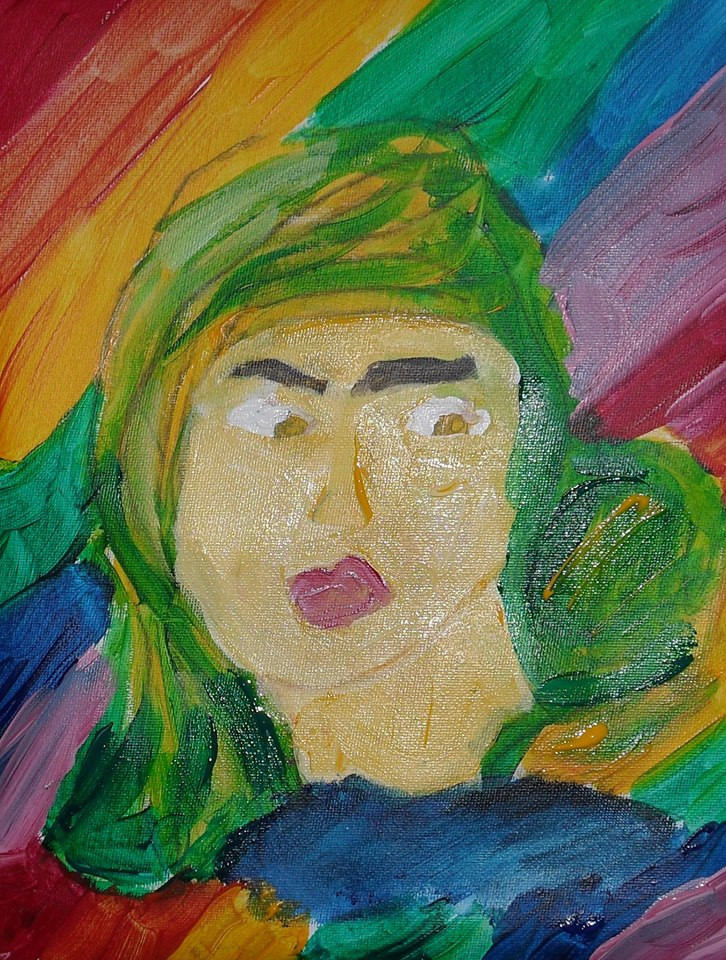
The Girl with the Green Hair after Michelangelo’s
The Delphic Sibyl, by Frøya Smith

One miserable night, when the rain pelted against the soil, Zephyr flew overhead. A storm was coming. Tendrils of her breeze stretched over the land beneath her, feeling for asylum. She found it: a cave off in the distance, clinging to the side of a mountain and cramped in size. It would do—though something was not as it should be. From the depths of the cave’s mouth, emerged a faint glow, flickering and feeble. She hastened her pace in pursuit of refuge and intrigued by the dying light. As Zephyr approached the mouth of the cave, she realised the light was a dwindling fire, his flames no longer dancing, his life waning.

“Hello?” called Zephyr, unsure if the fire would be able to return her greeting. He did not respond. “Are you alright?” she inquired. It was a rhetorical question but what else was there to ask?

The fire gestured slightly, his flames moving side to side, in what was clearly a “no.” Zephyr rushed to his side. Using her powers, her howling and fiendish gales, the kind of wind she was created to be, she summoned kindling from the forest. Small branches and twigs flew toward the cave, spinning through the air at a treacherous speed. They sung through the ether, hurling into the cave, to finally rest amid the fire’s embers. In a matter of seconds, they caught ablaze, sparks flying in a fit of spirit. Life returned to the fire, his flames roared and live coals crackled, caught in the wake of Zephyr’s mighty wind.

“Alive. I’m alive again. How? Why…?” He spoke in undertones, his voice trailing off as he interrupted himself. For a moment the two sat in silence. “You saved me.”

“Indeed I did.”

“I don’t understand.” He knew he should be dead. And yet here he was.

“Well, let me introduce myself, as you clearly aren’t going to.” The fire gaped at Zephyr. This stranger had just saved his life but she acted as though it were nothing. “They might call me the mistress of mayhem, the queen of the sky or the bringer of the windswept. But you may call me Zephyr, gentle breeze of the west.”

The fire stumbled over his words. “I, uh, name is, that is to say, I mean….”

“Out with it, will you?”

“Inferno. My name is Inferno.” No longer stammering, Inferno spoke softly. “Thank you. Just…. Thank you. Words cannot express the gratitude I feel towards you. You saved me from a treacherous fate, a painful death I would have endured alone. Thank you, Zephyr, mistress of mayhem, bringer of the windswept and gentle breeze of the west. I am forever in your debt.”

“You forgot queen of the sky.”

“What?”

“It’s Zephyr, mistress of mayhem, queen of the sky, bringer of the windswept and gentle breeze of the west. You forgot queen of the sky.”

“Are you kidding?” Inferno screeched at this quarrelsome wind’s ability to infuriate. “I just thanked you for saving my life! And all you can say is that I forgot part of your title?”

A playful smile danced on Zephyr’s lips. This was the Poltergeist of a wind that most are familiar with. “I did just save your life. You should be more grateful.”

Inferno paused, considering his position. The wind did have a point. His flames turned a rosy red, as he blushed. “I’m sorry,” he said.

“It’s okay. I was being a pain,” said Zephyr.

“So was I.”

The two stared at each other then burst out in laughter. Zephyr’s sides shook as she laughed and her winds rushed through Inferno.

“Ahhhh!” He screeched in pain and swiped at her breezes, trying to push them away. Zephyr didn’t know what she had done. “You will kill me if you don’t watch,” he wheezed. “I am a fragile force, formidable, yet fragile. I can be broken by wind, rain and earth.”

Zephyr didn’t understand, she’d never met anyone opposed to her breezes, but then she hadn’t met that many creatures.

“It’s all about power and how it is used,” Inferno continued. “Who has it and who wants to take it. You have power to destroy or sustain. This is your choice.”

Zephyr listened. Inferno’s words brought forth deep questions and she searched her mind for answers. She realised that if she let down her guard, if she let her winds fall astray, she could hurt him. Zephyr had never felt this way before: All her life, she had been cold; now she felt warmth.

Light from the clearing skies shone into the cave. The ether was exposed and stars illuminated Zephyr’s shimmering form. Inferno watched as her breezes swirled in midair but at the same time hardly moved at all. He gasped.

“What?” Zephyr asked, fearing he was still angry.

“You’re shining,” he said, “like stardust.” And Inferno’s flames danced in the moon’s glow.

#

Related reading: “Uranium” by Elise Marcella Godfrey

Gary Gets Angry Sometimes

This entry was posted on by .

Gary can’t pronounce my name; at first he didn’t even try. I don’t think it’s because my name is “ethnic,” as he doesn’t remember my white co-workers’ names either. He calls us Smiley, Pinky, and Blue Eyes, which makes us feel like 1930s gangsters. I call him Helmet Guy because each day during drop-in hours, he rides a shiny red electric scooter down the street from his unit to the housing co-op office and he always leaves his matching helmet on during our conversations.

Gary is a dedicated maintenance volunteer in his housing co-operative. He knows a lot of things about a lot of things. And about a lot of people. He’s resourceful. For instance, one day I wished aloud for a microwave in the office because cold dal just doesn’t have the right texture. As he left, he casually mentioned that he’d keep an eye out. I went back to accounting to the City about how we use their subsidy money. Not two minutes later, Gary returned, speed-walking with microwave in hand. Brown eyes glinting with the score. Official business.

“Holy shit!” my co-worker and I cheered.

“See, I got one for ya. That guy across the street was just getting rid of it!” Only the inside dish and one bottom peg were missing, but microwaves still work when they’re slanted. Gary brought us a dish the next day, found somewhere else.

He knows about mould and doorknobs and furnaces and insulation from his time as a superintendent. He knows exactly which day the City picks up garbage and which day they pick up plastics and which day they pick up paper. They alternate garbage collection now but do compost weekly, to encourage more green bin use. When this was instituted last summer, it drove Gary to the brink of madness.

“Why can no one keep it straight?” he yelled one day in the office. “They should pick up garbage weekly like they usedta ‘cuz people put their compost in the garbage and then the garbage just sits there stinkin’.” I asked the City to deliver calendars listing the pick-up schedule to everyone in the co-op. It seems to have caught on now. Most of the time. Things take time to become part of the culture in a housing co-op, but when they do, they have “always been” how things work.

redbuildings-dyanhatanaka

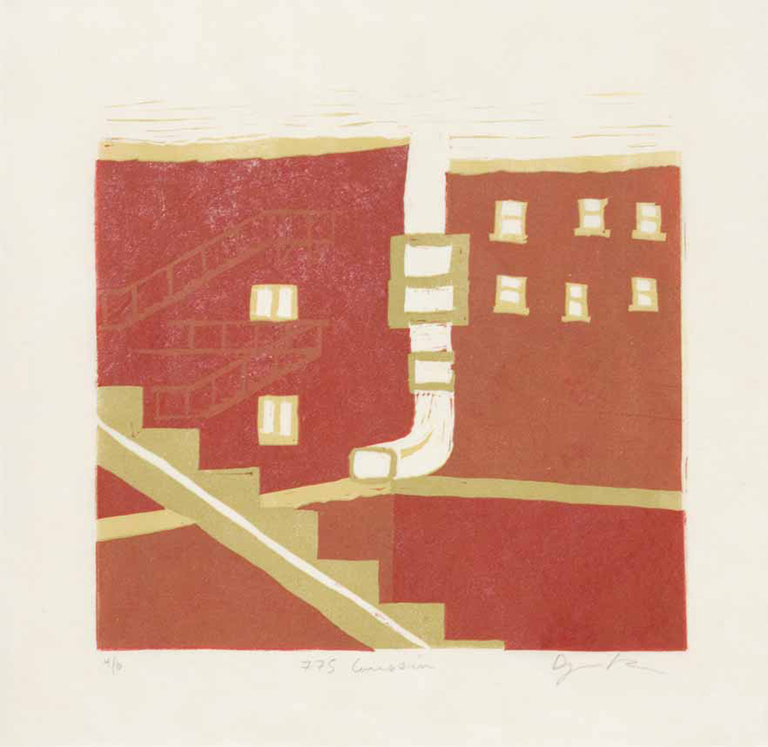
775 Concession by Dyan Hatanaka

Gary moves fast, he is a man of action, so this slow pace of behavioural change in the co-op doesn’t jive with him. He gets angry sometimes, and sometimes the reason is obvious but other times, he is not sure why. He has recurring nightmares about Skynet and apocalyptic visions of the office crumbling to rubble. He had lost his Star Trek uniform, and then he found it buried below the Beanie Baby collection that had to be thrown out after a bed-bug scare. One day after a pretty good discussion on aliens and atheism and terrorism, I asked him why he gets so stressed out.

“Maybe you shouldn’t drink ten cups of coffee a day,” I offered. He said that’s not the problem, it’s because he’s seen things. “Like what?” I asked, thinking of previous conversation topics.

“You wouldn’t want to know.”

Last weekend, we ran into each other in the neighbourhood and it would have been awkward not to walk together, as we were headed in the same direction. I didn’t want to talk about work on my time off, so I inquired after his wife. It had been their anniversary a few days prior. They had gone out for Chinese food and it was shit, he recounted.

“Aw, that sucks,” I said.

“Yeah, I told them about it, too.”

“I bet you did. Which anniversary were you celebrating?”

“You always ask the hard questions, Smiley! Don’t tell my wife!”

“Harhar.” I rolled my eyes.

After a silence, he said “Uhhh, four.” I was surprised; with his white hair and deep furrows I didn’t peg him for a newlywed. Then I learned that she was his second wife and they met while he was a superintendent. She’d lived in the building and he was so handy and they hit it off. His first wife? She had leukemia but didn’t know it. One day she woke up with a bad headache, went to the hospital, and died there. Within a week. That’s why Gary never goes to hospitals, even when he has angina attacks, because those places are doomed and those people don’t know what they’re doing.

Before we parted ways, he sighed and said, “You know Smiley, sometimes I used to get angry at my wife. I don’t know why. I really wish I didn’t.”

“I’m sorry Gary. I guess you can make it up by being good to the folks in your life now.”

“Oh I am.” He nodded vigorously. “See ya tomorrow!” The office isn’t open on weekends, but same same. The days go on.

Yesterday, Gary threatened again to “take the board down.” He was angry because the co-op’s board of directors had not yet approved a policy that allowed maintenance volunteers to have copies of master keys for every unit, in the case of an emergency while the office is closed. The board hadn’t even discussed the issue yet, since they meet monthly and Gary had brought it up only last week, but that’s not really the point. The point is, why is everything so inefficient? What would he do if, one day, there was a fire on a weekend? Why don’t people trust him?

“Well now, just wait. We can talk about this as a group at the monthly board meeting on Monday,” I said.

“They’re dragging their feet!” He replied loudly, pointing at me, eyebrows way up. This is a common refrain, along with “one hand doesn’t know what the other hand is doing” and “they don’t know if they’re comin’ or goin’.” It took me exactly 24 minutes from that moment to explain the process about keys listed in the co-op’s by-laws (“Only good for one thing, toilet paper!”).

After he calmed down, he apologized. “I’m sorry Zeela, I didn’t mean to take it out on you.” He’s recently started trying out my name. It’s kind of nice; Zeela is the nickname my favourite aunt gave me.

Gary gets angry sometimes. He doesn’t know where it comes from, but I can understand. For one thing, he hasn’t got much. Gary wouldn’t call himself poor; he gets by. I know that social assistance pays his rent at one of the City’s rare affordable housing units. The waiting list for a place like his is seven years. He won’t move anywhere, despite his frustrations with the co-op. He can’t. Almost everyone around him is stuck the same way—except for the folks who moved into the new condo buildings last week, and the people who frequent that hip new café that used to be a 2$ kabob place.

Gary gets angry sometimes because he’s got no ID. His birth certificate was in bad shape and when he went to get it replaced, the clerk at the desk punched a hole in it and gave him a form to fill in. This is an insurmountable task. Gary’s not the best reader because he didn’t finish school, because he got into “a bad scene” when he was a kid, because he got bumped from one foster home to the next, because he was taken away by Children’s Aid and split up from his siblings, because they all watched their dad kill their mom. He can’t get a birth certificate without listing his mom’s maiden name on the form, which he doesn’t remember because he was seven when she died and he never knew his family again.

Gary gets angry sometimes, like a lot of men I know whose childhoods have been fucked up. This doesn’t excuse his targeting of the board or his wife or me. He has been conditioned to be angry, to win with intimidation; he’s a scrapper, always has been, and he watches too much Fox News which makes him paranoid.

Sometimes, sometimes often, Gary is loving and patient and playful. He appreciates details. Like today, when he complimented me on the strength of the coffee I made for the meeting. “I’d like to take you with me when I go home on the spaceship,” he winked. And I might go, just to meet those few who live without gravity.

Three Keys

This entry was posted on by .

Years ago, my first real boss taught me two things. One. Listen to the boss. Two. Listen to your head and heart. In case of conflict between one and two, remember that God is watching; do what is right.

Today, my head is aching with the sandpaper of forced retail smiles and the fumes of polyurethane shoes. Against my heart, the jangle of three keys on a lanyard. Check shoes right and left, same size; scan barcode; enter payment; bag purchase; smile, “Thank you for shopping at Metropolis”; repeat.

My spine aches with ten-hour days and five-hour sleeps. While waiting for a Mastercard to ring through, I call my chiropractor’s office.

“The number you have reached is no longer in service.”

I leave a message on his cellphone. “Hello, this is Susan. I can’t get through to you. I am worried. I need you.”

Check shoes right left size barcode payment bag repeat.

As I hang up the phone, it rings. I juggle paperwork and small change, tuck the phone against my shoulder.

It’s my boss, calling to tell me he’s denying my request for a new ladder.

I remind him that already two of my salesgirls have been hurt from falling off the store’s broken and wobbly ladder.

He tells me that obviously I need to train my staff on proper use of a ladder. And furthermore, if my parttimer refuses to use the vacuum cleaner because it spits smoke and smells like burning flesh, instead of requesting a new vacuum cleaner I should get a new parttimer.

A little boy tugs on my pants leg. “Lady, how old are you?”

I tell him that today, I am really old.

He asks why I have green hair.

I tell him you are what you eat, and I eat a lot of broccoli.

Right left size barcode payment bag repeat.

I balance on a floor slippery with a layer of plastic shopping bags, dropped pennies, and till receipts as I headcount the lineup of customers and hand a lady her purchases.

She clicks her tongue at my wrist braces and Band-Aid fingers and asks if I am working alone again.

Before I can answer, the phone rings.

It’s my boss, wanting to know why I wasn’t working yesterday.

I tell him it was my day off.

He says that is irrelevant; there is work to be done.

He says that contrary to my request, the store’s carpet does not in fact need to be replaced.

After too many months of arguing, I am not concerned with watching my fucking language, so I remind him that my carpets are saturated with shit from a burst sewage pipe.

chosen

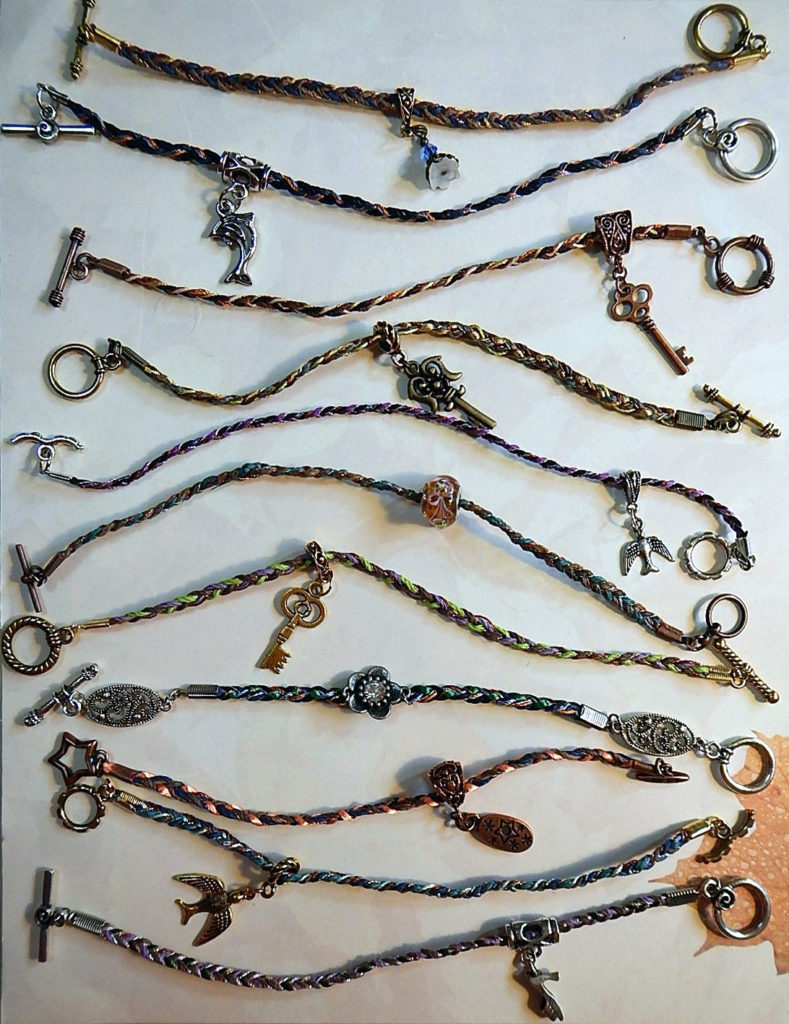
Chosen by Jan Jenkins

My customer looks horrified and scurries out the door.

Right left size barcode payment bag smile repeat.

Little boy tugs on my pants leg and asks how many earrings I have, and how I got them through my ears.

I tell him about a million, maybe more, and most of them were done with a big needle.

He looks impressed.

I tell him two of them were done with a gun.

He looks horrified.

A customer counts out pennies on my glass countertop. I pretend to watch, but really I am counting the reflections of burnt-out lightbulbs in the ceiling above me and weighing the consequences of my bosses’ wrath versus the logistics of climbing a broken ladder balanced on a shitstained floor with both hands bandaged and six months of five hour’s sleep to change four damn lightbulbs.

The phone rings. It’s my boss again. I can’t hear what he is saying, but it sounds like I am wrong again. I say, “We appear to have a bad connection. I can’t understand you,” and hang up.

Little boy tugs on my pants leg and asks if I am really really old, or if I’m just pretending to be.

He stands on his father’s toes and says, “Daddy, hurry up. The store’s closing and we’re gonna get locked in. This isn’t a good place to spend the night.”

I do not tell him I know from experience he is right. Instead, I lean over the counter and stagewhisper, “There is always a way out. I have a magic key to the magic door.”

He glares at me skeptically. There is no such thing as magic.

I pull my lanyard off over my head and hand it to him, keys jangling. “Have you ever seen a key like this one?”

He turns in a circle, counting keys, counting doors. One for the front door, one for the back. And one square and pockmarked, heavy and exotic, no door in sight.

Right left size barcode payment bag smile.

Wide-eyed, he returns my keys in solemn outstretched hands and whispers, “There really is a magic door.”

The phone rings. “Thank you for calling Metropolis.”

“This is a message from Telus Mobility. The following voicemail message is undeliverable: ‘Hello, this is Susan. I can’t get through to you. I am worried. I need you.’”

I lock the door behind the last customer and wave through the glass. The phone is ringing.

One. Listen to the boss. Two. Listen to your head and heart.

My head is full of sandpaper smiles and the fumes of cheap shoes. Against my heart, three keys jangle: one for the front door, one for the back, one for the bank deposit box. God is watching; do what is right. There is always a way out.

An earlier version of “Three Keys” appeared in the anthology Raising Lilly Ledbetter: Women Poets Occupy the Workspace. Lost Horse Press, 2015.