Archives

Five Pounds of Yellow Onions

This entry was posted on by .

Five pounds of yellow onions sit beside my cutting board. I hold a large dull chef’s knife. The cutting board is wooden and scored by years of use—a haven for E. coli, surely. The alternative is one of the large plastic boards, also rutted by use. Which is the dangerous one: wood or plastic? I don’t remember and there is no wifi here at Hope Kitchen.

My task is to chop onions, sorting through the pile for spots of mold and “squishy bits.” Because I wear glasses, the kitchen wisdom is that I will not be reduced to tears while I sort and chop. The cooks want as much as I can salvage, for the soups, the meatloaf, and the salads. While I work, Shelley brings me another two or three pounds of onions found at the bottom of a box of vegetables donated by the Co-Op.

At least now I have an explanation for tears.

After Roger died, I discovered I couldn’t cook. I did not know how to make soup, stew, paella, rice pilaf, stir fry, potato omelettes. He cooked these meals. When we knew he was dying, he asked me to promise I would prepare, cook, and eat “proper” meals every evening. I promised. Of all the promises I made during the last six months of his life—to ensure he was dead when they cremated him; to burn his gi; to sell his dress blues; to save his medals for our children; to read War and Peace; to keep his ka-bar—promising to cook a proper meal was the least of my worries.

After the first shock, when my life without my partner of thirty-five years began, I discovered among many harsh discoveries—I couldn’t start the chain saw—that I was clueless in the kitchen. I found jars of sauerkraut, hot sauce, raisins, a tiny foil slip of Spanish saffron, his favourite Uncle Ben’s converted rice, smoked paprika, packages of frozen chorizo. I did not know what to do with any of it. I did not know how to cook the meals he made for us over the years. His recipes were in his head, departed with him. Recipes on the internet did not yield the tastes, the smells, the textures of the stews and soups he had produced. I didn’t feel like eating anything I cooked.

I had to learn to cook to keep my promise to my dead husband.

I fetched up our community soup kitchen, where hot meals were prepared and served at 12:30 three days a week. When I called the coordinator to volunteer, she asked me about my specialties and I replied, “I can do what I’m told.” She assigned me to the Monday crew. I arrived for my first stint three months after Roger died, so stunned with grief I was speechless and often motionless. I had to be escorted to the grocery store, or I would forget what I was looking for and leave with random items, such as popcorn.

I am sure the Monday crew were hoping for someone with experience and skills. They got me instead. I remember the lead hands, Michael and MaryAnn, looking with interest turning to apprehension when I appeared in the doorway asking if they needed any help. “What’s your specialty,” I was asked again. I looked around the large, ramshackle commercial kitchen, figuring “oatmeal porridge” was not the answer.

“I do what I’m told,” I replied. “I can also peel and chop.”

“Can you open jar lids?” they said, eyeing my stocky late-sixties body.

“Yes.”

Michael waved me forward with his formidable chef’s knife. “Put on a hat and apron. Wash your hands. Don’t sneeze into anything.”

And we laughed, me with my pathetic imitation of person who is not so overwhelmed with grief she can’t breathe.

It became obvious I was not being modest. I didn’t know how to do anything. Chopping enough carrots for a soup to feed forty, asked to cut them in coins, I produced cubes. Prepping ten pounds of broccoli into florets too large to cook quickly in the stir fry. Cutting the bad bits out of eight red and orange peppers and missing the labels. Salvaging “vine-ripe” tomatoes so moldy they poisoned the pasta sauce. None of the peelers worked. I couldn’t get any of the can-openers to open cans. Every knife was dull except the set Michael brought to the kitchen every week, which we guarded with our lives.

I chopped. Not quickly or efficiently. For weeks, every Monday at ten, I arrived and chopped. Onions. Potatoes. Celery. Carrots. Turnips. Parsnips. Cabbage. Apples. I did not have much to say. I suspect someone told Michael and MaryAnn I was a new widow, and while they understood, they did not mollycoddle me. If I started leaking tears, no one rushed to rescue me.
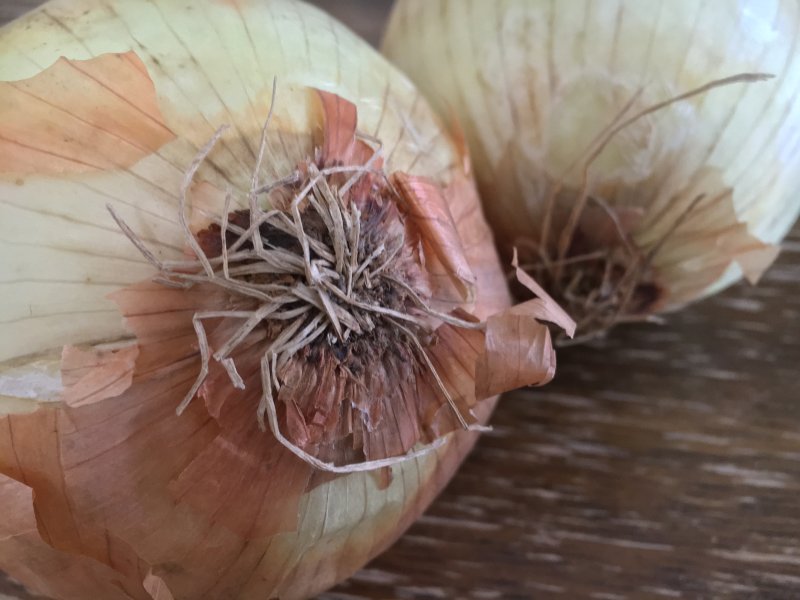
 

Photo of spanish onions

Sweet Spanish by Shirley Harshenin


Our local radio station DJ played music for us. Michael, a musician as well as a cook with years of experience, would heckle the play lists. I tore up bread for his bread puddings, prepared apples and plums for cobblers, formed hamburger into meatballs, cracked eggs, sifted flour.

When there was nothing else I could chop, I washed prep pans, stainless steel bowls, and the massive cauldrons that accumulate in a commercial kitchen. I cleaned the fridges and freezers, opened unlabelled jars and peered into mysterious plastic buckets, sorted vegetables, inspected packages and cans for best-before dates, set rat traps.

While I did what I was told, I also listened. Michael and MaryAnn would inspect the boxes of surplus produce from the Co-op, our only grocery store, discuss what to make with what we had, and do it. It was magic, to make something out of not enough. At ten o’clock they would be looking into the boxes and at 12:30 we had two mains, two soups, side dishes, salad, and dessert. My talent for finding random things in the fridges began to come in handy. We rarely had enough of anything. Every meal was an improvisation. Making do. Without the essentials. Such as husbands.

Early in the morning, men would start the fire in the wood stove in the dining hall, which was otherwise unheated, put on the coffee, and ask about milk and canned milk, sending me into one of the fridges to see what hadn’t curdled. Shortly after ten, men and women would come in, seeking warmth, and I would hear their voices. Sometimes there would be bursts of laughter and I would look up, bewildered, wondering what anyone could find to laugh about.

When serving time came, we lifted large trays onto the counter, Michael and MaryAnn served, and I hung back ladling soup. Those coming for a meal lined up, patient and expectant. Some had not eaten since their meal on Friday afternoon. After about ten minutes, “so they won’t ruin their meal,” I would carry the dessert into the dining hall. I couldn’t look at anyone. People smiled. Scowled. Argued with each other about conspiracies. Complained about their teeth if we served coleslaw. Complained about the free trade agreement if we served beef.

In our small community, many are inadequately housed and suffer food insecurity. That is city-planner talk for cold and hungry. Yet here they are always ready to lift down the chairs, carry the dishes back into the kitchen, make small talk, check on each other, pitch in. I wore my grief like a flag, but no one referred to it. Men and women gathered at the wood stove, coffee or tea in hand, in the simplicity of warmth, conversation, and a comfort-meal in the offing: thick soups, sausages, mashed potatoes with kale, carrots and turnip mashed, beets—buttered if we had it—vegetarian gravy or light cream sauce, and cookies. Warm food and a brief release from cold and damp. From sorrow.

I came to know, though no words were spoken, we all carried sorrow into that kitchen, set it down for a time, and then picked it up as we went back into the world. I went home to my waiting dogs after each Monday meal, apron wet, often with a yogurt container of soup, returning to the grief I set aside while I learned to cook.

Keeping my promise to the dead.
butcher’s hands

This entry was posted on by .

butcher’s hands

take three pounds of flesh and bone
cleave the block in two
trim the fat but leave the muscle
these hands must grip knives

use a boning blade
to fillet grooves between fingers
slice off the thumb tip
a destined loss

etch a jagged scar         across one broad palm
from middle finger to heel
a fate line
carve it as if this hand caught
a falling saw

score nicks and cuts on fingers        front and back
for rough texture
rub in porcine fat        palm and back
for softness

purge the thin red water
pour thick blood back into veins

keep these hands raw
for that sweet scent of autumn
of fresh rain mingling with decay

keep these hands raw
to deftly move        between the flesh of the dead
and that of the living

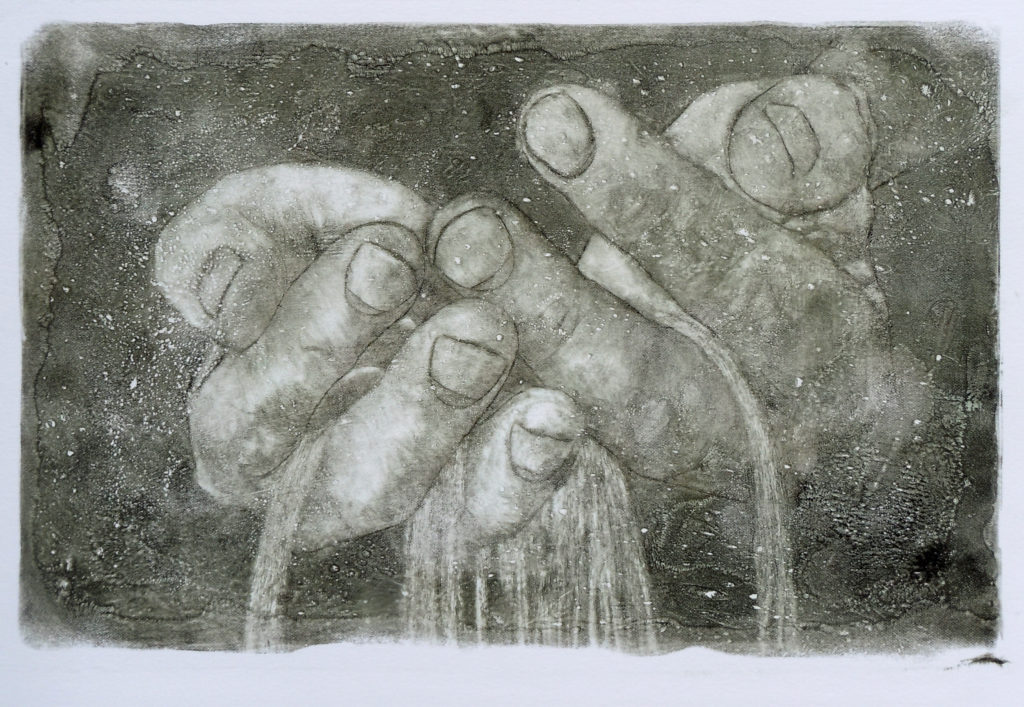
visual art (etching) showing sand running through hands

Time by Sally Warren

Food Fights

This entry was posted on by .

Bring Your Kid to Work Day and my Eighth Grader wanted to come to the cake factory with me. You can’t have kids on the plant floor when we are in operation, and to tell you the truth I didn’t want her to see me with a hairnet and scrubs on, sorting cupcakes into colours. We make sure the cakes go into the packages blue, pink, then yellow. It’s not exactly what I want her doing when she grows up. You stand on your feet the entire day, doing the same thing over and over while listening to the supervisor moaning how the line didn’t make its quotas. Halley thinks the plant is all Charlie and the Chocolate Factory, but she’d think different if she’d stood for a shift smoothing chocolate icing onto cream eclairs one by one.

Best I could do for Take Your Kid day was buy a box of ‘seconds’ cakes from the factory store for Halley’s class and send her to my friend Norma’s café for the day. She wiped the tables down and folded napkins and drank so many milkshakes she couldn’t eat dinner.

Halley would probably hate this place anyway. That heavy, floury sweetness and the hissing of the machines and the hairnet elastic itching your neck. Plus, she’s a real social kid. We work in teams on the lines, but we’re spread out and can’t talk to each other. We’ll use hand signals if we’ve got a problem—like we need the machine slowed. You gotta concentrate super hard on what you’re doing. People think industrial food production is all automated lines and robots, but they still need workers. Women have nifty fingers, so my line is women except for Rob, who pours the icing into the spreader.

Even though we stand apart on the factory floor, we are a good team. We’ll pick up the slack for someone who’s not at their best. I can tell if a girl’s tired by how she holds her hands over the cakes on the conveyor belt. Sure and quick if she slept well, shaky and slow if the baby cried the whole night. There’s a way a woman’s belly settles into her hips when she’s been on her feet for six or seven hours that means she’s feeling it in her back. We know when one of the Bangladeshi girls gets bad news from home, too. Somehow the others tilt towards her, even though they’re spaced out eight feet.

I’d like Halley to meet the girls here one day. She’d get a kick out of them—we’ve got some characters. Tammy and Paula use body language a lot. Tammy is top of the line and Paula right at the end. Their relationship is rocky. If they’re fighting, they’ll sit at the table at lunch, elbows propped, and slant their heads together rigid as an A-frame, chowing down on their food like they’re tearing into each other’s throats. When everything’s good, they sit relaxed on opposite sides of the table and tease each other. Once they were having a tiff and Tammy turned up the production speed of the cakes bit by bit through the shift. Eventually cakes were piling up at Paula’s section and she’s flailing around all panicky, trying to work out why she can’t keep up. Wicked, that Tammy. That’s as bold as it gets for pranks on the line though. No one wants to lose their job.

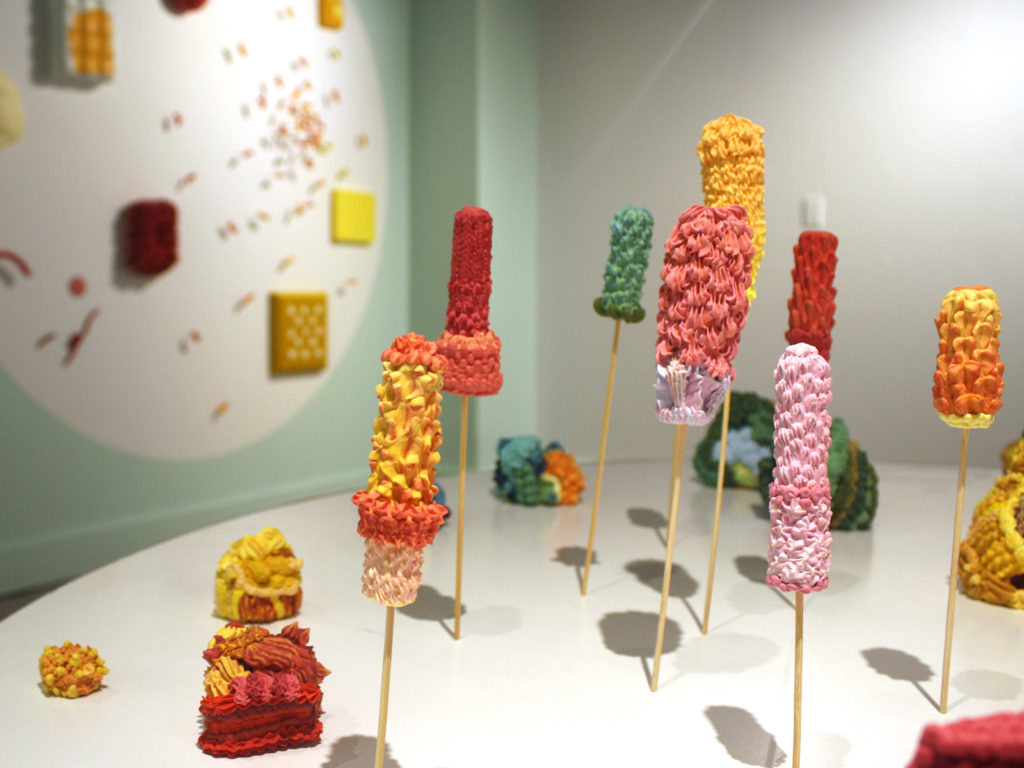
installation art showing colorful cake

On the Table (Dainties) by Aralia Maxwell


Then there’s tiny Joyce, mid-line and constantly glancing up and down it, checking, checking. I swear she knows the cake colours without looking down. She adjusts the machines and supervises the line. Been doing this for 35 years. Back in the day this was a hard place to work, according to her. No daylight or fresh air circulation, and the noise of the machinery was incredible. I guess we’re lucky to have big windows now. It’s bright and we don’t have to wear ear protection. There’s an outdoor relaxation area. The cafeteria’s clean and warm.

Joyce sticks up for her line. The Line Manager carped on about hairpins and earrings that Quality Control found dropped into the packages and glared at the Bangladeshis with their beautiful long hair. Joyce gathered up her five-foot-nothing and said management should get better hair coverings then. After, she reminded the ladies on the qt to leave their pretty jewellery at home. All the rest of us have short hair. I’ve been a single mom for eight years, no time for anything fancy. Halley could make it in management. She bosses me like crazy. Us line workers are literally the end of the line in the pecking order. Head Office issues orders and sends them to the Regional Directors, who push them on to the Line Managers, and they dump them on the Supervisors, who squeeze us line workers like toothpaste out of a tube.

Joyce may be a softy with her team, but she and her hubby go hammer and tongs. He’s retired. Joyce has two years left. They’re saving for a trailer in Florida. Joyce decided Jeff could make her lunch sandwiches every day since she did it for him for forty years. You can tell how they are getting along by the sandwiches he packs for her, and what she buys for him from the Seconds Shop. Most of us don’t eat what we buy at the shop—you lose the taste for sugar here—but it’s a big perk of the job. They sell anything slightly damaged or not quite up to standard at a deep discount. I get cakes, buns, tarts, all kinds of good stuff, for practically nothing for my mom and my friends. Jeff loves the sweets. The bigger he gets from eating them, the smaller he likes his treats. It used to be chocolate rolls and pound cake, but now he goes for those fancy little squares covered in ganache, and lately he’s been crazy about mini cherry tarts with whipped cream dabbed on top. But Joyce hasn’t bought him any for a bit on account of The Sandwich Wars.

At first, Jeff made Joyce these fantastic sandwiches. Thick whole wheat bread with layers of cold cuts and cheese, garnishes of pickles, and the best mayonnaise. We were all jealous. But then they had a big set-to. The next day it was an egg salad sandwich, the day after that bologna without ketchup. When she got a lobster roll one day, we joked that she got makeup sandwiches instead of makeup sex, but the next day she pulled a slice of Kraft cheese out of two pieces of thin white bread. Not good. Last Monday she opened her sandwich container, pulled apart the floppy bread slices, rocked back on her chair and laughed.

“What? What’d he put in it?” we asked.

“That’s what’s so funny. Nothing,” Joyce said.

“Nothing?”

She opened the sandwich in her neat little hands like a book. It was just two pieces of plain bread that looked like they’d been sucker-punched. Joyce slammed them down on the table and set off for the cafeteria line. She bought herself fish and chips and scarfed them, scowling the entire time. Storm brewing for sure.

Tuesday, she went to the Seconds Store at lunchtime and bought a tray of the cherry tarts Jeff loves. I watched her cut away the cellophane window of the box. It had a tear in it, that’s why the box was in Seconds.

“Made up with Jeff, did ya?”

“Huh.”

Something was up. Joyce carefully scooped the whipped cream off the top of each tart with a spoon and put it on a plate. Next, she took a spray can out of her bag and started reapplying cream on top of the cherry filling, so the tarts looked just like they did before. By this time, she had an audience standing around our table. Tammy and Paula were A for Anger, peering over Joyce’s shoulder. Other line workers started gathering to see what was going on. The Bangladeshis were whispering together with their hands over their mouths, and even Rob wandered over. Things were edgy, like a union meeting.

“I don’t get it, Joyce. Why are you taking the cream off and putting it back on? Don’t make no sense.”

She handed me the can and squinted up at me fit to burst while I read the label. It was men’s shaving cream. Next thing I knew, Tammy lunged right over the table, snatched the can from me, and sprayed it over Paula. Joyce burst out laughing like a steam release on the sealer machine, and suddenly it was complete chaos. Shaving cream schooshing, screams and giggles and the whole cafeteria tizzy with silliness while Jeff’s precious little cherry tarts sat still and red and perfect on the cafeteria table.

Maybe Halley should work here in the summers when she’s older. She’d learn a thing or two.

A Feast to Die For

This entry was posted on by .

Today, Amarjit was making Hardev’s favorite dishes. She wanted to make them perfect. She would prepare his favorites, masalah chicken with red and green peppers, lamb kebabs with yoghurt and mint, moong dhal, Aloo Gobi, rotis, and for dessert, she would spoil him with gulab jamuns. Peace offering.

Amarjit sautéed the onions, garlic, and ginger in the hissing oil in the frying pan. She looked at the washed pieces of chicken in the sinkah, the henand recalled her reaction at the butcher shop when the young man said, “Very good choice. Fresh young hen!” Amarjit started at the description. That was what Amro, her mother-in-law, had said about her all those years ago: “Just like a fresh young hen,” and cackled, showing her betel-stained lips.

Amarjit vividly remembered that rainy December in her village in Punjab. Barely sixteen, she was making chai for her father when the lazy afternoon was disrupted by the arrival of the foreigners from Canada. She heard her name lovingly called out by her father. With her dupatta covering her head, she barely raised her eyes to catch a glimpse of the smiling face of Amro and the leering look of the man, ten years older than Amarjit, that she was destined to marry. Just like that, her voiceless fate was sealed in the arranged marriage proposal. Those were her last days in Punjab before she became the wife of the rich Canadian wallah, Hardev.

“Lucky,” everyone in the bleak village had whispered, their eyes flashing with envy. “Going to Canada!”

Now Amarjit brushed her tears, still bitter, with the back of her hand and turned her attention to tossing the perfect proportion of pungent spices into the masalah chicken.

Twelve noon. Hardev banged the door open and thundered in, sitting down at the dining table, looking older than his sixty years. She noticed his deep wrinkles and bushy brows. With bulging but approving eyes, he surveyed the food she had slaved over all morning. Hardev piled his plate and noisily began shoving his mouth with pieces of roti wrapped around chicken, pausing to bite into the lamb kebabs. He noisily slurped the dhal from the bowl, scooped the cauliflower and potatoes with his fingers. A beast.



Illustration of a woman holding a tray of food

Food Plate by Ildiko Nova


Amarjit never ate with him. He complained she was too noisy. He complained she was eating too much. He complained she was eating too little. She just sat across from him and watched like a sentinel, noting each approval and recoiling at any dissatisfaction. Sitting back, Hardev pushed his plate away and said, “I knew that when I saw you in your father’s kitchen all those years ago, it was a good omen. You must have learned to cook from the gods.”

Amarjit could hardly believe her ears. Praises. Hurriedly, she waddled into the kitchen and brought out a big bowl of warm, fragrant gulab jamuns. His eyes widened in appreciation. He knew that she had been too busy all morning to have gotten into any mischief. “Acha. Wonderful,” he spat out. She glowed. This one day of praise was akin to months of bliss. Hardev washed his hands and left. No goodbye. No word.

With a sigh of relief, Amarjit cleaned up the mess, humming a Hindi movie tune. She silently savored Hardev’s praises. Thankful that the thali did not fly at her in unprovoked anger. No bitter words slammed into her gullet. Now, she looked forward to solitary bliss. First, she relaxed in the prayer room and chanted the beautiful scriptures from the Adi Granth that transported her to her father’s house where she sat at his feet as they prayed together. Then, she sang a hymn on her waja, turning her head towards heaven, forgetting her worldly sorrows.

Suddenly, the peaceful afternoon was shattered by the angry shrill of the telephone. Amarjit grabbed the receiver. For a few brief moments, it appeared that Amarjit had frozen into time itself. Her face drew a blank look, and her mouth kept gaping. There was not a single sound from her. When she put the phone down, she hung her head for a brief moment. Then she ambled into the kitchen.

She went to the leftover ball of atta and turned on the flame to heat up the pan. She slapped the atta between two palms and doused it in flour. She put it on the counter and deftly rolled it out to the size of a dessert plate. Again, she gingerly lifted the flattened roti and tossed it from one palm to the other before placing it on the hot black pan.

Amarjit watched as the brown spots emerged on the outer side, and she flipped it over as it puffed. With a dishcloth, she pressed the outermost sides of the roti, making sure all parts were nicely browned. She tossed the perfectly speckled roti onto her thali. She reached out for her homemade jar of mango achar on the counter and heaped an overflowing tablespoon onto the compartment next to her roti. Then, she opened the fridge door and took out the leftover bowl of fragrant chole and homemade creamy dhai that she had made the day before. Hardev had refused to have any because she had not made chicken to go with it; he had stormed out, as usual.

She never cared for the fancy food that Hardev craved and insisted that she cookall that never-ending preparation. Amarjit loved the simplicity of her village food: roti, chole, dhai, and achar. Divine. For the first time since she had arrived in Canada, Amarjit ate with gusto in Hardev’s house, their house. She savored every bite as if it were her first. Only when she had satiated her hunger did she finally allow herself to think about the phone call from the emergency room of the hospital barely ten minutes away. The caller told her that Hardev had collapsed in the parking lot of the shopping center. The voice on the other side of the phone whispered, “I’m sorry. It was a heart attack. Just like that. He died immediately. He did not suffer.” Could she please come down to the hospital and make the necessary arrangements?

With a deeply drawn sigh, she put on her sandals and decided to take a slow and leisurely walk to the hospital. She wondered if she would miss cooking.

The Lucky One

This entry was posted on by .

It’s your turn to prepare the sweet bread for the Christmas family gathering this year. Your mother used to take care of it, and her mother before her. But with those matriarchs gone the responsibility now falls to you, the eldest woman in the family. You’ve baked before: nutmeg cakes for potlucks, baklava for your husband’s birthday. But you’ve never done anything of this size and importance, and the task is daunting. You try to remember how your mother did it. You wish you took notes when you had the chance. In the end, it’s the power of your memory, your talent for improvisation, and the internet that come to your aid.

You begin by dissolving yeast and sugar in warm milk before adding melted butter. You beat five eggs and add them to the concoction, with flour, salt and ground mahleb. As you knead this mixture bits of it stick to your hands, leaving patches on the tips of your fingers and under your nails. When your arms feel sore you switch to using the stand mixer.

You put the dough in a well-oiled bowl and let it sit for an hour and a half until it doubles in size. You then lay it on a large pan and shape it. Your mother used to braid the dough, but you simply spread it out so it bakes into a slab the size of an extra-large pizza. You don’t have the time and patience to attempt anything else. As you work, you mentally prepare your retorts in case anyone comments on it.

Before placing the pan in the oven, you stick a toonie wrapped in aluminium foil inside the dough. This is the prize, the treasure every family member yearns to find. Encountering it means you will have good luck for the following year. It’s nothing but superstition, but deep down you believe it.


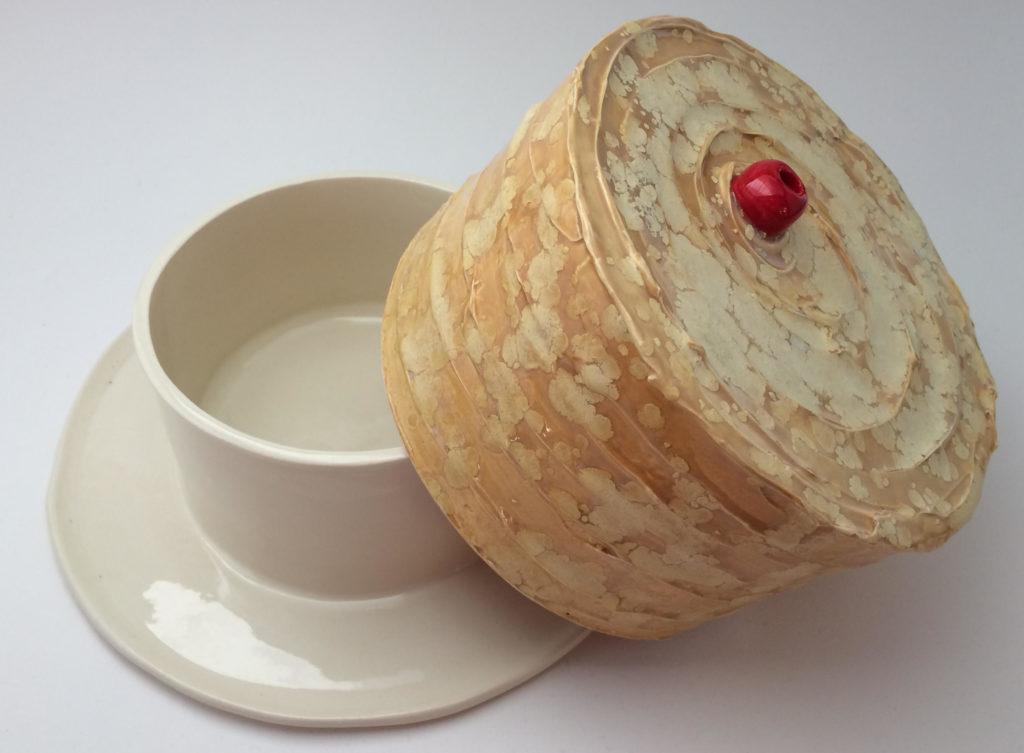
ceramic cake and cake stand

Cake by Marla Benton


The family rarely comments on the taste of the bread, its look or its texture. All that matters is what is to be found inside. You’ve never won the coin. Your mother did, four times. Her mother won it twice. You’ve never had that kind of luck, but maybe this year the coin will be yours. Your reward for your hard work.

You buckle under the sweet bread’s weight as you pull it from the oven. Once it cools down, you put it in a bag—any large bag will do, considering its size. When it’s time to leave, you ask your husband to help you carry it to the car. It takes up most of the backseat, and you listen to it slide and bump on the drive over to your cousin’s house.

You give your cousin a quick peck on the cheek when you arrive, then bypass everyone else on your way to the kitchen to set the pan on the counter. The sweet bread has its own distinguished place, away from the other dishes. There are exclaims of surprise, remarks of how big it is. These are followed by words of encouragement. They’re sure it turned out well. They’re grateful you took on the task of making it. They reassure you with rueful smiles that your mother would be proud.

The sweet bread is cut after the main course, but right before dessert. You wield the knife, since this behemoth is deemed your responsibility. You try to cut it in evenly-sized slices, but some pieces turn out bigger than others. If your relatives notice, they’re kind enough not to comment. In accordance with tradition, the youngest picks their piece first, then each person has their turn in ascending order of age. You’re second to last—you remember when you used to be one of the first.

Like everyone else, you break your piece in half, then in smaller bits to search for the coin. You don’t know where it is even though you planted it, because it shifts position as the dough bakes and rises. You took your best guess when selecting your piece, but in the end you chose wrongly. This year, your brother-in-law is the winner. He triumphantly holds up the foil-wrapped coin, crumbs drifting to the table like dust motes. It’s his third time winning. Three years of good luck.

A part of you bristles at the unfairness of it all, but you say nothing. You swat the feeling away, telling yourself you’re being a sore loser. Your time will come. You swallow your disappointment and join the others in congratulating your brother-in-law.

The bread is rarely eaten the day of the celebration. After the coin is found, the rest of it is packed away, to be either stashed into freezers or eaten for breakfast the following morning. The festivities resume, and conversations pick up where they left off. The lucky one fingers the coin tucked safely away in his pocket. You know he will hide it in a drawer when he gets home so he doesn’t accidentally spend it. You often joke that you would lose it, and it’s probably for the best that you never win.

You feel giddy in this moment. A weight lifts off your shoulders while a pit forms in your stomach—all your hard work vanished in an instant. But your attempt was seemingly a success, and the tension drifts out of you like smoke on a breeze. Everyone had a good time. You have done your family proud. That in itself is a reward.

Even so, you hope you’ll win the coin next year.