Archives

Ten Lessons I Learned from the Salish Sea

This entry was posted on by .

1. greet the water
plunge your hands under the surface, fingers dancing in the tide
remember it like an old friend
like a beginning
like a home
speak your name to this place
listen for its response
say thank you

2. say thank you again

3. know that the place is here, and the time is now
if the midnight algae is glowing in the waves
dive in, freedom first
grab your friends, grab each other’s hands
there are galaxies underwater
do not hesitate
there will never be a moment like this again
but there will be many moments
eat them up

4. eat everything
forget that
eat what you can identify
and if you don’t know what it is
don’t eat it
this place can heal you
so learn the plants, learn the medicines, learn the liquorice fern rhizome
and learn that rhizomes are underground horizontal stems
seek a mentor, find a book, remember

5. this place will hold you, do not hold back
do not hide from the big emotions
if you are afraid you will be swept away in their currents
look for bull kelp
hold on tight
you may sway, you might rise and fall
but you will stay anchored
listen to the tiny emotions
lay down next to them in the grass
watch them bloom
be tender, take care
allow yourself to be held

6. sleep outside
drink the milky way before bed
count the stars to fall asleep
wake up early with the birds
sip the cold air
watch your breath meet the fog
wash your face with the morning dew

7. be quiet

8. accept change
accept that you will be changed, will cause change
there will be many portals to go through
dynamic interfaces of land and sea, hopes and fears, dances and stillness
every step ripples outwards
everything you touch reacts
accept that you will find pieces of yourself nestled between stone and sea glass
rivers will erode new pathways inside you
flow, all things change

9. live
let your spirit soar with ravens in the hemlock treetops
jump with orcas in the seafoam
live
find community, find your people, find yourself
live knowing you were not the first here
nor will you be the last
beings have used this land, loved this land
since time immemorial
each layer of history a harmony of the song this place sings forever
sing along
live
live like you are going to stay

10. stay

Photo showing a women sitting on a tree trunk in dense forest.

Still frame from “Ten Lessons” by Makaila Wenezenki

Watch Makaila’s full video of “Ten Lessons” on YouTube or listen to the audio below.

Words > Stories > Action

This entry was posted on by .

RE Nature: Concerning nature.
Renature: To restore to original condition.

We began plans for this issue of Understorey Magazine over a year ago, in August and September of 2018. It seems like a long time has passed.

At that time, few people knew of Greta Thunberg, fewer had attended a Climate Strike. Extinction Rebellion did not exist. The IPCC had yet to release their game-changing report, the one that warned we had only twelve years to take serious action against climate change.

In the past year, it seems, our awareness has transformed. Even our language has changed. It is now commonplace to talk of the “climate crisis” or the “climate emergency.”

But while global awareness has recently surged, the situation itself—warming, melting, acidification—is not new at all. Half a century ago, back in the 1970s, Exxon (and probably others) accurately predicted and then actively buried the fact that burning fossil fuels would rapidly warm the planet. A quarter of a century ago, in 1992, nations met in Rio to sign the UN Framework Convention on Climate Change. The goal was to limit “dangerous anthropogenic interference” with the climate. And decades ago, Indigenous people, especially those in the Arctic, sounded the alarm, told us we are not doing enough. They have been living in a changed climate ever since.

The climate crisis has been called a “long emergency.” But things are speeding up—and it’s not just the climate we have to worry about. The UN has also issued dire, unprecedented warnings about species extinction. Some researchers say there are in fact nine planetary limits or boundaries; global temperature and species extinction only two of them. They say we have already transgressed four of those boundaries. Without a radical change of direction, and soon, we will not survive as a species.

So….

Why write poetry? Why write fiction or memoir? Why take time to paint or weave or sketch? Even for one morning, why ponder stories when so much is at stake?

A guiding principle of Understorey Magazine is that stories inspire change. Unearthing stories that are not often or not widely shared can build bonds, strengthen community, fuel action. This is why, for 17 issues now, we have chosen themes that are vital to our everyday lives but tend to stay hidden under the surface of everyday conversation: age, blood, service, motherhood, and more. In telling these stories, we announce: This has happened. This is happening—to me, to us. Stories help move us forward, they urge the question: Now what?

But as author and environmental journalist Linda Pannozzo recently reminded me, both through her writing and in person, stories can also blind us. Told over and over, stories can mire us in “truths” that were never truths, ideas that never made any sense at all. Patriarchy, for instance. Or more generally, dominion. Terra nullius. Nature’s bounty. Limitless economic growth. Whose stories are these? How are they sustained? What happens if we erase them and tell something new?

In his essential book, The Truth about Stories, Thomas King says: “The truth about stories is that that’s all we are.” Think about this for a moment. We are the stories we tell. We become the stories we tell.

In this issue of Understorey Magazine, our contributors do not lord over nature’s bounty. Nor do they stand aside in reverence or awe. They do not separate themselves at all—from nature, or from a nature in crisis. “We are accomplices,” writes Anna Quon, capturing in three words an alternate and necessary story.

Mi’kmaw author Tiffany Morris asks about specific words and definitions: “there is not a word in every language for / extinction event,” she writes. What does it mean that the English-speaking colonial world now requires this term?

Many of our contributors look at the storytellers themselves. “Auteur theory is for the birds,” writes Tanis MacDonald, forcing us to question who is penning the stories we tell of nature. Who believes they are directing the plot? And what about those relegated to the wings? Those who are homeless, endangered, living precariously, already suffering, or already lost? How will their stories shape who we are as a society and a species?

Of course, we have to do more than sit and write. We also have to rally crowds, get our hands dirty, listen to the too-busy and the still-doubtful. And, yes, we must pause to acknowledge the absolute wonder and our place in it. But creating a new narrative requires brave new storytellers, as well as a place to tell their stories.

So we invite you to read, think, comment, share, and act—RE Nature.

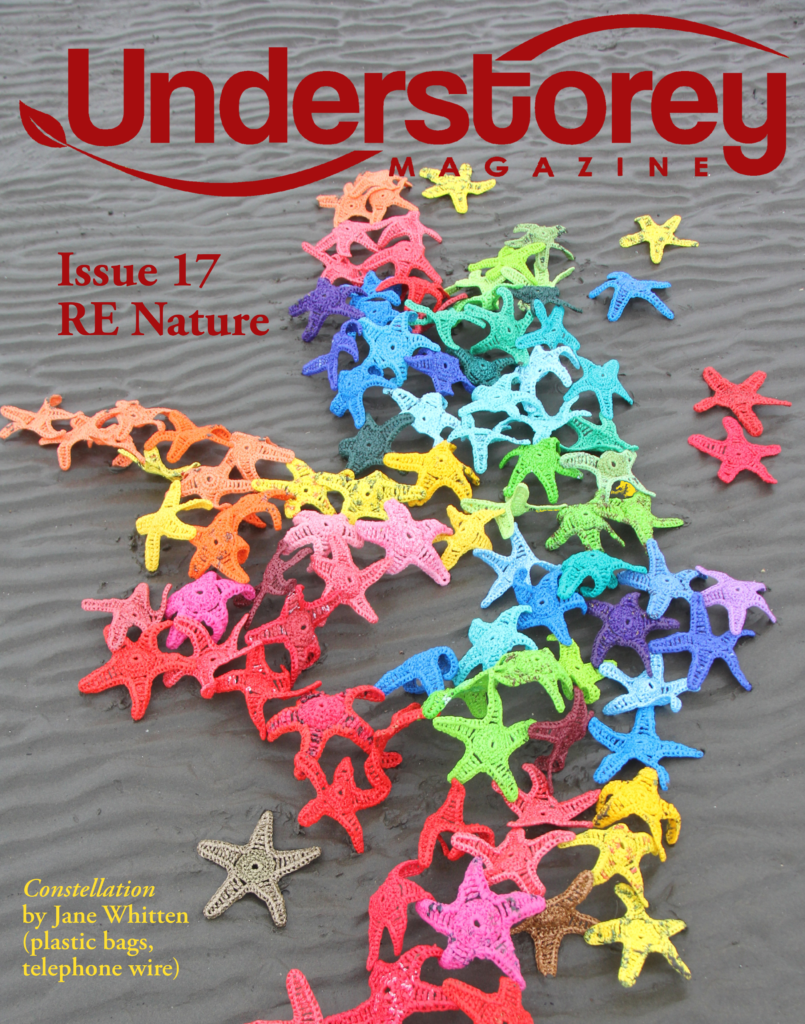
Thank you to all of our writers and visual artists, and to all who submitted work. We could not publish everything but we appreciated and learned from everything we read. Special thanks to our poetry editor, Rachel Edmonds, who vetted submissions and provided editorial comments, all while undergoing chemotherapy and planning a wedding. And a big thank you to our cover artist, Jane Whitten. Jane creates woven art with non-traditional but sadly abundant materials such as discarded plastic bags, telephone wire, and fishing line. The resulting portrayal of natural beauty and nature in crisis suggests not only where we now stand in the world, but several possible future stories.


The cover for Understorey Magazine Issue 17 showing sea stars created by Jane Whitten with plastic bags and telephone wire.

The Oriole

This entry was posted on by .

The Oriole

Beyond lit panes, a flimsy fragile feathered thing
wavers on the highest bough, her scant weight teetering

above a paisley floor stippled with shadow and trembling
light. The bird trills as though her heart will fly

through gilded ribs of a gold chest, shatter
like a wave on a stony shore: wide open.

In here, the news stories flip by, tired cards thumbed
on an old Rolodex file. So quick, so awful I can hardly bear

view or listen. Now I’m watching the grizzled
trees in northern BC, scarecrow effigies ignited. Flames

scissor and smoke cuts a warning cloud in the tarnished
muslin sky. I imagine the elk frantic, the rabbits frenzied

and turn it off before the next reel can take hold. Through
the open window the ethereal lilting chords pour hymn

notes, rising to dusk’s flannel rafters. Don’t ask me why
I picture the listing Titanic: the brave orchestra playing, focused

and dogged. I see icy water breaching the deck, black
all-seeing portholes sobbing into a frozen sea. I watch it curling

back in a raging wave swollen with the last lost melodies. All that
remains is the waiting, the burst of flotsam on a distant dissolving shore.

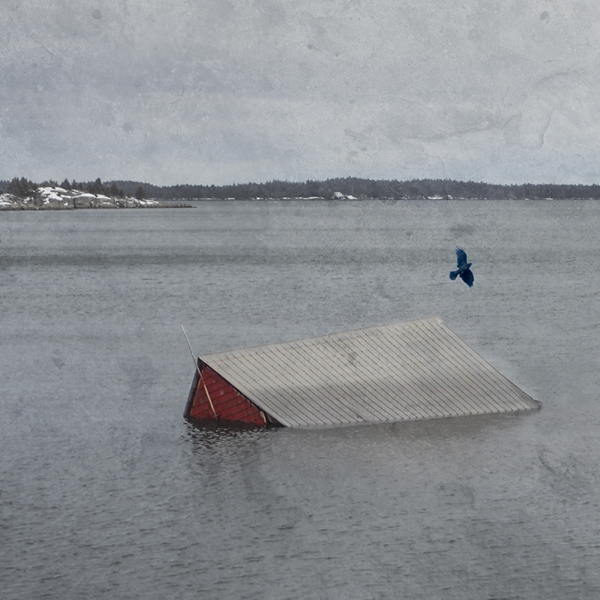
Photograph by Sara Harley showing a building submerged in water and one bird flying overhead.

Rising by Sara Harley

Future

This entry was posted on by .

we saw the future before we lived it,
we learned new definitions of the word “apocalypse”
we screamed chants that rang out like machine gun fire
when we pulled the trigger of our lips,
gun cocked and ready,
like my tongue; cocked and ready.
fire, aim, steady —
the message can no longer get lost in translation,
the message is known and spans every nation,
“hey hey, hey ho, climate change has got to go.”

my father was apprehensive about raising a family
he didn’t want to have to take my hand as we looked out upon a dying world and say:
“you know? all of this will be yours some day.”
my mother knew she wanted to have a family,
she’d show me our broken world and then on bended knee would say:
“i know it’s not going to be easy my love, but look at what you see,
you can change this darling, you are the key.”

because the future is a storage locker our grandparents didn’t know how to unpack,
emissions, fumes and our impending doom.
the future is a skipping record that can only play one track,
extinction, humanity and our incongruity.
the future is empty words and the promises that were made but not kept,
ghosts that haunt the halls of the burning house we stopped calling home,
the future is the secrets that are again and again swept,
underneath the carpet and yet they hang in the air with the every growing carbon.

a million footfalls echo as one,
a million heartbeats sound at once,
as through our bodies resound the pounding of war drums,
a united voice thunders:
“hey hey, hey ho, climate change has got to go,
hey hey, hey ho, climate change has got to go,
hey hey, hey ho, climate change has got to go.”

we cannot be stopped,
for we are unstoppable,
our movement is momentous,
our movement is colossal,
we are the ocean that brings the tides of change,
we are the young who bring new voices to the table again,
we are the message and the mouthpiece our voice knows no range,
we are the forests will herald fresh growth,
we are the future,
not the one that you know.

Listen to Katia Bannister performing “Future” at the Global Climate Strike on September 20, 2019:

Two Poems

This entry was posted on by .

All the Words for Blue

                                                                   One astronaut returned
   held
the moon   and   the unknown                                        wanting
      one small safe place in space
         Earth        perfect                                       oceans
                     conditions 
                   for human living

Earth will survive, the astronauts say. 
                                                                   to tell us
It’s us. We are
flimsy, fragile, perhaps too soon
                           gone                                   every word
                       from this                                 for
                                                                beauty         
                    our only home.
                                                             all  the    words   for   blue.

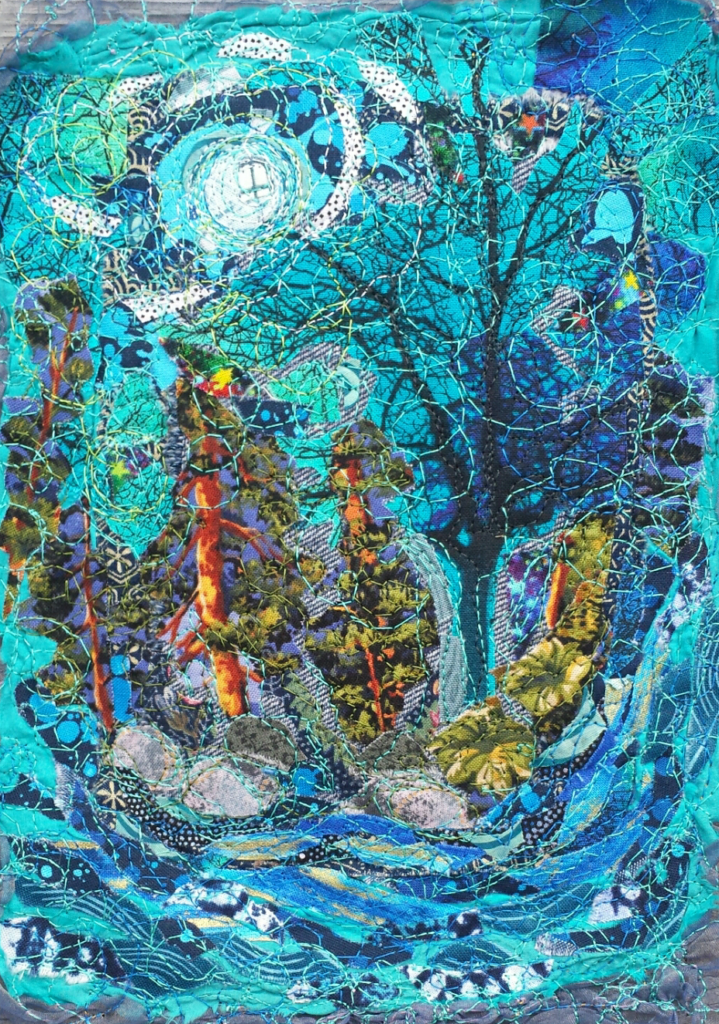
Textile art by Rachel Ryan showing trees surrounded by blue.

Morning Moon by Rachel Ryan (fabric collage)

At the Tree Zoo, Mesachie Lake, British Columbia

Big numbers                spray painted             eye level blue
                       across their horned bark
tall trees

I lean
all my weight        slight        close to earth
into

a vast living wall          long drips fall slow
                              in      my mouth        open      raised

green cloud of needle and branch

Grow feathers        spread wings           be eagle
             see mountains        snow in high reaches
                      these giant firs        numbered
                                   tree zoo 

It is late, I am tired, the motel bed will do. Under car wheels,
the road whines slick, nearly frozen. The radio, CBC.
“Can you use different words?” asks the host. Snow slides in clots
down the windshield, car fan on defrost set high, wiper blades
can’t do enough. 

The guest is a lawyer,  a woman,  Indigenous
                  even-voiced, firm, implacable         

in my ears, in the storm, she repeats

Apocalypse           Water              Hypoxia               Trees.