Archives

Ruby

This entry was posted on by .

I need you to listen now, just listen. I’m going to tell you the story of how we survived the August blizzard. We both need to know this story so that we remember: you and I are survivors.

Before the storm, when you were still a brand-new person, in those weeks of late summer when the barometric pressure was high and the sky clear blue, we stayed mainly in the big park where there’s a real forest and a river. The afternoons were so warm, and the nights cool for sleeping. There was plenty to eat—wild carrots and cattails and so many blackberries. And the cook at the canteen always gave me the leftover soup. Your cheeks got chubby and rosy and every day you seemed to feel a little heavier in my arms.

When the snow started, falling straight down, I heard people saying how pretty it looked. Later, when the flowers were all broken and bent and covered over, the wind came. The snow on the ground was too heavy for the wind to pick up, but it drove the falling snow sideways, slamming it into faces and bodies and cars and buildings.

I didn’t plan for us to go to the mall. I was trying to get to the little adobe house at the community garden across the street from the mall. It’s squat and sturdy, close to the ground. Less likely to blow away or be bashed in by a falling tree. I thought if I could block the doors and windows with wood and snow we could get enough shelter from the wind.

It took us over an hour to walk there. We’d have been faster if we’d left my cart behind, but I couldn’t do that. A few times, I had to hold on to the cart with both hands to keep myself from being blown away. You were safely tucked into my big coat. By the time we finally made it to the garden, I knew we needed to be inside a real building.

I don’t like the mall. I’ve never felt safe there. But I knew there would be water, and food, and maybe heat. At least for awhile. We hid the cart in the underground parking garage, way over in one corner, behind the garbage bins under a ramp. I took out what I thought we might need, threw the tarp over the rest, and said a prayer. Then we climbed the smelly concrete stairs into the mall.

Outside it was all roaring wind and snow. Inside there was a totally different kind of roaring and I think it scared me more. So many flashing lights and sounds and overwhelming smells. In the food court people were stuffing their faces with ketchup-y fries and messy burgers, fried chicken, horrible orange sweet and sour sauce, tubs of bubble tea. Maybe they were trying to forget about the mess outside or pass the time while they waited for it to stop, or just filling their bellies while they had the chance. Above the food court, the huge tv screen was showing ads for holiday cruises and anti-aging cream and the latest kind of phones.

I’d wanted to be a tv weather girl when I grew up. Grandmother used to let me practice whenever I stayed over at her house. I would stand in front of the big map on the wall in her library and use the yardstick to point to places where I said there were “weather events.” Watch for trends, Grandmother advised. Notice how things are changing.

Grandmother always refused to go to the mall. She said it made her feel dirty. The only time she took me I was seven years old and I begged her to let me see Santa Claus. We waited in line for twenty minutes before she hauled me out by my coat collar and never went back.

By the time the power went off, you and I had found a good hiding place in the family bathroom, near The Gap. Each time we went out there were fewer people. I don’t know where they all went. Maybe they were in the parking garage. I wondered if I should check on my cart, but it felt too risky to leave our hiding place for that long. The emergency generator lasted only a few more hours.

We were still in the bathroom when the skylight collapsed into the food court. The sound woke me from a light sleep. A deep groaning then sharp cracks, like the sound when the thunderstorm is right over your house. A terrible clap. I heard a voice yelling, the roof, the roof! Then a screechy grinding. I pictured the metal frame of the skylight twisting and breaking. Then horrible crashing and thumping as if a dump truck had unloaded tons of boulders onto a glass table top. I held my breath, and maybe you held yours too, like we were deep-diving together. I didn’t breathe again until there was silence.

When I thought things had settled down enough to be safe, we went to have a look. All the tables and chairs were buried. I noticed a corner of the giant TV screen sticking up out of the snow mountain. But I didn’t see any body parts. I stood for awhile, just staring up at the open roof, shocked by how wonderful the fresh air felt, and how strange the wind sounded, whistling in circles above us. The sky was the colour of rotten potato.

That’s when Spider and Mavis came out of the WalMart and found me. I didn’t know they were in the mall too. I used to see them at the shelter sometimes. I knew they were good people. They offered me some of the juice they had, and some butterscotch candies. Spider jumped a little from foot to foot. He said he was just looking for some pain killers. I think Mavis could tell I was hiding you in my coat, I saw her looking down at my body with a sad smile, and then back at my face.

After that, we started spending more time out of our hiding place. Even though the snow and wind kept coming in through the hole in the roof, it was a comforting reminder that the sky was still out there. Someone started a fire in a garbage receptacle and people brought scraps of anything burnable to keep it going. The smoke floated up and out through the broken roof.

I heard a woman say that the snow is a plague sent by God to punish us. Spider said it’s the government’s fault. Mavis said her brother used to work for a company that flies those weather bombers—cloud seeders they call them. She said that her brother has made lots of weather, but never a storm like this. Spider said they were trying to make it rain because of the wildfires, and the drought, but they screwed up and made it snow instead. It’s too full of water, he said, it’s not frozen enough. That’s why it’s so heavy. Why the buildings are collapsing. Plague woman says only a God who loves us would send such a terrible destruction. God wants to purify us, she says.

But snow is just snow. I knew it would melt the way snow always does. And then we could start again.

I didn’t know how much longer I could keep us warm enough, though. I lined our little den with the shiny emergency blankets that I found in the camping store; I burned one of our candles for two inches before we went to sleep, then another two inches when we woke up again. The blankets reflected back the candlelight and you gazed up at it without blinking. But yesterday morning you had frost on your eyelids. I had to breathe on them before you could open your eyes.

Last night I dreamed about Grandmother’s mink coat. I was small again, in the dream, not tall enough to open the closet door. She was there, and she lifted me up so I could reach the knob. Inside, the coat floated in the centre of the empty space, not on a rack or a hanger, just suspended in the air, hovering above me. I reached up to touch it and when my fingers felt the hem, heat flowed down my arm into my shoulder and filled my whole body. I felt my muscles relaxing, my blood vessels and lungs expanding and oxygen flooding my brain. I felt as though I were filled with sunlight—not just shining on me, but actually inside me, radiating out. I could have heated a whole continent. As soon as I let go, the feeling ended and the cold returned.

I woke up with a plan. If Grandmother’s house was still standing, I could get the coat and we might have a chance. I knew that when the snow melted we could dig up the potatoes and carrots left in her garden. We could be warm and fed.

We had to get out of the mall. We had to believe we’re survivors.
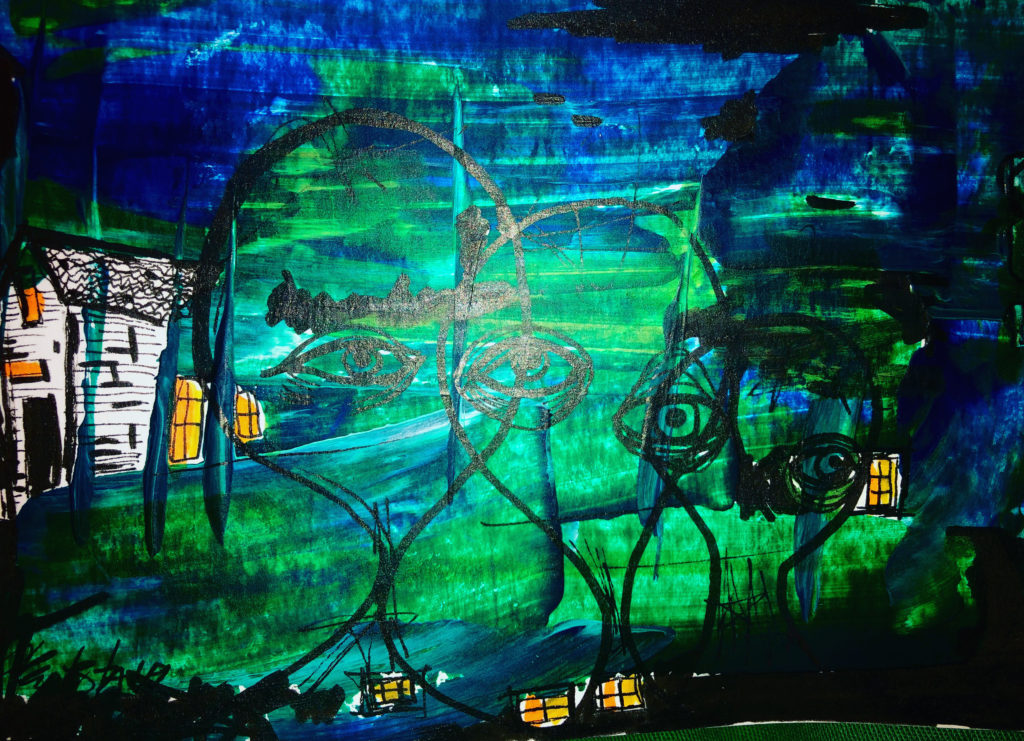
Painting by Flavia Testa showing a house with lighted windows in an abstract forest.

Mi Casa es Su Casa by Flavia Testa
Turning: a climate grief poem

This entry was posted on by .

Turning: a climate grief poem


It's grief,
alright.
the same burning arrow
through the heart's gills
the same stone weight
of emptiness   — loss
	of words
	of what to do
	of a place
 
     that doesn't ache
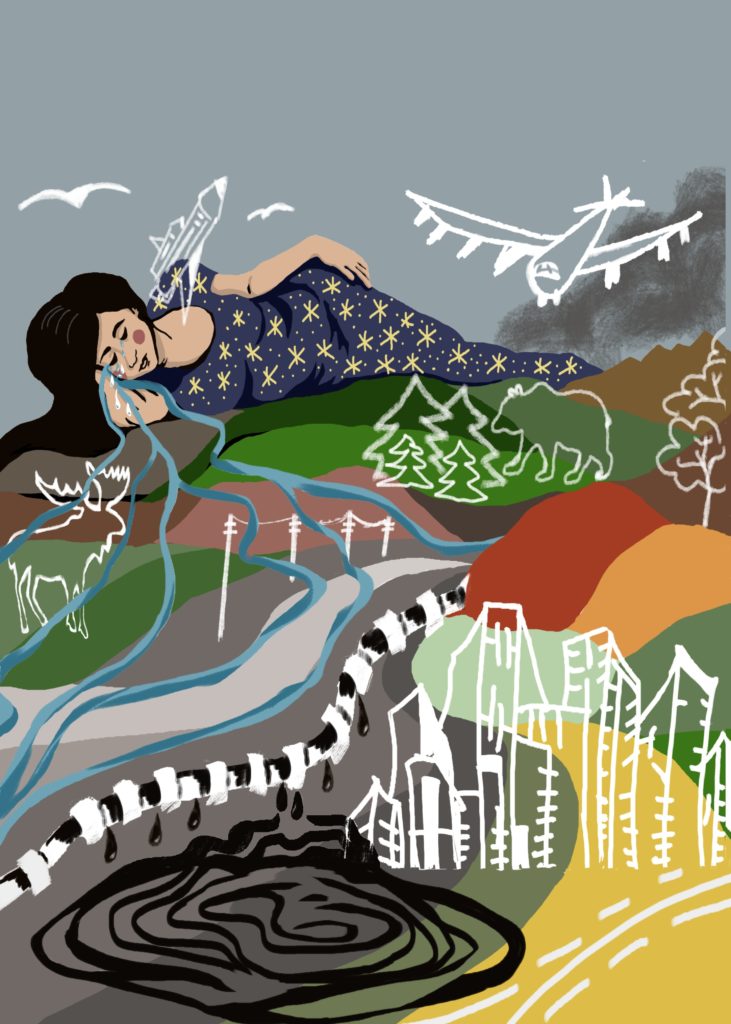
Painting by Ildiko Nova showing a woman crying a river, a city, mountains, airplane

Broken Harmony by Ildiko Nova

the way the living room,
the bedroom and the kitchen
ache

we are accomplices
to our own undoing
everytime we flip
	a switch
 		we flinch
each cup of tea
	each text

a word burning in the air

	will we ever heal again?

our fly-covered hopes,
the dreams 
we stole from others, our dreams —

are kindling for the Great Disaster

we scratch at chimneys
the smoke that bleeds 
from them, our blood.

	words can't heal this
	they never could.

but if we turn, as one —
	a murmuration 
	or a school of herring

We might staunch the wound
And quench the burning 

the things that
creature bodies know
(we need each other)

the things that words,
 	together, know,

they cannot heal us
but they can turn us —

one mind in many bodies,
a wise mindlessness
or mindful bodyness

toward the cool 
places
where undying 
grace is.

Rains

This entry was posted on by .

The woman looks up, curious but distracted by the little ones tugging at her skirt. I want to talk to her. I get out of the car and walk over, the translator now knowing what to ask before even saying a word to me. He speaks to her in Mandinka, the language of rural Gambia. He continues to talk and I wait to see if she is willing. Yes. She wants to talk too. And so we begin.

Have the weather patterns changed over the course of your life? I ask. Are things different now than they were when you were younger?

Questions about perceptions of weather and climate are often a part of my research and I’m genuinely curious to learn the responses. Here in the Gambia, however, I can now almost predict what I will hear: the weather is indeed changing.

Yet this particular woman seems to have a lot more to say and I wait for the translator to unlock her wisdom.

Yes, she says, the weather is different. It used to rain very reliably. These people, they are farmers and they could plant their seeds and the rain would come and they could rely on good harvests. But now, now nothing is reliable. The rains don’t come. People plant seeds and they die. It is getting very difficult to farm.

I ask further: Why do you think that the weather is changing and the rains are so unreliable?

She speaks quickly and seems agitated, her hands gesturing. I am eager to hear her explanation but surprised by the words that come from the translator’s mouth.

It is the young girls. They wear short skirts now … exposing their bodies. They don’t show respect to Allah. And so He is angry. We anger Him with this and He is punishing us.

The woman then asks if I could take a photo of her with her twin granddaughters. She scoops them up and hoists them upon each hip.

**

I first came to the Gambia, the smallest nation on the African continent, several years prior to this encounter. As a Geography Professor at Saint Mary’s University in Halifax, I’ve had the chance to travel to the country on several development and academic trips. The connection with the Gambia had been forged by an historical relationship: my university assisted in the development of the University of the Gambia. Early on, when presented with the opportunity to travel there, I wasn’t excited. Poor and underdeveloped, I thought, dry and dusty. My head filled with stereotypes. But my first trip sealed my love for the so-called “Smiling Coast” and the people changed my perspective permanently.

On this particular occasion, a colleague and I were investigating perceptions of climate change among rural Gambians. The northern and eastern regions of the country are classic Sahel, dry and arid for much of the year and with people relying heavily on the distinct rainy season to grow food. I was curious to know what Gambians were thinking and feeling about changing weather patterns and what explanations they had for the changes. What would they do when the rains no longer fell?

**

Towards the coast, a group of women gather. During the week they sell produce at market stalls to support their families. They are talking to me about farming, their traditional ways of life and how things are getting harder now.

Before, there was enough rainfall. People were engaged in farming. There is not enough rain now. A lot of farmers have lost hope. Climate change has discouraged people.

Climate change. I did not expect to hear this term. It’s one we in the west use describe the impacts we levy on those in less-developed countries but not one that local people in the Gambia often use themselves. I don’t know where these women would have learned the term and I didn’t probe them. Perhaps it’s becoming more common through environmental education campaigns and the fact that food and water security depend on understanding the issues. It could also be that with the prospect of rising sea levels, in a country that is at or even below sea level, the term is making its way into the media and mindsets of local people. In any case, the women continue….

Government agencies and NGOs, they tell youth to think more about farming and fishing. Is this realistic? The drought is making it very difficult. There is not enough rainfall to harvest anything. So the youth go backway.

Backway is the local term for those who attempt the trek to Europe in search of opportunity and success. On the African continent, the Gambia ranks among the highest per-capita contributors to irregular migrants who make the journey across the Mediterranean. Primarily youth, they risk their lives on routes from West Africa through the desert to Libya; from Libya they get into over-loaded boats that will take them to Italy and other parts of Europe. They know the risks but they still do it, or want to do it, because of the pressures they are facing at home and the successes they have seen of those who have landed on the shores of Europe. So the very cultural landscape of many rural villages is changing. The youth are gone. The women, the caretakers of the villages, are hoping and coping and praying for the successful migrant journey.

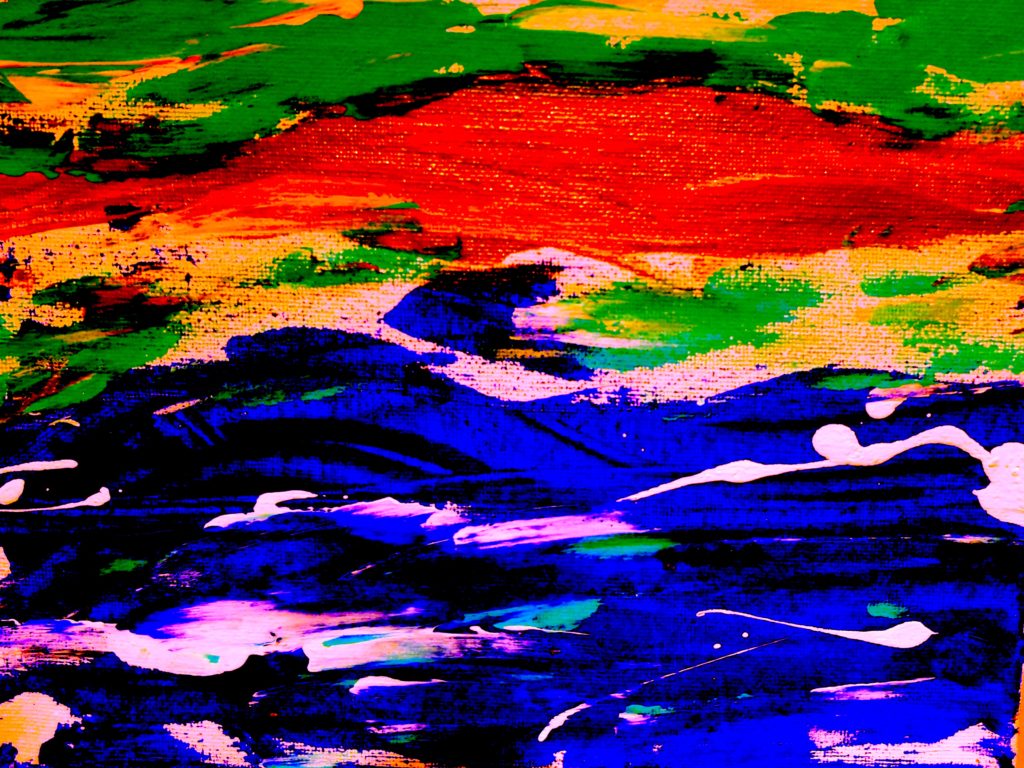
Abstract painting by Renée Cohen showing rust hill and blue ocean.

Ocean Reflecting Rust Hill by Renée Cohen

In a rural village in the so-called upcountry of Gambia, I speak with with a group of young girls just out of high school. They tell me their frustrations with those of us in Europe and North America who view migrants as thieves and criminals. The girls want me to know that the boys they went to school with—the ones who left—were the brightest in their class. These boys were unable to secure scholarships to study in Europe and decided to travel the “illegal” route instead. Their boat capsized. They all drowned. The girls were grief-stricken, but also angry.

They were the top students. They should have been able to go to Italy, to Germany, to the UK. Just to study! They were not criminals. They were just boys. Their mothers are left without sons. They are gone. Like they just disappeared. These houses here, this is where they lived. Now they are gone. One, he was my boyfriend. We were going to get married. Now who will I marry and have children with?

**

I feel like a hypocrite, of course, flying all the way around the world, contributing to the climate changes that so gravely impact Gambians. I like to think I am somehow different and that by asking these questions, by seeking out audiences who willingly listen to these stories, I am not as complicit. I hope that my efforts to educate my students back in Canada, my efforts to lend voice to those who might not otherwise have one, are in some way are my carbon offsets. But I don’t know.

**

We walk into the dark circular home of a traditional birth attendant. Our eyes quickly adjust from the bright sun to the dark interior. There are only a few small seats and a bed inside.

I birthed a woman in that bed today, the woman says.

I looked at the bed and wonder how the birth had gone. How different and difficult delivering a baby must be in conditions so far from those in the west.

How many babies have you delivered? I ask.

Oh, I don’t know, I have lost count. Many hundreds or thousands, she says, laughing.

We smile awkwardly, trying to imagine the babies who have entered the world and the brave mothers who birthed them in this bed. Even getting to this traditional hut can be a challenge. There are physical limitations to travelling during the rainy season and when flooding occurs. Women therefore prefer to have babies in the dry season, so travel is easier and their planting and harvesting of rice isn’t impacted. Raising crops and raising children—both the sole responsibility of women. But now the extreme heat and the unpredictability of the rains and crops are making pregnancy and childbirth, which were never easy, even harder.

**

We talk of concepts like mitigation and adaptation in the discourse on climate change. But how can women in rural Gambia mitigate or adapt to their new realities? In my travels, I haven’t seen many options. “Adaptation strategies” can quickly become an academic conversation among those in circles of power. Something necessary to discuss. The reality for many, and for women and children in particular, is that they must simply confront new challenges. They must cope with climate change, no matter what. So it makes sense that a lot of the weight of climate change and the new challenges they face are lifted up to God. To Allah. And, ultimately, the blame is often laid on the shoulders of those who have nothing to do with the rains that do or do not fall: girls with short skirts, not the consumption and consumerism of the industrialised world.

Editor’s Note

This entry was posted on by .

To look up from my own work as a playwright and professor and edit this issue of Understory Magazine, with its focus on diverse stories of womxn on stage, was in some ways the pause that refreshes. It is inspiring to have this opportunity to engage with the unique and rich work being done by artists across the country. How invigorating to edit this issue at a time when equity, diversity, and inclusion are finally coming to the forefront of theatre and the performing arts! Pow.

Many thanks to Katherine Barrett for helping to shape and refine the idea for this issue. There were many ideas in the air when she asked me to edit an issue. Some might have easier but this, we felt, was the most needful and challenging. To have a glimpses into the lives, work, and artistic practices of the writers you see featured here, and to deliver their work to you, is a distinct honour. You will find excerpts from plays or performance texts, creative nonfiction about the inner lives of performers, and poems that capture the particular frisson of “liveness” and what it means to be on stage.

At the same time, editing this issue was also heartbreaking in some ways. As The Status of Women in Canadian Theatre, Equity in Theatre, and other similar initiatives reveal, there is a still a huge disparity between the challenging and rich work being done by womxn and what actually makes it onto Canadian stages. There are so many calls for “opportunities” for playwrights … that don’t offer much opportunity at all. There are so few opportunities for real play development and production. So much more work to be done.

It was a key and joyful part of this process to co-edit with writer and Mount Royal University student Audrey Jamieson. A colleague and I were recently discussing the fact that if you don’t have a mentee under thirty years old, you’re kinda doing it wrong. This is as true of editing a magazine as it is in the classroom or in the rehearsal hall. As I enter the middle (ahem, prime) of life as an artist, it is just as important to be a mentee as it is to be mentor. We must all strive to attune our ears to fellow artists in all stages of their lives.

We are really proud to offer you this issue, Diverse Stories of Women on Stage. It is in no way exhaustive, but it is certainly rich and diverse.

Assistant Editor’s Note

This entry was posted on by .

It was such an honour to work on this issue of Understorey Magazine with Natalie Meisner and Katherine Barrett. The amount of wisdom and experience—of both the stage and the life surrounding it—from the womyn who shared their stories was astounding. Natalie has been an amazing mentor through this process, but so have the amazing voices that I had the honour of reading.

This issue of Understorey is a platform for womyn across the country to share in our common struggles around equity, diversity, and inclusion, but also rise to the challenge of creating a world where we don’t need to struggle any longer. I wholeheartedly believe that art and literature are the keys to crafting this new world.