
Archives

Hanging Out the Wash

This entry was posted on by .
Abstract Blue Floral by Anya Holloway

Abstract Blue Floral by Anya Holloway

Ma hangs the wash on the long clothesline in the backyard of our butter-yellow house. The sea rolls in the distance. I watch from my window.

When the heat of high summer is a skin and the sea breathes from its deep belly, in the midst of that season heavy with close dreams, she crosses the warm grass, barefoot, laundry basket lopping against her hip. She sets it down and stretches to see the dull blue of the water, the languid gulls. From the basket she pulls curtains of rain and lays them, smooth and silvered, over the line. Her hands are dark against their shimmer. A wind builds, sweeps, drops across the yard, bending tired petals, washing dull leaves, pittering against my window as I draw it closed.

At summer’s end, Ma reaches into her great deep basket and pulls out a sheet of heavy fog. She snaps it straight and pins it to the clothesline. It blocks the sea, the trees, muzzles the sound. The air sweats diamonds that cling to the green of the grass at the cliff’s edge, the spider’s web in my window.

One brittle morning she picks a heavy shawl of snow from the basket; white, edges as sharp as ice. Watching her pin it to the line, my breath frosts my window. Outside all turns grey and white; air as cold as steel, sea as cold as iron.

When the winter starts to ease, I watch Ma, wearing her red rubber boots, carrying a crisp new laundry basket, round and deep. She sets it down on the softening snow by the clothesline. She cracks her wintry back and smiles at the sea, up at the bluing sky. Digging into her basket, she pulls out a jacket of fresh grass, embroidered with tulips, lilacs, daffodils; its buttons: spring buds. She takes two wooden clothespins from her pocket and clips the jacket to the line. She walks to the shore, her path traced by the yellow, pink, the purple of flowers of make-you-weep beauty.

When the sky is high blue, I open the window and the dust winks in the sunlight. The air breathes against my cheek.

One morning I hear the creak of the screen door opening below and I watch Ma carry the laundry basket snug against her belly. She is wearing a white dress with fuchsia buttons and a whirl of butterflies across its back. I see the sun catch the down on her arms. Her hair curls against her pinking cheek.

She sets the basket down and reaches into it to pull out a blanket of frost-edged air, clear and knife-sharp. Carefully, she lays it over the clothesline and steps back, warming her hands under her arms. The wind rocks stray leaves to the ground where, unseeing, she crunches them underfoot.

The breeze turns chill. Ma catches her breath, picks up the basket and hurries indoors.
Below me, the door closes tight.

I draw my window down, noticing
jeweled leaves on the trees
deep blue of the sea
sharpening of the sky.

The early fall of night.

Always a Mother

This entry was posted on by .
Living Sea by Linda Roe

Living Sea by Linda Roe

No matter what I do, I am a mother.
No progeny required to lavish love
on my endeavours, whether I am raising
eyebrows, the bar, tomatoes, or even a child
from my womb, or yours, or hers. It is fine work
to knead life’s pliant dough, watch it growing

round, fueled by the yeast of intention. Growing
babies is a singular task. It suggests a mother
who feeds on demand, changes on need, her work
the main melody with measures of sleep. Love
invested, deposited with such interest in a child
whose future return is not guaranteed, raising

high-risk market uncertainty. I’m all for raising
Cain occasionally, but I’m more interested in growing
peace, inside and out, sinking deep roots, harvesting child
plants which grow on their own, separate from the mother.
I find comfort in the notion that beyond death, our love
lives on, though I don’t comprehend what makes it work.

Taxes, family, life–everything is a work
in progress. Some days I feel so mortal, raising
the possibility that I may run out of love
before it’s all done. Lately I’ve had this growing
sense that it doesn’t matter. I am an expectant mother
who treats each day as a precious new child.

My plans are derailed daily by the arrival of said child
pretending to be a problem. This is my work:
to look deeply beyond illusion until I spy the mother
lode of golden opportunity. Raising
consciousness seems a sure-fire way to keep growing.
Even the Beatles told us all we need is love.

This being alive is a great labour of love.
How can I be more gentle, treat myself like a child
who is, despite my age, still learning, still growing
into my womanness? Take note–this is NOT paid work.
I’m a volunteer player who’ll soon be raising
the ante with the hand I’ve been dealt. Holy Mother!

Who wouldn’t love to say that it will all work
out? This innocent and wounded child I’m raising
inside will keep growing, and I’m always her mother.

Silence. Please.

This entry was posted on by .
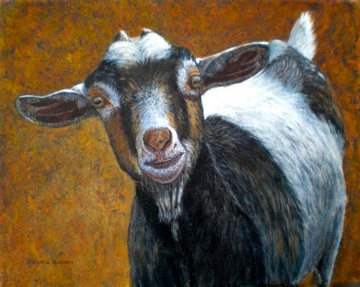
Up Close and Personal by Virginia Houston

Up Close and Personal by Virginia Houston

I am trying to learn silence. It’s not easy.

I am trying to remove clutter. That, too, is difficult.

By silence I mean moments of stillness longer than a few seconds. You know: when nothing hums, beeps, whistles, dings, roars, revs, crackles, or chirps. When no one talks, cries, yells, or mutters. When I can see an idea form in my head without interruption and can dwell on it for more than a millisecond.

And by clutter I don’t just mean the discarded bags, random receipts, single glove, broken pencils, and never-to-be-opened mail that gather by the door or spill over the counter. I also mean the to-dos waiting for me in my computer, on the desk, in the kitchen, or rattling around in my brain. It only takes few seconds after I wake in the morning for them to swarm around my mind, poke at me for my attention. They cling to me all day, despite my efforts to flick them off.

Like most women, I have no idea what it’s like to have nothing to do.

Quiet. An empty morning. A clean slate. Virginia Woolf, you’ll remember her, said every woman should have a room of her own.

Room? I’d be happy to have an hour.

The rare time I think it’s possible—usually when the chaos of the morning is over—a tiny bubble of effervescence forms in my chest. This is it. I can concentrate. I can go to ground. Begin to remind myself who I am, what I’m here for. Plan something. Read a page. Write a paragraph. Eat lunch in peace.

But when I pour a coffee, I notice jam stains and important mail on the counter. To heat my soup in the microwave, I have to put the turntable back on its moorings and scrape the red splatters off the walls. Does no one else notice these?

And those precious twenty minutes? Gone. Eaten up in the dishrag, expended on the phone, or flown into cyberspace in the form of “urgent” emails.

This is such an old story it’s cliché. I felt the need for quiet decades ago, and I’m still talking about it, but now with friends in the next generation. If it’s not doctors’ appointments or soccer games or all-night puking or the late-night run to the grocery store then it’s the meeting with the school psychologist (again) or a ripped zipper on the snowsuit. It’s the missing button, the late registration, and what the hell has the dog rolled in now?

We can crow all we want about how feminism has improved ordinary women’s lives. And to some extent, that’s true. I was chief cook for our first thirty years of marriage; my husband is in charge for the next thirty. Our one remaining resident offspring cooks and cleans. Okay, not to my standards—red splatters, remember?—but it’s a start.

I often leave my own house to have a thought. I am lucky to be able to do this; most women I know cannot. Recently, I flew across the country to go on retreat with my sister in an abbey outside a prairie city. I found a room, uncluttered days, and avoided email. Or tried to.

As I sat watching the magpies on the tops of the pines, looking at the snow sparkle on the horizon, I remembered my mother’s words when she was old and blind and only a year away from death.

I feel useless, she said. No one needs me. What’s life if you’re not useful?

I argued with her then. Don’t be silly, I said. None of us needs to be anything other than our selves to be valuable. We only need to be: that’s what’s precious. You are you.

I believed what I was saying then. I believe it now. But I still struggle. What would happen if I didn’t write that letter, clean up that mess, call the clinic, answer the door, attend that so-important meeting? Would someone else see the crud on the sink? Remember the birthday? Would I feel freer, or would I feel guilty about not showing up, not pulling my weight? The forces of our culture—family habits, community and gender expectations, that rushing river of life pulling us forward–are difficult to resist. How much noise and clutter in my life is out of my hands? How much do I create? Do I have a secret wish–god help me, Mom–to be useful?

I’m not sure. But I’m off to make coffee in a clean kitchen (not my own) and to settle into a chair by the window where I can overlook an unfamiliar horizon, and think about it.

Early December in Toronto

This entry was posted on by .

Clouds heavy with snow hang over the city,
not yet ready to release wonder.

An occasional perfect snowflake escapes, and is suspended
between sky and earth.
It floats at the whim of a gust of wind,
and dissolves into thin, cold air before it reaches the ground.

We are gathered in a small house
on a street shadowed with old branches.
Trees silhouetted against a gray sky stand along both sides of the road
forming a tunnel of sorts, leading to the centre.

Inside, we prepare for the coming.
In ancient and timeless woman ritual, we cleanse.
We dress the birth bed and set out linens for swaddling.
We simmer fragrant broth and brew tea scented with lemon and honey.
We gather in warmth and recount the ancient myths
of gods born to virgins and carpenters,
of heaven and earth coalescing into divinity,
of the joy that this child will bring to the world.

The slow motion time of this advent cocoons us.
We wait in expectancy and excitement as the time nears and the pain begins.
We hold her close and whisper words of support.
A small boy rubs her ankles and knees, and declares his love.
His father paces and worries, cajoles and encourages, feeds and braces.
Eternal rhythms surge and wane until at last, in a midnight clear and cold,
another life begins.

Silent night, holy night.

No angels or shepherds herald this birth on a night
in early December,
but the divine within is pleased.
A girl child is born.
The world is transformed.
Hallelujah!

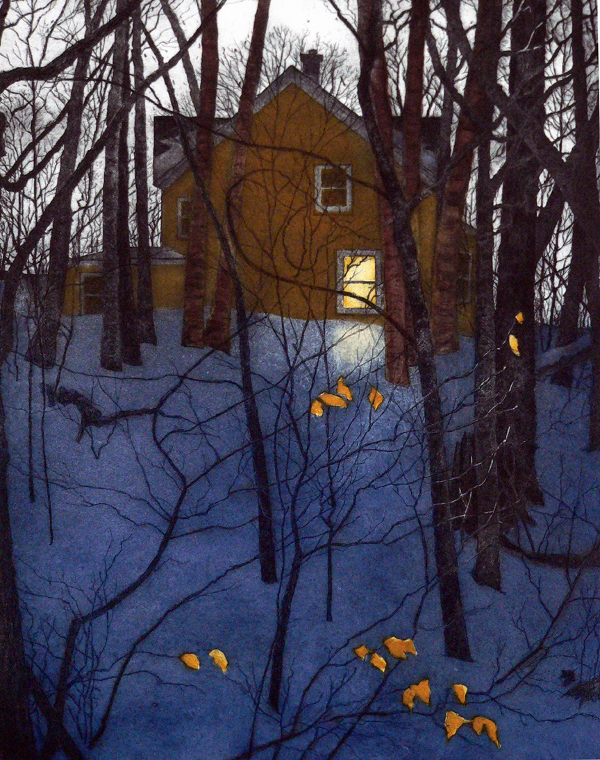
Twilight by Anna Syperek

Twilight etching by Anna W. Syperek

Preview: Double Pregnant

This entry was posted on by .

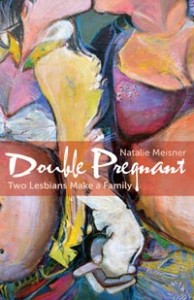
double pregnantNatalie Meisner is a writer from Lockeport, Nova Scotia. She currently lives in Calgary and teaches creative writing, drama, and literature at Mount Royal University. In her forthcoming book, Double Pregnant: Two Lesbians Make a Family, Natalie describes the decision she made with her partner, Viviën, to become pregnant–at the same time. Double Pregnant will be released on Mother’s Day, 2014, by Roseway/Fernwood Publishing. Here, we offer a preview of the chapter “Not Hollywood.”

Not Hollywood

We arrive in Nova Scotia with no further complications and make an appointment at the hospital on the South Shore where we will give birth. They need to do a series of tests in order to begin monitoring both us and the babies. Because this is a whole new world for us, we decide to take the optional tour that is run for couples expecting their first child. The head nurse shows us around the facility. We tour an observation room, a birthing room and a recovery room while she talks us through some possible scenarios of how our birth experience could run.

We are taking this tour with four other couples, and as we enter the birthing room, the nurse indicates some stools and chairs where we are to sit while she answers any questions we might have. Large padded chairs are grouped in pairs with utilitarian wooden stools. The nurse, indicating our swollen bellies, says she’s pretty sure the pregnant women need the comfortable chairs. The fathers-to-be head for the stools. The problem comes when we head for our set of chairs. Viviën is definitely showing and obviously pregnant but is still trying to be tough. She says she’s fine with a stool. She’s only six months pregnant, after all. She waves me toward the comfy chair. One of the fathers-to-be jumps up and darts into the corridor. He comes back with a padded chair and puts it in the place of Viviën’s stool. It is a little gesture, yet one that goes a great distance toward making us feel at home.

I give him a smile as Viviën settles in, and the nurse begins talking us through what to expect when we come in to have our babies. She explains that we should come to the hospital either when our water breaks or our contractions are five minutes apart. Then we will be put on the monitor for observation. Every woman’s labour is different, she stresses, and the hospital tries hard to accommodate different kinds of births. There are cots available that can be wheeled into the room so that our partner can stay over during the birth process. When we are determined to be in active labour, we will be given a birthing room, but we are free to walk the halls, take a bath, use the birthing ball or the mats and do whatever our bodies tell us. This hospital appears to be remarkably forward thinking compared to some that I read about.

The nurse handles a few more practical questions before she gets to the juicy part: pain relief. I can feel all the pregnant women around the circle shift forward in their chairs. No matter what our views on this subject might be, no matter what kind of birth we hope to have, we all want to hear what she has to say next. The nurse says there are methods of pain relief that work independently and also in conjunction with one another to assist women during the process. Of course breathing, relaxation, movement and bathing are all helpful. If those methods aren’t enough, you can request an intramuscular injection of a painkiller such as diamorphine or pethidine, but this must be given early in the labour. If it is too close to delivery, it might slow down the baby’s breathing. During the first stages of labour they use a numerical scale to notate the dilation of the uterus. In preparation for birth a woman must go from zero to ten, ten being fully dilated. This process, says the nurse, can be quite painful for some women, while others might only feel a kind of pressure. Once you are in labour, you can request a mask that is connected to a tank of nitrous oxide and oxygen. When you breathe in this gas, it can reduce pain but can also make you feel light-headed and sometimes nauseous. She hauls out the tank and mask to show us what it looks like.

I glance sideways at Viviën to gage her thoughts at this point and notice that she looks woozy. She has low blood pressure, and sometimes if she is ill, or distressed, or even if she sees blood or a needle, she faints. I recognize the twirling dark look in her pupils and lean over to ask her if she is okay.

“Of course the heaviest form of pain relief is the epidural. This is a needle in the back …” Suddenly the nurse jumps forward in alarm. Just as I am whispering in Viviën’s ear, she faints and is sliding down in her chair. Another pregnant woman and I grab her elbows and help her slide safely to the floor. She has told me this is a terrifying experience for her—she hates the feeling of losing control of her body. So, after helping her to the floor, I talk to her, stroking her back and then her cheek for a few moments until she starts to come around again. My only concern is that Viviën gets through the spell as calmly as possible. But the fathers-to-be, the other pregnant women and even the nurse are all pale with shock. One of the guys offers up his coat as a pillow for her head.

“Well I guess that concludes our tour,” the nurse says, shaking her head. “That’s the first time I’ve ever lost one this early in the game.”

It gives me a stab of panic to see Viviën’s strong body go down this way. Especially when I feel so vulnerable myself. There have only been a couple times when I’ve questioned the wisdom of what we’ve done, never the pregnancies themselves, but the timing. Maybe we shouldn’t have tried to get pregnant at the same time. Maybe I should have just supported her through this. Am I an idiot? What if I can’t get her to the hospital? Doesn’t the husband have to drive at Mach 2 through a blinding snowstorm to get his beloved wife to the hospital? Carry her into the emergency room in his arms in the nick of time…. Wait, that’s Hollywood.

The unfortunate thing about living in an age so saturated with cinematic images is that they can frequently pull a bait-and-switch on you for the circumstances of your real life. We aren’t the Hollywood version of a family. I couldn’t carry my woman over the threshold like the hero of the story even if we weren’t both pregnant! But just like anyone in love, I would do anything, I mean anything, in the world for her. Whatever we have to do for each other, we’ve always found the strength for, and this won’t be any different.