I come from a long line of laughers. My father was a prankster who loved to play jokes on people. His favourite day of the year was April Fool’s and, as a gullible child, I always fell for his pranks. One morning, when I wanted an extra dose of sweetness in my cereal, I discovered that he had replaced the sugar in the bowl with flour. I knew immediately that he was the culprit. My mother was a hearty laugher. I remember her playing cards in the evenings with friends and there was always boisterous laughter involved. My grandfather was a talented storyteller, and my uncles and aunt were natural entertainers who would easily fill a room with music, singing, and merriment.
I was known as the serious child. At a young age, I was described as responsible and methodical, and my older sisters often told me to “lighten up.” But my mother peppered me with opposite advice. I remember her saying, “Never laugh too loudly or too heartily in public,” and “Cover your mouth with one hand if you giggle.” In a class-oriented society such as ours, laughing too much or too loudly outside the home was considered rude and uncouth.
The Portuguese are not known to be a happy people. This is a stereotype, of course, but I wonder how it came to be. When I think of Brazil, also a Portuguese-speaking country, I conjure up images of Carnival and the samba, and dancing in the streets. Their Portuguese ancestors? We are better known as seafarers and masters of nostalgia—a people of saudade—famous for the bluesy tunes of the fado. My people are not a smiley lot, at least not in public.
I remember visiting my home island of São Miguel in the Azores when my children were teenagers. Both of them remarked that people did not smile much, that they looked so unhappy. Even my husband agreed. “Everyone looks like they’ve had a really hard day,” he said. I issued a daily challenge: “The first one to spot a person smiling or laughing gets to choose where we have lunch.” It turned out they were right—smiles were hard to come by. Some days, I feared we would starve.
My attitude now towards joy and laughter is different than what this public persona of the Portuguese seems to convey. Despite my sensible character in childhood, my humour genes became more prominent as I grew up. When we moved to Canada and I started school, I covered my discomfort and loneliness with humour. I made so many mistakes when I was first learning English. Each time I said “tree” instead of “three” or “sink” instead of “think,” I knew my classmates would laugh but I liked to head off the chuckles by laughing first. Later, as I grew more comfortable with the language, I would offer quips in class to make others laugh. Sometimes, the teacher laughed too. “Don’t do that too often, you don’t want to be the class clown”: my mother’s words resonated in my head. I was learning that it was best to be reserved in public settings, but among family and friends, it was fine to laugh and have fun. I learned later that it wasn’t just a Portuguese thing; society in general seems to dismiss laughers and prize seriousness, especially where women are concerned.
I listened to my mother and tried to be more serious in class. I looked forward to the evenings when I could relax with her and my sisters. I no longer needed to be prodded to lighten up. We would poke fun at each other and laugh till the tears came.
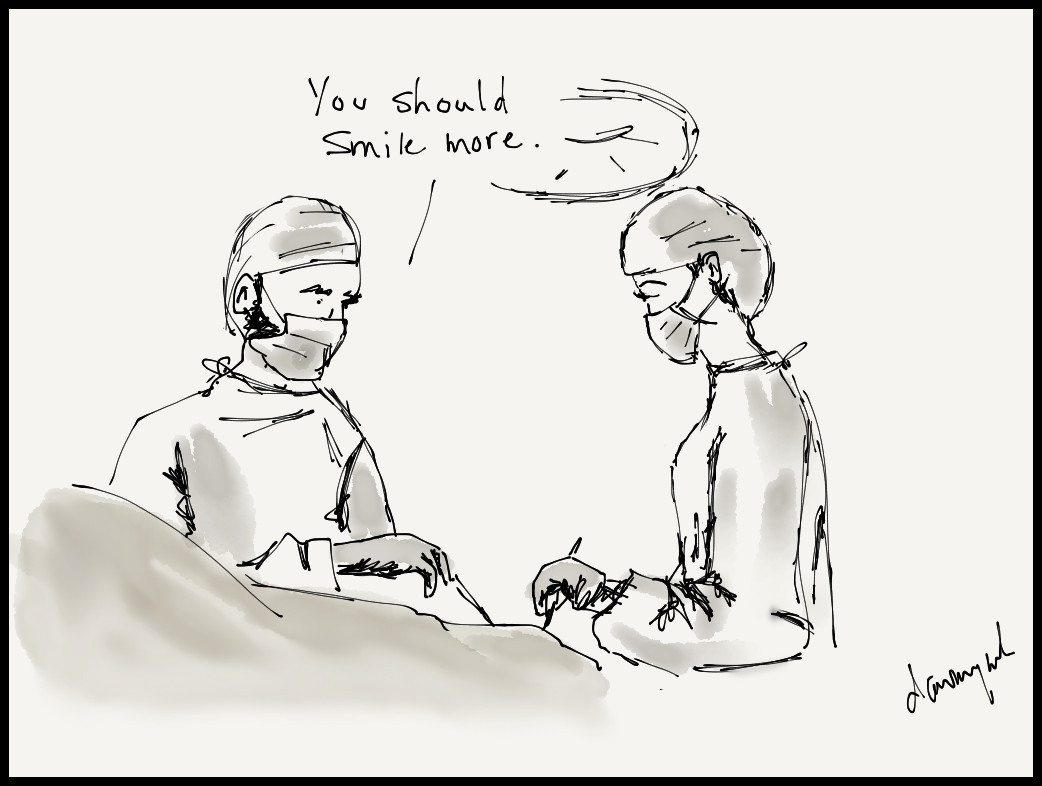
When I landed my first permanent job, a researcher for a government department, most of my co-workers were male, except for the administration staff, and I was the youngest by at least five years. As I eased into my role and grew more comfortable, I started joking around with my colleagues. At one meeting, I remember sitting around a big table, flanked by a dozen older men wearing suits in various shades of dark blue. Afterwards, my boss took me aside to give me advice on how to thrive in my new professional role. “Don’t smile so much. When you laugh easily, people don’t take you seriously.” I wondered then if he would have been inclined to give the same advice to a male employee.
Smile More by Dawn Mockler
I gravitated towards the women in the office and shared lunch with them in the boardroom or joined them for brisk walks. The men worked at their desks or went for the occasional “liquid lunch.” I noticed that they took extra-long lunches on Fridays and would come back more jovial than usual, filling the hallway with laughter. I later learned this was due to their excursions to the local exotic dance club. I called them out on it and said that I noticed the men-only nature of these outings. They responded by inviting me to join them the following week.
I did not enjoy myself and I felt objectified, even though I was sitting at a table, with all my clothes on. I asked my boss who was sitting next to me, “Why is this okay for a professional but smiling isn’t?”
Within a year, our group was disbanded, and I was transferred to a different department. The atmosphere was more casual, and I enjoyed the camaraderie I shared with my new colleagues but, on some level, the message had stuck: smiling is not professional.
It was tricky to manage my image as professional at work and relaxed at home, as reserved in public and carefree in private. I juggled my mother’s advice and my boss’ opinions and tried to conform but at some point, I must have decided that it was too exhausting, and I became less concerned about what others might think of me. I gave up trying to convey the ideal polite, professional image.
I often wish I could go back to that boardroom and observe the young me, navigating my uncertainties among all those men in dark blue. How much did I smile, and did I really laugh too much? I imagine my youthful exuberance has been tempered over time by age and experience, but do I laugh more or less now?
There have been times in my life when the ability to laugh has felt remote. There were the years when I was the primary caregiver for my ageing, ill parents. My days revolved around tasks, duty, and responsibility and I don’t remember laughing much then. And there were the times I lost people I loved. That’s when I feared I might never laugh again.
But one day, inevitably, I would catch myself smiling. Maybe it was when I noticed the first crocus poking out of the soil in the spring or when my neighbour’s cherry tree burst into full bloom. And then one evening over dinner with my husband, one of us would say something silly and we’d both start laughing. We’d laugh so hard that I would snort, and he would wipe tears from his cheeks. And we would agree that it had been way too long since either of us had laughed like that. And I would carry on, grateful that time and beauty conspire to soften the sharp edges of grief and help me return to laughter.
Now, when I look in the mirror, I examine the wrinkles around my eyes and mouth. I have developed some pretty significant laugh lines. I see them as signs of resistance. I have somehow managed to keep laughing, even when I’ve been told that I shouldn’t.
Listen to Esmeralda Cabral read “Smiling Is Not Professional.”
“BIRCHWOMAN’S”: a store that’s a cross between a hippie emporium and a pawn shop. It is dim, yet through the sunlit motes we can make out an assortment of curios and oddities. Every inch of the space is taken up by salable objects: jewellery, furniture, art, shirts that say “Where’s the Beef?” Long, beaded curtains hang from the ceiling and a hammock is set up above the cash register. There is no sign of life.
A knock at the door.
Silence.
Another knock.
Tentatively, AUDREY PHAM, a tall, young woman with dark hair, aggressively permed, enters the shop. She wears puffy ski pants, the kind that are also overalls.
AUDREY: Hello?
She encounters the beaded curtain in front of her and awkwardly navigates through it; the beads get caught in aforementioned aggressively permed hair. She untangles herself and takes a scrap of paper out of her pocket: “Audrey Pham, Team Canada. Billet information and address.” She flips it over. It just says BIRCHWOMAN’S.
AUDREY: (Under her breath.) What the hell? Hello? Mrs…. Birchwoman?
She picks up a few of the objects around her. She finds a doll and animates it.
DOLL: I’m Birchwoman! Welcome to my spooky store!
AUDREY: Yeah, gosh, it’s like clearly from the first ten minutes of every horror movie.
DOLL: Don’t you feel like any second the camera will slowly pan past an antique that’s super-possessed?
AUDREY: Oh boy. Yeah, you’re right.
DOLL: What do you think the possessed object is?
Audrey holds the doll up and they look around from side to side.
AUDREY: I don’t know. That rocking horse looks pretty suspect though.
DOLL: Like if we turned our backs, it would start rocking? But, like, blurry and in the background.
AUDREY: Yeah! Oh my gosh, exactly. So scary.
DOLL: What’s that over there, Audrey?
AUDREY: What? Wait, how do you know my name?
DOLL: I know a lot about youuu. I think I heard something….”
Audrey creeps closer to the rocking horse.
DOLL: What’s it saying, Audrey? Do you hear that?
VOICE: WHAT DO YOU WANT?!
Audrey screams and flings the doll away from her.
AUDREY: Oh God! Are you a ghost? If so, I’m sorry, I really don’t have the time to solve any, like, unsolved mysteries or avenge your untimely murder or whatever. Please don’t haunt me. I have a brother though, I can take you to him, he’s… supple, you can easily possess him. He’s retired; it’ll be good for him to get a hobby—
VOICE: WHAT ARE YOU LOOKING FOR?
AUDREY: (Looking around) N-nothing, I’m—hello? Is someone—
VOICE: We’re not open for customers today. And if you’re from that Neighbourhood Society, it’s appointments only.
AUDREY: I have an appointment! I’m Audrey Pham, the uh—Olympian…. I’m supposed to be here.
From the shadowy recesses of the store, BIRCHWOMAN emerges. She walks to the front door and slams it shut. A lot of BIRCHWOMAN’s questions sound like statements.
BIRCHWOMAN: The Olympian.
AUDREY: Hi.
BIRCHWOMAN: You just walk into people’s homes.
AUDREY: I just thought, ‘cause it’s a store—
BIRCHWOMAN: We’re not open.
AUDREY: Oh. Well, it’s a Wednesday afternoon, so I guess I just assumed you were open.
BIRCHWOMAN: We’re not open for customers.
AUDREY: Uhhh?
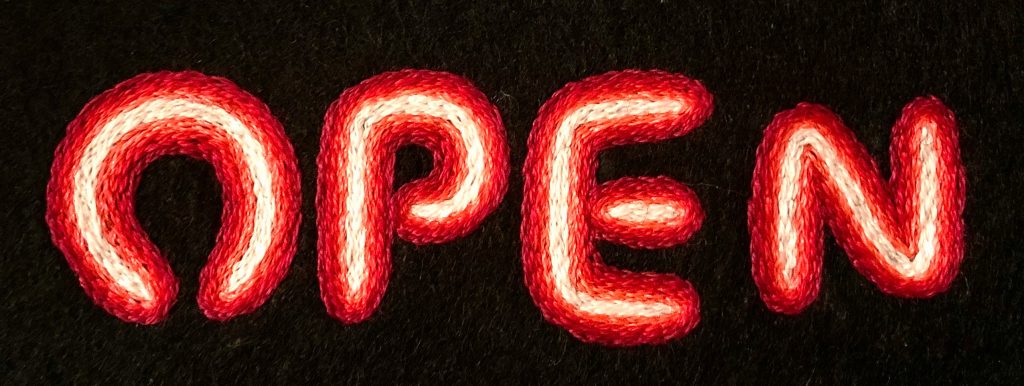
Open embroidery by Amanda Tickner
BIRCHWOMAN: So. You’re the athlete.
AUDREY: That’s right. It’s nice to meet you.
AUDREY extends her hand. BIRCHWOMAN dismisses it.
BIRCHWOMAN: Cold season. (Coughs wetly.) When’s your thing?
AUDREY: My—? Do you mean the Olympics? My final pass is February eighteenth.
BIRCHWOMAN: Well, you better win again. I’m not changing that sign.
AUDREY: What sign?
BIRCHWOMAN pokes her head out the front. She makes an exasperated sound.
BIRCHWOMAN: Oh shit, it’s blown down again. Cheap glue. (Pause.) Are you gonna stand there or are you gonna help me.
AUDREY: Oh! Sorry!
Audrey gives her a hand and together the two pick up a large banner and move it inside.
BIRCHWOMAN: Don’t ever buy vegan glue. I swear to God, it’s just pine sap and karma.
They straighten out the banner. It reads, in all caps and a bold font, perhaps Papyrus: “MEET OLYMPIC GOLD MEDALIST, AUDREY PHAN! FREE AUTOGRAPHS*!” In smaller print, underneath: “*GST NOT INCLUDED. LIMITATIONS APPLY.”
AUDREY: Oh… This is…. (Nodding). This is.
BIRCHWOMAN: We’re gonna put it back outside. Come on, let’s go.
AUDREY: You know, I don’t have a gold medal.
BIRCHWOMAN. Yeah, I figured you didn’t carry it on you. That what the “limitations apply” bit is for.
AUDREY: No, I mean I’ve never won a gold medal.
BIRCHWOMAN: Excuse?
AUDREY: Yet. I’ll be competing for one on the eighteenth.
BIRCHWOMAN: The eighteenth.
AUDREY: Maybe.
BIRCHWOMAN: Maybe.
AUDREY: I have to… well, we all have to qualify first.
BIRCHWOMAN’s eyes narrow.
BIRCHWOMAN: At the… qualifiers? Okay. I’ll just cross out “Olympic gold medalist” and write “Olympic Qualifier. Maybe.” Sure. That’s the same.
BIRCHWOMAN digs a felt marker out of a nearby pencil cup.
AUDREY: …and my last name’s Pham.
BIRCHWOMAN: Yeah, Phan, I got that.
AUDREY: No, Pham.
BIRCHWOMAN: Phan.
AUDREY: Pham. With a “mmmm.”
BIRCHWOMAN: Nnnnnnn.
AUDREY: Mmmmm.
This continues.
AUDREY: “M”! Pham with an “m.”
AUDREY hands BIRCHWOMAN her registration slip as proof.
BIRCHWOMAN: Well, what the hell am I supposed to do with all this “Phan Club” merchandise, Audrey Pham?
She sorts roughly through a box.
BIRCHWOMAN: I got 300 coffee mugs that say “Number One Phan,” “Phandemonium.” And this. She pulls out a folded fan and snaps it open. On one side it reads: “My Uncle went to the Calgary ’88 Winter Olympics and all he got me was this stupid—” Flips to the other side. “Phan!” Tell me who’s gonna buy a sweatshirt that says: “Phantom of the Opera.”
AUDREY: Um. People who like Andrew Lloyd Webber?
BIRCHWOMAN: Please. He peaked with Starlight Express.
AUDREY: If it makes you feel any better, if my name was “Phan” it’d be pronounced “Fawn.” (Cheerfully.) So you’d still have a box full of garbage.
BIRCHWOMAN snatches the banner away from AUDREY and folds it up again.
*
This is an excerpt from my play Go for Gold, Audrey Pham, which is about a fictional Olympian competing in the non-fictional sport of ski ballet (I highly recommend looking this up on YouTube). Currently, I am expanding this play from a modest one-act to a sexy two-act magnum opus. (Hopefully. We’re not quite in workshops yet.) The title character of the play, Audrey, is very much a mixture of myself and Ali DeRegt, the comedic actor and puppeteer for whom I wrote the part. Audrey is awkward, kind, and funny. In initial meetings with people, her natural humour takes a backseat to politeness but, occasionally, her bolder and weirder jokes can’t help but slip out. The eccentric shop owner Birchwoman is both her own person (who is so much fun to write) and a metaphor for Audrey’s inner, often-leashed humour: loud, brash, unforgiving, and totally uncensored. Writing the two of them is endlessly cathartic for me as, respectively, they embody the jokes I allow myself to present in polite company, and the secret humour I easily let loose amongst a select group of confidantes.
Telling jokes is scary! But with high risk comes the potential for such sweet reward. Laughing with other people does the work of five cocktail hours, easily bumping up strangers to acquaintances and work-friends to friend-friends. Laughing at something with others can simultaneously excite and soothe, each chuckle acting like an affirmation of “It’s okay, it’s going to be okay.” Laughter in a theatre is a singular experience that I certainly took for granted before the pandemic. Can you imagine being in a space with hundreds of other people right now, all shaking uncontrollably at some bit on stage? Humour in theatre is a powerful tool, be it in a ridiculous farce or an unexpected moment of levity in an otherwise sober play.
Humour lets audiences relax. It softens their posture and opens their hearts. And then, if you’re a sneaky writer, it’s the moment you can strike with the thesis of your piece. A spoonful of sugar makes the medicine go down, and the best writers do it in a way that their audiences don’t realize they’ve taken any medicine at all (but at that point, it’s too late. They’re now changed. Nailed it).
As a shy person, one of the greatest salves I’ve found is to give my jokes to characters, and have those characters played by actors who are not me. What a joy, what a thrill, and what a relief to have these actors go out there and riff on the material I’ve written for them, while I sit comfortably in the audience. Phew.
Well, the digital audience, for now.
Thanks, Theatre!
Miss you, xoxo.
Listen to “Go for Gold, Audrey Pham.” Ali DeRegt – Audrey Pham; Braden Griffiths – Birchwoman; Camille Pavlenko – stage direction and essay.
The whole family started acting weird. They weren’t sick, like with the flu or whatever, just pained and hobbled and whiny, Donna said. Like they’d all caught the menopause.
Funny.
Not when you hear how it ends.
She told you this at work?
In the lunchroom. Donna said it started with the woman’s own decay, which happened like that [snaps fingers]. “Imagine a needle scraping across your greatest hits,” Donna said, “and then, boom! It’s over. The only sound is….” Wait, I gotta get this right: “The fulsome circling around the dusty finish.” Scritch, scritch, scritch.
Did Donna make that sound?
That’s the record player sound.
You added that part.
You wanna argue sound credits or hear the rest of the story?
She and Donna met and shared an apartment at university. They partied, lived on processed cheese and cheap draft, graduated together. They’ve been close ever since, even live in the same neighbourhood. Donna told me once, “Picture yourself at a rock show at midnight, standing in front of the stage with cowboy boots on and a drink in each hand, cheering and spilling and going deaf.” That’s basically how the woman lived her life.
Basically, not literally.
Well, d’uh! The spirit of that, though. Living in the moment type deal, full of risk and audacious energy.
Audacious energy?
You don’t deserve to hear this story, Anusha.
I’m listening!
So outta the blue, the woman starts, well, aging. One day she’s out for a long run, uphill both ways, with zero stretching or anti-inflammatories. Next day she wakes up and her bedside table is covered with pill bottles and cross-stitch and self-helpy books. She gets up, achy, sweaty, exhausted. Tries to get dressed but nothing fits because overnight, she got fat!
What do you mean “overnight?”
Overnight.
OK, because before you were being metaphorical.
No, literally.
How old is she?
I don’t know, like… ten, fifteen years older than us?
Early fifties.
Around that. So this woman is totally baffled.
And delusional.
No, no. Donna’s known the woman since forever. The woman told her it felt like someone was playing a trick on her, like she was starring in some reality show about old women.
Weird.
Gets weirder. The woman wanted to ask her husband what the hell was going on but he was in the basement huffing and puffing on his stair-climber fitness thingy.
Elliptical?
Yeah. I’ve never tried it.
Great exercise and easy on your hips and knees. Apparently, if the tension’s right, you can get the same workout as running.
You an elliptical saleswoman now?
Just passing on gym scuttlebutt, Marie.
Anyway, woman puts on an old pregnancy skirt and oversized concert T-shirt and sits on the bed confused and sleep deprived. Then bingo, she figures it out: she’s menopausing.
More like meno-fastforwarding.
Haha. Right?
Did she have a dry vagina?
What?
I hear your vagina dries out in the menopause.
Jesus, I don’t know! Donna didn’t say.
Anyway, you started by talking about the family getting sick.
Well, if you’d let me continue! So her mind starts racing. What’s next, the woman wonders. Sweater vests? Polident? Sunday morning aquafit?
Thick ankles. Age spots. Downgrading your investment risk.
Right? So all these horrifying things are coiling in her head when her uterus starts cramping like the devil himself is trying to squeeze out one last period. She starts weeping, partly because the best years of her life are over and partly because the pain feels like a sucker punch to her empty ovaries. Ovaries like compost bins for dying strands of DNA. Surprise! the punch says. Remember when you were lusty and fertile? Me neither!
That’s a lot to unpack.
Absolutely. So she’s wiping away tears when her daughter knocks on the door, also crying, because, guess what? She just started her period!
Like, first time ever?
First time. So, despite the strange coincidence and her own suffering, the woman shifts into mother mode and tells the daughter it’s normal and has to be endured and offers the girl a pill.
A painkiller.
What other pill’s she gonna give her, heroin?
I don’t think heroin comes in pills.
Oh for Crissakes!
I’m sorry! If you’re gonna use examples, be accurate.
The girl can’t take a painkiller because, remember? When you’re a kid it seems impossible. Like you’ll choke and suffocate. So the woman crushes the painkiller in peanut butter, feeds it to the girl and sends her off.
Is the peanut butter relevant?
Try to keep up Anusha, OK? The mother’s own cramps are getting worse—tells Donna it feels like her uterus is being corroded with acid. So she reaches for the painkillers and, oh shit! Her shoulder!
What!?
Shooting pain like she’s being stabbed by a shaft filled with molten lava.
Isn’t all lava molten? Isn’t that the definition of lava—molten rock?
Just lava then, OK brainiac? So she sits on the side of the tub and is practically hysterical at this point. I told Donna that’s funny because in the olden days, they used to call menopausing women hysterical. It comes from the Latin word … hysteronia I think, meaning insufferable, middle-aged woman.
Hystera you mean.
What?
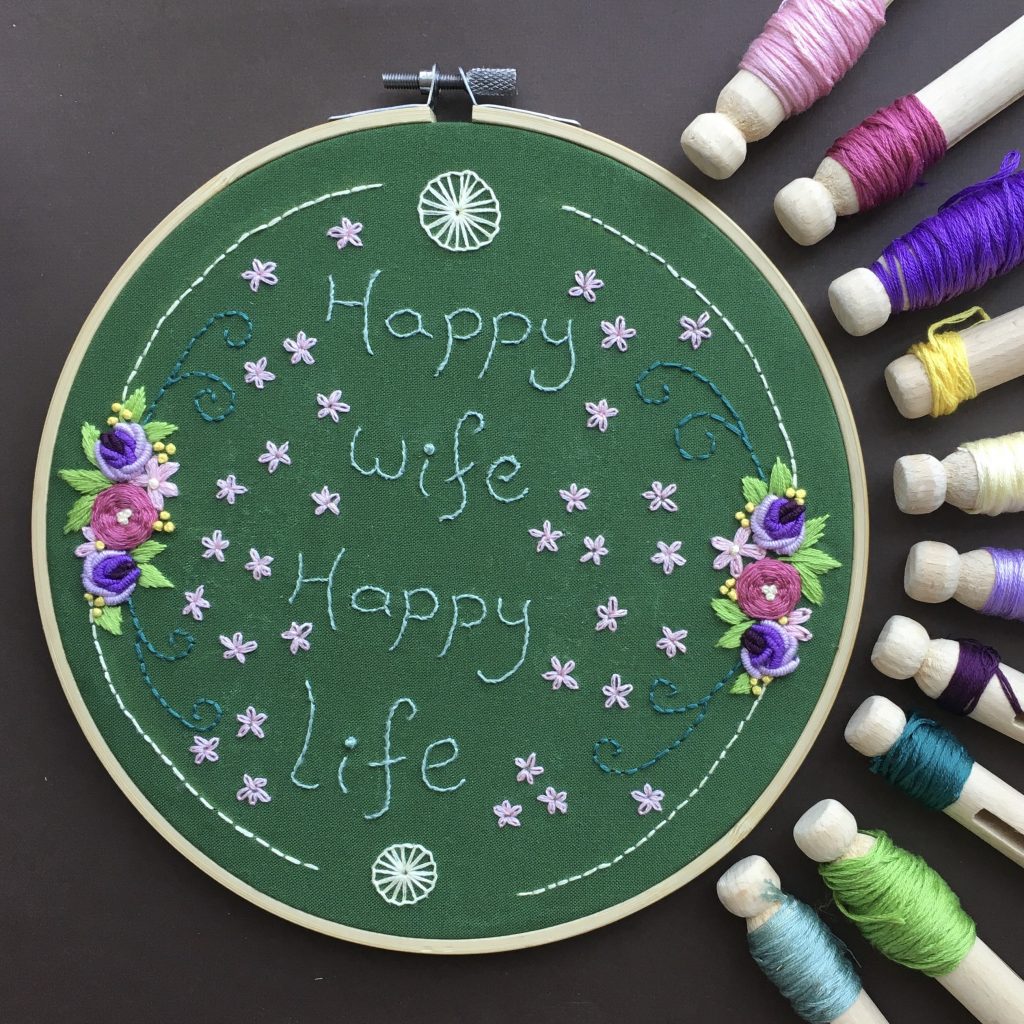
Happy Wife, Happy Life by Tali Tjiang
From the Greek, hystera, meaning uterus.
Whatever! Did you know women in the really olden days never went through menopause.
What are you talking about?
They died before it happened.
Ha! The blessings of a short life expectancy.
Totally. You know, some women bleed non-stop when they’re menopausing.
You’d die if you bled non-stop.
Not literally!
Literally. Not literally. Make up your mind!
You want more coffee?
Love some.
Aaaanyway … after a short pity party in the bathroom, the woman stands up to wash her face and when she looks in the mirror, she sees movement on her head, like she’s got lice or something.
Ewww! You didn’t tell me there was lice in the story! You know I have a thing!
Calm down. It wasn’t lice. It was just grey hairs blooming from the part in her hair. She told Donna they looked like “dusty wires pushing through drywall.”
Speaking of drywall, we just renovated our bathroom.
Oh yeah? Nice.
Wait, she could actually see grey hairs growing?
Before her very eyes. But she told Donna no point wallowing. Menopausing didn’t magically erase all the stuff a mother has to do right? So off she goes to wake her son for school.
He older?
Younger. Like eight or something. Boy says, “Please don’t make me go to school.” “What? Are you sick?” she asks. “No, it’s my shoulder,” he says. “There’s a pain when I try to lift my arm, like a hot poker stabbing me.”
Same pain as mom.
Same.
Is Donna sure this woman isn’t suffering from Munchausen Syndrome by Proxy?
The hell is that?
You know, when a parent ascribes fake symptoms to a child, pretends they’re sick when they’re not.
That’s messed up. No this sounds legit. Donna says the woman’s son explained the pain in detail and it was the exact same symptoms she had. So, mothering kicks in again. She swallows her own pain and they do some stretching thing together but it was too painful so she rubs the boy’s shoulder with a topical ointment.
Those creams are useless.
Waste of money. So she says to the boy, “Go eat your breakfast and you’ll be fine.” Then she goes to the basement to find her husband but he’d already left for work.
What’s he do?
Insurance broker, apparently. So the woman gets the kids out the door and decides to do laundry before tackling a report she’s been working on. She’s a graphic designer, works from home. The cat comes into the laundry room to use the litter box but it’s acting funny. Walking in circles, eyes kinda milky, lame back paw, stomach dragging on the floor. Cat’s barely two years old!
And?
It was like the cat was menopausing too!
C’mon! This is a joke, right? Punchline coming?
Donna swears it’s all true.
I don’t know about this Donna.
She’s the head of HR. Masters in social work. Comes to work in pant suits. Volunteers at an animal shelter. Not the embellishing type.
I don’t know what to say.
Good! Just listen then. The woman’s on her way up the stairs to her office but has to stop and sit because she’s so tired, seeing white spots floating before her eyes like she might faint.
Drop in blood pressure.
When she goes to stand up, holy dyin’ she falls back down!
What now?
Her hip! Donna says she got a sharp pain like her hip just cracked.
Like the head of the femur or further down?
How should I know?
Is that part of menopausing?
Oh yeah. Bones crack like toothpicks.
Awful!
So the woman scoots her way downstairs on her ass and crawls to the living room couch where she sits, weeping and looking through old photo albums of when she was young and beautiful: hiking up mountains, dancing at Burning Man, swimming in the ocean, stage diving at The Ramones.
Why doesn’t she call an ambulance?!
I know! That’s what I said. But Donna said she just hates to make a fuss or be a burden. After a cup of tea and rest, she hangs the laundry, finishes the report, makes a double batch of blueberry muffins—her daughter’s favourite.
So, slacks off, in other words.
Haha. Yeah, unbelievable.
This coffee is great by the way.
Thanks. It’s from that fair-trade place in Little Italy. Hipster hellhole but great coffee. So… as the day goes on, the woman’s condition worsens. Her head gets super heavy and starts sinking toward the ground, rounding her spine like a fish hook.
How does Donna know all this?
I guess the old photos made her nostalgic and she called Donna late that afternoon and told her everything. Donna freaked and told her to go to emergency—even offered to take her—but the woman refused. Said she had too much to do.
Haha. Of course she said that.
And now, well…. Donna’s totally beside herself with grief.
Wait, why?
A couple hours later, she called Donna again. Said her son got home from school and when she asked about his shoulder, he said he had a new pain. Guess where?
Hip.
Yup. He said when he stood up before lunch, it felt like his hip cracked. The teachers didn’t think it was serious enough to send him home but the boy was obviously distraught.
What did the woman do?
Well, by now she’s bent over like a crone, aching all over and trying to figure out what the hell’s going on. Is menopause contagious? Can kids get it? Is her pain real? Is theirs? Will she ever find relief? Apparently she handed the boy the TV remote and a bowl of chips and left him there with Netflix.
With parental controls on, obviously.
Maybe, maybe not, right? She told Donna the daughter was whining when she got home so the mom crushed another pill—painkiller—and sent her to bed with a hot water bottle. Then the husband gets home.
Finally! So…he takes her to the hospital.
Nope. Husband goes straight to the den without saying hello. The woman follows but it takes, like, a half hour to get there because she has to keep sitting on the floor so she won’t pass out. When she finally arrives at the den, husband’s got a drink in one hand and his face in the other, and he’s crying!
What?
Blubbering like a baby. When the woman asks what’s wrong, he says something about his withering male virility and the pointlessness of his monotonous job. Says he’s tired of people calling him in crisis. Says he’s depressed!
Great.
So the woman says “You can’t be depressed, I’m depressed!” And he says, “Look, I didn’t ask to feel this way.” And of course, the woman shifts into loving spouse mode and asks if he’s hungry and he says maybe some spicy dip with garlic bread would be nice and she shuffles off to make it.
The hell is wrong with this woman?
She gets to the kitchen and the cat comes in, moaning and slow blinking up at her, pawing the woman’s foot. So the woman leans over to pet her but something cracks in her back and she can’t straighten up so she just tips over and lays on the floor.
Oh my god!
She calls for help but nobody hears her so she drags herself to the phone and calls Donna.
Not 911 of course. That would be too sensible.
She tells Donna about the cat and the husband, says she’s on the floor and can’t get up. Donna says the woman was wheezy and barely audible. Donna told her she was calling 911 and coming over.
What a relief!
Donna lives a few blocks away so she arrives before the ambulance. She knocks on the front door. No answer. She goes in anyway and finds the woman….
Yes, and…?
Dead.
….
Dead-dead?
Yes.
From menopause?!
Donna screams and the family comes running. Guess what the husband says?