Archives

Me and My Fancy Chair

This entry was posted on by .


I depend on more than one piece of technology in my daily life. My wheelchair is the fanciest, most complicated, and most expensive piece of technology I own. I have a love-hate relationship with my wheelchair as it’s where I spend most of my time. I sit in my fancy chair for up to ten hours a day and it’s difficult to get me in the chair in a way that allows me to function easily. Being comfortable would be fantastic, but I know not to expect too much. I should be able to hold my head straight and move my right hand unhampered by the chair. My right hand functions the best; it’s the hand I rely on.

I have multiple sclerosis and the wheelchair enables my life. That’s the love. This chair, which was new to me in October 2019, offers many leg-positioning options that I didn’t have in my previous chair. (I would never go back to that previous chair. Oh, there’s the love showing again.)

It doesn’t work alone, however. My wheelchair will only help me lead a fulfilling life with the expert skill of my caretaker—a caretaker who experiments with different ways to place me in my chair, in the hopes of finding a better way, so I can make the most of my day. A caretaker who is also a good listener and problem-solver. With the help of my caretaker and another piece of technology, an overhead lift with its accompanying sling, I am placed in my chair in the morning and stay there throughout the day.

You have to imagine this morning routine: my wheelchair is parked alongside my bed. The sling is laid beneath me by my caretaker, who takes the six straps on both sides of the sling and attaches them to what I like to call “the death star” (mostly because it’s always getting in people’s way). It is in fact a battery operated lift that is lowered to my chest. The straps are expertly placed on hooks on either side of “the death star” so that it can lift me safely up out of bed and onto my chair. The lift slides impressively because of the ball bearings that move me from left to right, from the bed to the chair. I have to admire the smoothness of this ride. Do I enjoy it? Somewhat, it is safe. Do I like it? Not so much, because I do not physically participate. How the sling is placed beneath me relies completely on the experience and expertise of my caretaker. And how I land in the chair also relies on the carefulness of my caretaker.
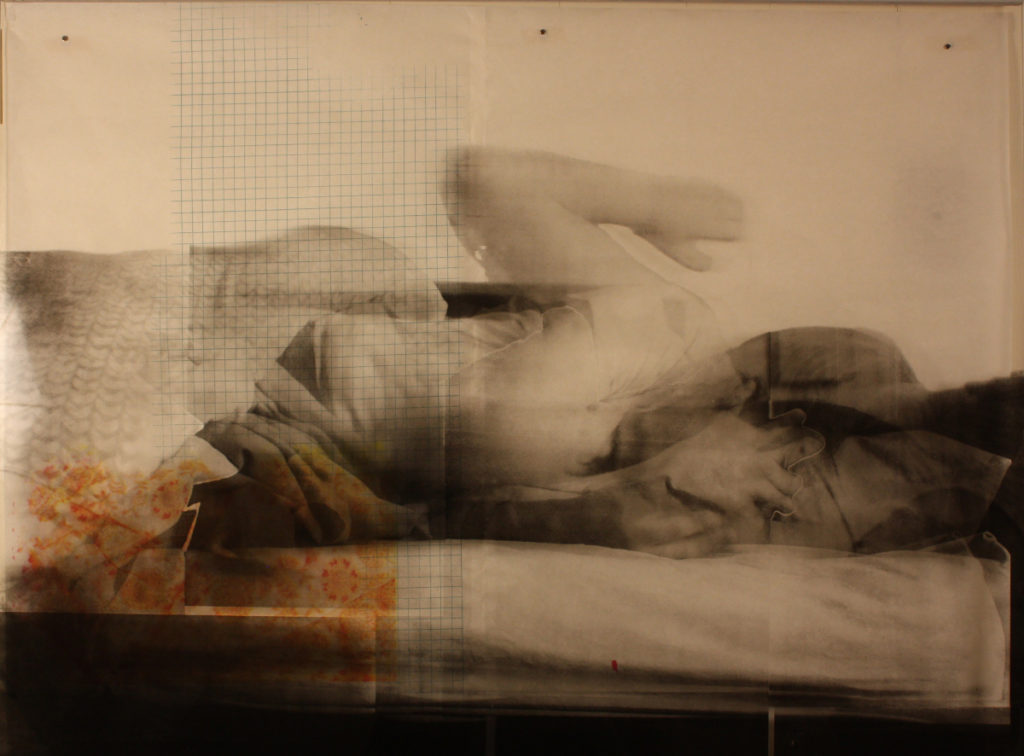
art by Heather Huston showing a figure half-rising from bed

The Everyday Liminal by Heather Huston

Once I am in my chair, the sling below me, there are several shifts that have to take place to re-position me. It’s too complicated to describe in detail, but a small shift to the left will sit me in such a way that I am able to eat without choking and allows me to tap on the keyboard of my laptop and not fall further to the right in a slump that will become uncomfortable by the end of the day. The correct placement in my chair allows me to eat meals, open my laptop, watch Netflix, read and send emails, and write passages such as this one. On a good day, I will get to FaceTime my daughters, maybe share a laugh with my son. On a good day, I may enjoy a visit from a friend or walking the dog with my helper.

When daily living provides me with so many obstacles—things that tire me out—having a chair that can be adjusted with ease is extremely important. Any wheelchair needs to have ease of adjustment and this brings me to the hate side of my current chair: the design of its parts. How can adjusting a single part of a chair require so many different tools? This chair requires wrenches, Allen keys, and ratchets. Two different tools are required to raise or lower the armrest to a better position.

For example, with the flick of a switch located just beside the seat of my chair, the armrest can be pulled out of its position and only with difficulty placed back securely. It is in fact easier to pull the armrest out than re-position it. This is a safety flaw; the opposite of a safety feature.

Let’s talk design some more. The head rest is secured to the back of the chair with a bolt. A wrench is required to loosen or tighten it. But the bolt at the base of the head rest is hidden behind a touchscreen. This is a secondary touchscreen meant to allow my caretaker to tilt, elevate, or turn the chair right or left. We don’t use this feature (fortunately I can use the controls myself). But I’ve become frustrated when we have to tighten the base of the head rest and it’s hidden behind this touchscreen. The second screen is simply bulk that is more annoying than useful.

In effect, what I’m asking for is a chair that allows me to move enough to get my daily activities done, while I’m also being physically supported, so I don’t tire myself out. On the 50th anniversary of the moon landing, as I was bumped and scuttled throughout the day and required a re-positioning in my chair, I joked that if NASA built me a chair, it would be the best chair possible. And that is my secret, playful wish: for NASA to build me a wheelchair.


In a Rita-Perfect World

As uncomplicated as silent companionship
when we listen
To simple playful magic
and the air…

When we listen
to a whale’s blow hole.
and the air escaping
reminds me of

a whale’s blow hole.
Bumped and scuttled between boats
and reminding me of swimming
between fishing lines.

Bumped and scuttled between boats,
submerged in the Saint Lawrence Seaway
between fishing lines,
the world sounds garbled.

Submerged in the Saint Lawrence Seaway,
when we take care of each other,
the world sounds garbled
then something new wants to be born.

When we take care of each other,
and remember to play,
something new wants to be born,
then laughter becomes the shower for the soul.

Remember to play,
when there are no more right whale deaths.
then laughter becomes the shower for the soul.
In a Rita-Perfect World;

when there are no more right whale deaths.
NASA will build me a wheelchair
as uncomplicated as silent companionship.

Two Poems

This entry was posted on by .

The Modeling Religion Project

What could go wrong? Sure, go for it,
commission the services of some software
to sail the edgeless expanse of algorithms
on a mission to discover why humans believe.

Douglas Adams was right: the only meaning of life
we are capable of finding equals 101010.
It is such a surprise, isn’t it?, when a child of Deep Thought
calculates that people can be manipulated.

Tweak a social factor there, a political one there,
and you have the power to move people between
religion and atheism. All Things Bright and Beautiful
are rendered great or small. The map approaches

the size of the Empire. Next step? A better UX
so a layperson can change the variables —
the funding proposals could call it METPHR.
So turn your keys to power, step right up

enter your vectors, calculate your result,
and don’t forget to save and print,
tear off the sprocket edges, tuck it into the pocket
of your expensive suit and away you go.

(Author’s note: In Douglas Adams’ sci-fi magnum opus The Hitchhiker’s Guide to the Galaxy, the supercomputer named Deep Thought calculates the answer to “the Ultimate Question of Life, the Universe, and Everything” as “42” (or 101010 in binary). More information on the Modeling Religion Project can be found here.)


painting by Su Rogers showing 1920s flapper, technology, and religious symbols

An Ecumenical Embrace by Su Rogers (Art Bank of NS)


The Modeling Religion Project

Boudica tree
kite, witch-tree
Bird trailer, cast onward
english, southward.

— Vogon Poetry Bot
April 8, 2020, 7 a.m.

Out of evil evil flourishes, out of tyranny tyranny buds.
— Alfred Lord Tennyson, “Boadicea”
1864, time unknown

Ah, how to explain to you, Warrior Queen,
your name has just been invoked by a bot
generating poetry by fictional expansionist aliens?

Welcome to our millennium, Mother of Forsaken Queens.
Here, you’ll need more than a dart and a lioness-like stare
to pry out some truth from beneath the strata of ironies.

In our defense, oh Razer of Imperialist Ambitions,
the Victorians were, like, totally way worse than us —
we are too self-deprecating to do any real damage.

But the Victorians cast a statue of you guarding London.
Remember that place? That hive of imperialist scum
you burnt to the ground? Yeah, that’s the one.

So what, oh Lover of Liberty, if our laughter
echoes over us in eternal loops of self-referentialism?
The feedback only hurts a little. And, besides,

out of evil absurdity flourishes. Out of tyranny irony buds.

Author’s note: In Douglas Adams’ The Hitchhiker’s Guide to the Galaxy, the poetry composed by Vogons is the third worst in the universe and used as a form of torture. In 2016, 38 years after the original Hitchhiker’s radio play aired, the Vogon Poetry Bot began generating computer-written poetry on Twitter. In 2020, almost 2000 years after her death, Queen Boudica of the Celts was dubiously honoured as the subject of one of the Vogon Bot’s “poems.”

Beverly

This entry was posted on by .


Their footsteps had disturbed the morning dew and left a long trail of dark green in the grass. I breathed in, exhaled slowly, and trudged up the hill following one of the wet paths. My inner voice echoed with every step. It was the sound of my mother: keep your head up, your back straight, careful of your words.

Years ago, unsuitable soil was dumped here during road construction and pipe excavations. This rolling hill was left wedged at a fork in the road between two streets, both named Beverly. Later, a few random trees were added, an afterthought, no doubt.

It was an unused parcel of land but that day the project team had gathered to kick off the “first of its kind” green infrastructure facility in our city. The team stood in two separate groups at the top of the hill: the field workers and the office folk. The groups had not yet met face-to-face, though introductions had been arranged through emails and phone calls. I was the lone female engineering designer on the team. For this project, I was also stepping into the role of construction inspector.

Stopping halfway up the hill, I took another deep breath. One of the land surveyors had laid out the project on the ground with white spray paint. I hopped over a white line, then another, to the group of my familiars: the office folk. We were the project administrators, designers, planners, and engineers. I nodded, offering friendly hellos. We made small talk about the weather and family. We listened politely to each other’s news. I answered questions from the engineer about the facility and we discussed its construction.

In the other group were the field workers: the land surveyors, machine operators, inspectors, and labourers. They didn’t seem to use birth-given names to talk amongst each other. New monikers had been appointed over time, likely through a slapstick event, shortening of a last name, or as a token of their skill. Their plaid jackets hung loosely over worn-out, orange t-shirts branded with big reflective Xs. Overstretched jeans partly covered their moulded, unlaced boots that were caked with old mud and splatters of oil.

At some point, Keith, the machine operator, broke off from the circle of field workers. He walked over and tapped my shoulder with the back of his meaty hand. A few guys from the field glanced my way.

“We have a few questions, too.” Keith said and he walked up the hill. I quickly followed at a pace that was double time to his natural stride.

“Well, over there, runoff from the road will flow off the pavement through the grass,” I said, catching my breath. “Then it will flow through a strip of rocks over there. Water that flows through the rocks will filter down through the engineered soil, about here.” I waved my hand over the land, stopping at the areas of importance and making circles in the air. I looked up to his face for clues that he understood. A full set of rolled design plans were tucked neatly in the pit of my arm. I held the heavy tube of paper tightly against my coat. Its length balanced my small frame.

“I’m used to laying pipe” he said, “now, I’m buildin’ gardens?”

“No, it’s not a garden, really. It’s an engineered bioretention facility. There will be pipes underneath.” I squished the grass with my shoes as I began to unroll the plans, firmly planting my heels in the ground. “It’s designed to filter…”

Keith walked away as I was showing him the design and casually joined back into his circle. My eyes squinted after him as if there were a glare from the lights of an oncoming car. I waited, watching to see if he would return. I was left frozen in no man’s land for what felt like several minutes. Winding up the plans, tighter than before, I snapped the elastics forcefully at each end to secure the roll. I walked back to my group with my blood simmering, replaying the scene over again in my head.

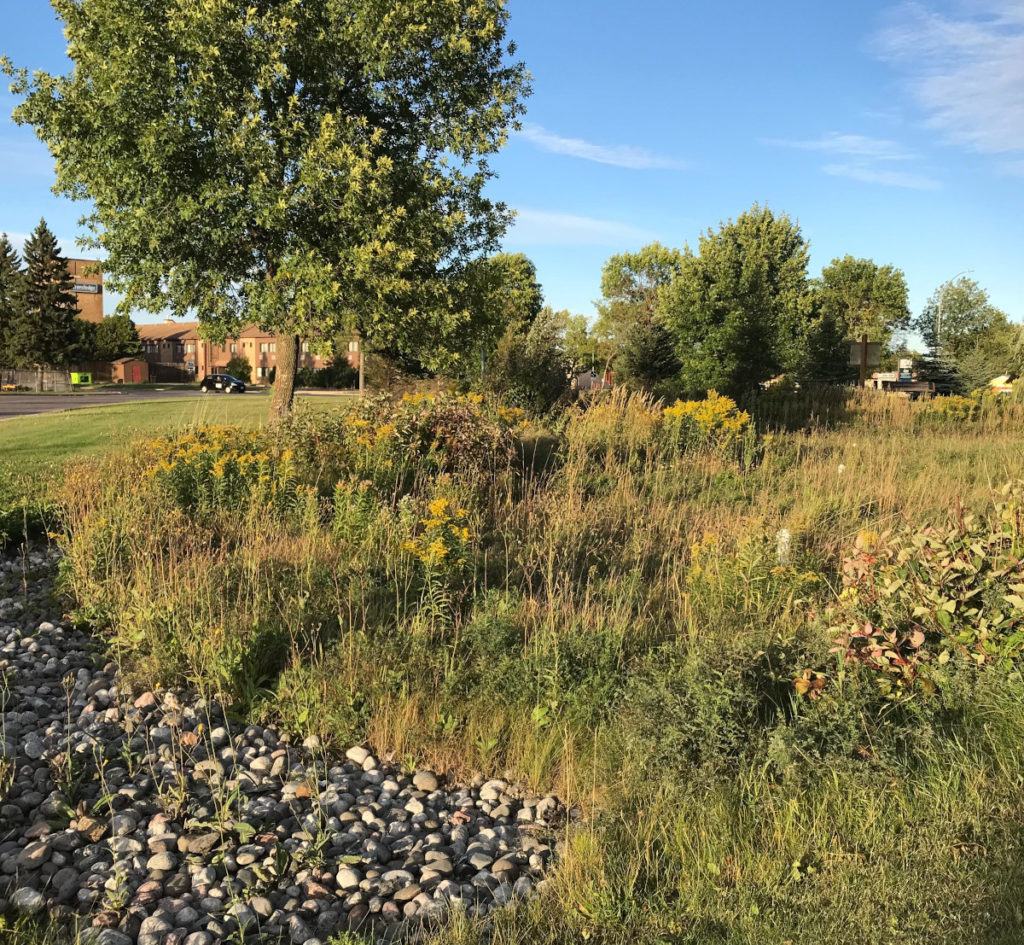
photo of bioretention area showing rock, trees, plants

Beverly Street Low Impact Development Area photo by Gail Willis

Conversations began to fade and the two circles dispersed. The office folk walked away, one by one, to their cars and waved good-bye. The field workers continued to linger on the street. One guy talked to another in a truck. A few workers gathered outside the excavator, and one had his foot raised, resting on its tracks. Some were leaning on shovels, while others organized tools. I walked alone down the hill towards my car. When I stepped off the grass onto the pavement, I was signalled by a raised arm and a backwards wave.

“How are these garden pipes gonna connect to this catch basin, here?” Keith shouted. He was standing on the street beside the surveyor and pointing at the metal grate in the road. Beaming, I made short quick strides in their direction.

“Under the layer of engineered soil, there will be a series of subdrains. Each length will connect to a monitoring well,” I said, glancing toward the hill. “Any water in the subdrains will flow towards the outlet pipe.” I paused and tapped my toe a few times on the grate. “And the outlet pipe will connect to this catch basin with a sixteen-inch pipe.”

“We’re gonna be taking out a lot of dirt then, eh?” Keith said. “Any idea how much?” Without waiting for an answer, both men turned and walked up the hill. In the distance, I heard the surveyor answer: “I’m guessing several truck loads.”

The guys started to dig before dawn on a Monday morning. I drove by their dump truck, already full of dirt, on my way to the site. My mind raced. I kicked off my shoes and stomped into heavy boots. I shrugged on an oversized plastic safety vest and fastened the Velcro straps around my waist. My hard hat perched loosely, a bright orange dome tightened to the last notch. I stuffed my calculator into my back pocket. With my arms full of equipment, I leaned forward up the hill. I forced the legs of the tripod into position in the ground, bouncing heavily on each leg. I plunked the “one-man operated” automatic digital laser level on top of the tripod. Marking the measuring rod with penciled lines, I checked the level against the benchmark and headed to the work area. I stood on the edge of the excavation.

“You should’ve been set up before we arrived!” Keith yelled, stopping the excavator. “If I was a contractor, you would’ve lost your job already!” All eyes fixed in my direction. My stomach turned. I hopped down into the trench. In a hurry, I flattened a spot in the dirt with my foot. My lips pursed in a thin line and I felt my cheeks flare red hot. Placing the rod on its end, I raised the metal sections of the ruler until the automatic level beeped.

“Keep digging, Keith,” I announced. The bottom elevation of this trench had to be precise for the facility to work.

“I don’t think so,” he said, staring intensely.

“You need to dig more, about twelve inches or so.” I matched his stare.

“Nope. Check again, did you set up the laser level right?”

“Yeah.”

But I immediately began to second guess myself. I reexamined the pencil marks on the rod, then grabbed the calculator from my back pocket. I punched in the numbers again to double check.

“307 millimetres. That’s roughly twelve inches. You gotta dig another foot,” I said. The area between my eyebrows tightened.

“Check the plans!” he yelled. “You want one of the guys to do the measuring?”

“I designed the facility, Keith. I know what the plans say!”

Keith shook his head and shut the door of the excavator. The machine roared back to life. The teeth of the bucket combed the earth, quickly and methodically, making a small pile. The bucket scooped the pile, curling under, and swung the sandy clay loam into the back of the dump truck. The other guys grabbed shovels and rakes to level and smooth out the hole. I checked again and signalled with a horizontal wave then a thumbs-up when just the right level was reached.

The work stopped at midday for lunch. The sun glared against the back of my sunburned neck as I dismantled the laser level from the tripod. I placed it neatly in its plastic briefcase before gulping down some water. I descended from the hill and sat in the grass under a tree near my car. Keith’s truck rolled up and stopped before me at the edge of Beverly Street.

“We’re goin’ for lunch,” he said, nodding in the direction of the guys sitting in the back. His arm hugged the outside of the truck door. “Come on, let’s go!”

“Ok,” I said, rising up and letting the warm air fill my lungs.

“You need a nickname,” he said, grinning. “What should it be guys?”

I walked over and joined their group.

Boys and Girls Build Software

This entry was posted on by .

Boys and Girls Build Software

Boy and girls were given the task to build software from scratch,
Their very own.
The boys got to it immediately, building it up from bones.
Began to hatch,
A plan, a strategy to wind it up, put in the least amount of work.
The boys, they were expected to excel.
No back-ups, they knew they wouldn’t fail.
The girls they paused, racked their minds,
Immediately thought it wasn’t plausible.
Immersed in self-doubt,
They took the longer route, they put thought,
Into how things became, how they were, how they can be.
But the weight of doubt wore them down.
The girls donned shaky confidence.
The girls consulted their class notes, insulating the plan, lest they fail.
The boys of the class began to goad,
Offered their ideas.
As if the girls had any shortage.
The boys had gone past level one,
Of trial and examination,
With fun and play.
The software was good enough, plus
The boys felt content and complete
With so little, there were more opportunities to accommodate.
Ever so focused on one end goal
Tackling every obstacle that tried to stall
Their destination.
The girls labored on the state,
Of this one project,
Faltering, thinking, crying, laughing, rejoicing.
Succeeding.
A hundred journeys morphed into one.
The girls devised the roadmap, every hindrance, minute detail.
All that planning, double the effort.
The challenges of time, the burden of smug advice,
From their male counterparts stood
Heavy on their backs.
They had a point to prove.
They’ve never had it without a fight.
A path, half-imagined, half-existing, laden with difficulties
Fully in sight.
The next time you teach your son
The easier ways of life,
Make sure your daughter hears them, too.
 

graphic image/poster showing woman holding electronic technology

Retro Future by Ildiko Nova

Salad Spinner

This entry was posted on by .

Salad Spinner

My mother is mystified by the salad spinner,
mesmerized by its whir and endless spin,
suspicious that it could do a better job
than her hands that know vegetables so well,
hands that know how to wash the silt from greens
– fenugreek, mustard, amaranth, bathua, choliay –
hands that know how to blot the wet from vein and blade,
how to fan the leaves on faded shawls in the sun.
Now these hands learn to assemble
and disassemble this new thing, these plastic parts.
She watches the merry-go-round
cull moisture from thin air, from tender growth,
marvels at the pool of water in its base,
excess and unwanted.
She fans the leaves on faded shawls in the sun
and boxes this thing that has replaced ritual.
She tells me, this salad spinner can only do so much.

Self Portrait by Nadia So