Archives

Milky Light of a Clinica’s Infinite Gaze

This entry was posted on by .

Milky Light of a Clinica’s Infinite Gaze

21 and I’m dispensing eight months of rent
to feel some weighted kind of fleshy titillation

trans girls from YouTube said it would be painful
having silicone bags shoved into the bust –
but then again, all the lips : hands : teeth : tongues
that I know from the meat market are no comfort

it started in May of 2014 when
I posted an ad like the ones on Craigslist
from curious anons and visiting beauty queens
whose wishes broke open with fishy trade

paid lover labyrinths have paid for this endeavour
to cultivate an augmented outlook on my being

this is what it means to hack the body in transition:

two years of hormones are barely enough
for kilogram implants and my little A-cup
to hold one another as if they can handle
the afterward waiting in a stranger’s embrace

never forget the surgeon’s misgendering

deep blue sleep in the milky light
of a clinica’s infinite gaze

hours later when the drugs wear away
I land like a needle on the full moon jellies
infixed below the surface of my tender chest
and cry for the first time this slow world to come

Manner of Speech

This entry was posted on by .

Manner of Speech

I wrote a computer program to write haiku. This was in 1994 or thereabouts. I wrote it in PASCAL. Here is its best work:

art by Karen Boissonneault-Gauthier showing a woman's face and computer keyboard

Interfacing by Karen Boissonneault-Gauthier

The taller teacher
enlightens slowly, but this
ignorance consumes.

Or rather not its best work. It had no best work, because I hadn’t written into the program any sort of function for besting. It only had functions for working. The above work is the only work it made that I remember 25 years later.

The other day I was walking down 3rd Avenue and I heard a man say, “It’s about yay big,” which is a thing my father says. “Yay” or “yea”? Or “yae”? I thought of my father but it didn’t occur to me to call him. I actually need to call him for practical purposes to do with a kid and a car but I’ve been putting it off. I don’t like talking on the telephone.

Suppose that I had written a computer program for having telephone conversations. It wouldn’t have to have good ones. It would just have to have ones that followed the rules.

“Hello.”
“Hello.”
“Do you know who this is?”
“No.”
“Me neither.”

A Message from DBDLI (June 2020)

This entry was posted on by .

On May 25, 2020, in Minneapolis, USA, George Floyd was videoed being brutality asphyxiated by a police officer kneeling on his neck for nearly nine minutes while no one stopped the horror. Two days later in Toronto, Ontario, Regis Korchinski-Paquet was killed falling from a balcony; she had been with police in her apartment after her mother called 911 out of concern for her daughter’s health. These are only two of far too many incidences of anti-Black racism that have led many of us to feel overwhelmed with disgust, frustration, despair, trauma, pain, fear, and anger.

Persistent state violence against Black people and systemic anti-Black racism in our workplaces, communities, and institutions here in Canada and around the world underscore the urgent need for change. It also highlights the need for an amplification of Black voices, perspectives, and stories.

In the time of a global pandemic and the resurgence of the Black Lives Matter movement, people of all backgrounds are seeking and listening more carefully for Black counter-stories. We are craving the rhythm of poetry, looking for the respite that visual art can offer, and yearning for the familiar sounds of African Nova Scotian voices of every timbre to help us feel we are not alone. In these pages, you will find breathing spaces and resonance. You will be reminded that we are “bound together with threads of compassion” (Wanda Robson), that we can critically hope to “build more capacity to find the courage to give back, despite the adversities we face” (Wanda Thomas Bernard), and that we do indeed “belong to a crowd that would not negate your very existence” (Késa Munroe Anderson).

As a board member of the Delmore “Buddy” Daye Learning Institute (DBDLI) and Chair of the Alexa McDonough Institute for Women, Gender and Social Justice, which partners with Understorey Magazine, I thank the talented women featured in this edition. The contributors—young and old, aspiring and seasoned—express their stories through art, poetry, and essays, covering such topics as critical hope, healing, home, racism, exclusion, body-image, family, loss, and beauty.

I also want to express my appreciation for all those who enabled the contributors to share their creativity in a beautiful and accessible way. Thanks to Katherine Barrett, Editor-in-Chief of Understorey Magazine, for her unwavering commitment to providing a platform for women and girls to express their stories and for her foresight for this special edition. Thank you Lindsay Ruck for guest-editing this outstanding edition. The DBDLI, which is committed to advancing Africentric education, is proud to have collaborated with Understorey Magazine and fund the print edition and the re-issuing of this edition at this critical time.

Remember: “Your truth is powerful” (Guyleigh Johnson).

Please enjoy and share this brilliant “African Nova Scotian Women” publication.

From the Editor (2nd edition, June 2020)

This entry was posted on by .

I wear it joyfully. I wear it big. I wear it womanly. And I wear it Black. Black. Black. As night, deep and soft and endless with no moon. Just black and perfect splendour in life and in being a woman in this world.
—from “Mirrors” by Maxine Tynes

I was in Grade 3 when I first realized I didn’t look like the other kids in my class. A young boy used a word to describe my skin colour and in that moment I felt so small. I felt ugly. I felt different. All I wanted to do was run home, stay in my room, and never go back to school again. Up until that point I knew I didn’t necessarily look like my friends. Sure, my hair had far more volume than most, and I had hit a serious growth spurt that made me taller than most of the other kids at school. But for me, the differences stopped there. I hadn’t realized that other children might view my skin colour as a negative. It never occurred to me that my complexion would be something they could mock and point out as a fault. To my recollection, that was my first experience with racism, but it certainly wasn’t my last. When something happens over and over again, one can become numb to the action. It’s so common that it no longer has the same effect as it once did. But no matter how many times I was called a name or made to feel less than, it never hurt any less. If anything, it hurt more.

What we are seeing right now around the world are people who are saying in one voice that they will no longer let this be the norm. They will no longer accept the title of second-class citizen and, this time, they will ensure their voices are heard. People are starting to make a concerted effort to listen, to learn, and to try to grasp just how deep systemic racism has been rooted into every facet of life.

We’ve also seen a great many people looking to celebrate the beauty of being Black. And that is exactly what this issue of Understorey Magazine has set out to do. When the issue was first released in 2017, I was honoured to act as its guest editor. And once the call went out, I was blown away by the number of submissions we received from the African Nova Scotian community. This province is bursting with incredibly talented and proud Black women who are using their craft to celebrate the beauty of their race, their culture, and their ancestral roots.

Within these pages you will find works of poetry, essay, painting, sculpture, and beautiful quilts. I am grateful to Editor-in-Chief Katherine Barrett for giving these women the space and the platform to highlight their work. I’m also thankful to the Delmore “Buddy” Daye Learning Institute who funded this issue in 2017 and is now providing the re-print to mark the extraordinary changes happening in our world in 2020.

I wish I had such a publication to show that Grade 3 little girl who was made to feel ashamed of who she was and what she looked like. I wish I could tell her that Black is beautiful and that, one day, in the midst of a civil rights movement, she’ll be telling her own daughter to be proud of who she is, to love herself fully, and to not be colour blind, but to be colour conscious.

Let’s celebrate our differences. Let’s lift each other up. Let’s make sure this is a movement, and not just a moment. Black women matter. Black artists matter. Black futures matter. Black dreams matter. Black lives matter.

Print Edition, 2020

The Delmore “Buddy” Daye Learning Institute has generously funded a second printing of Understorey Magazine Issue 12 with our new editorial. If you are interested in receiving a copy, please contact us at [email protected].

About Our Cover

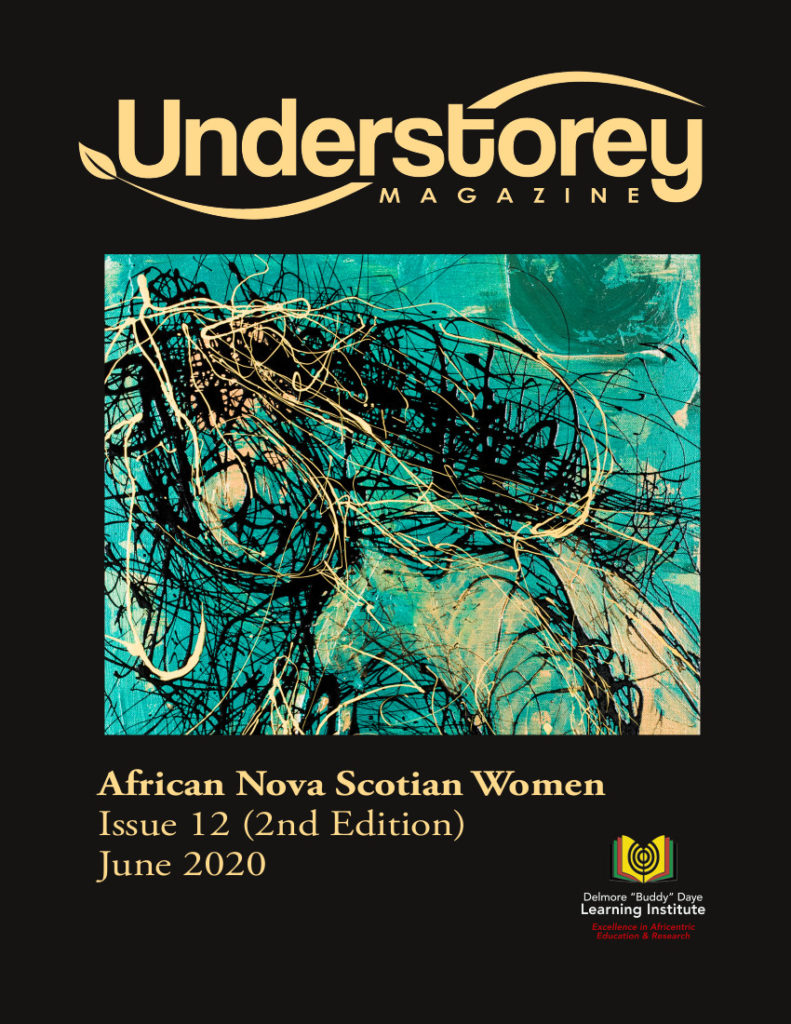
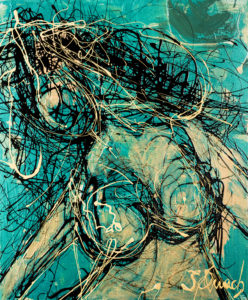
Our cover for Issue 12 features work by Nova Scotia artist Shreba Quach.

Shreba says, “I have been an artist all my life but only in the last five years have I called myself one. Creativity has been a tool for healing and recovery from a traumatic past.”

The full painting from which our cover was created is shown here.

Our Future, Our Story: New Climate-Writing by Youth

This entry was posted on by .

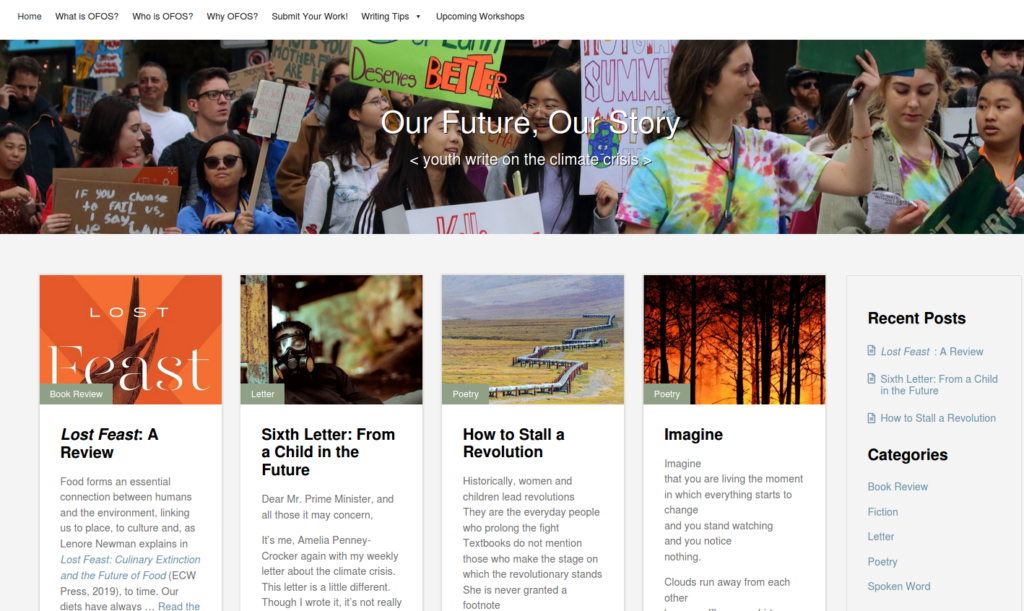
In October 2019, Understorey Magazine and the Alexa McDonough Institute organised a two-day workshop for youth. The focus was on writing about the climate and ecological crisis: journalism, poetry, spoken word, fiction, essay.

From that workshop, and several subsequent workshops, the website Our Future, Our Story emerged.

The site publishes climate-writing by youth in Canada. By March 2020, the site—including vetting and editing submissions, posting articles, design work, and promotion—will be youth-led and youth-run.

Please share information about OFOS and follow on Facebook, Twitter, and Instagram.

screenshot showing homepage for OFOS website