Archives

Discussion de Famille

This entry was posted on by .

Discussion de Famille

Je sais que tu es là,
Ma voix ne sait pas,
Il joue une clé de sol sur un alto;
“Je t’aime,” ne signifie rien.

Mon esprit est avec vous.
Mes mots ne sont pas.
L’espace entre nous est l’air,

Perdue dans la traduction.

Mon cœur se bat,
Ma mère hurlant jusqu’à ce qu’elle pleure.

Le vôtre cœur et le voix ne peuvent pas pleurer.
Un petit viola joue des chansons brillantes.
Saute,
Sauter,
Sourire.
Tes sons bouillonnants sont une symphonie du joi.

Mes mots ne sont pas le vôtre.
L’espace entre nous est l’aire que le bruit ne passera pas.

Saute,
sauter,
les petit mains,
me serrant.

Il y a pas d’espace entre nous:

Une clef de sole et une clef de base.
“Je t’aime,” est quand ma petit cousine me prend dans ses bras.

Mémoires d’une vieille maison acadienne

This entry was posted on by .

Mémoires d’une vieille maison acadienne

Jeune homme
C’est toi qui m’a bâtie et soigneusement réparée.
Jeune femme
C’est toi qui m’a aimée, nettoyée, remplie avec ta famille.
Ici vous avez passé toute votre vie ensemble.

Homme
Tu as rempli le poêle à bois
Fabriqué six chaises, une table et le bureau blanc dans la chambre de Marie-Hélène
Caréné le châssis du suête
Joué le violon
Mangé et bu ton saoul.

Femme
Tu as lavé le plancher avec une brosse
Boulangé, six jours par semaine
Broché des bas et des mitaines.
Tu as chanté, en travaillant
Récité le chapelet, le soir après souper.
Tu as berçé tes neuf enfants.

Ici, vous vous êtes aimés.
Vous avez grandi, en riant, en pleurant,
Avec vos enfants.
Vous avez vieilli
Vous êtes morts maintenant
Mais votre maison demeure encore
Et elle parle de vous.

Un effet d’entraînement 

This entry was posted on by .

Je n’ai pas cherché la francophonie par exprès. Je suis née à Terre-Neuve, dans une famille complètement anglophone, et mes parents ont choisi de m’inscrire en immersion française tardive parce que j’avais de bonnes notes en école élémentaire. Bref, je suis tombée dans la francophonie sans comprendre la conséquence et l’influence que cette langue aurait sur ma vie une quinzaine d’années plus tard.

Pendant ma jeunesse, je n’ai jamais trop réfléchi à mon opinion sur le français. J’étais un bon élève, je suivais mes cours en français sans plainte. Ce ne fut pas avant ma dernière année de secondaire, où venait le temps de choisir un programme d’études universitaire que je me trouvais à dire « Bon.… J’aime bien mes cours de Français, peut-être que je pourrais l’étudier ». L’idée m’a frappée tellement soudainement, je ne me comprenais même pas. Quand mes proches m’ont poussé vers un autre poursuit, et je demeurais la seule à défendre l’idée de suivre le français, j’étais une adolescente naïve qui écoutait ses aînés plus sages et expérimentés. Ça va sans dire qu’après un court trimestre comme étudiante de biologie, parmi les échecs les plus colossaux de ma vie, je me suis inscrite dans le programme de Langues modernes et classiques à l’Université Saint Mary’s, où je me suis enfin plongée directement dans ma langue de cœur.

Ma chute était rapide. J’ai pris avantage de quasiment toutes les opportunités que l’université me présentait, un trimestre en France, des sessions à discuter en français avec mes profs et d’autres étudiants, pour combler le tout avec un diplôme de maîtrise en Littératures françaises. C’est à travers mes études que j’ai appris la phrase « francophone d’apprentissage », une phrase que je crois me décrit à 100%.

J’habite aujourd’hui au Nouveau-Brunswick, la seule province bilingue du Canada. Je suis enseignante d’immersion française. Ayant bouclé la boucle en quelque sort, je me trouve de l’autre côté du pupitre, espérant que j’allume chez un élève la même passion que je ressens pour le français. Mais dans ma province, la relation entre l’anglais et le français demeure très compliquée, remplie de chagrin des deux côtés depuis longtemps. Il me semble que la façon dont je suis tombée dans une vie bilinguefrançais le jour au travail, anglais le soir avec les amis et la familleest devenue une représentation d’une relation linguistique idéale.

Mais parfois, je me sens un peu coupablej’ai le meilleur des deux mondes en parlant les deux langues de ma province. Je sais que le fait que je sois bilingue est l’une des raisons principales pourquoi j’ai pu trouver une poste d’enseignement à temps plein tout de suite après avoir complété mes études, tandis que mes amis qui n’ont pas le niveau de français suffisant doivent faire de la suppléance ou se contenter de chercher un emploi dans une autre domaine. Même plusieurs parents de mes élèves me disent qu’ils ont choisi l’immersion pour leurs enfants parce qu’ils veulent qu’ils aient un avantage dans le marché du travail quand ils seront adultes. Ces parents n’ont pas tout à fait tort, mais ça reste décevant de voir une attitude aussi pragmatiste autour d’une langue et d’une culture tellement riche.

Pour moi, le français m’a ouvert plus de portes que j’aurais cru possible. Ça va sans dire qu’au niveau professionnel, parler plusieurs langues aide ces jours-ci, mais au niveau personnel je trouve que j’ai une vie énormément riche. À travers mes divers intérêts, j’ai pu rencontrer plusieurs amis francophones que je n’aurais jamais rencontré-e-s sans ma langue d’adoption. Je n’ai pas eu peur de voyager dans d’autres provinces et d’autres pays, qui m’a donné la chance de voir et vivre d’autres cultures. Je fais tout ce que je peux pour partager les nourritures, les littératures, les films que je puisse avec ma famille. C’est la moindre façon que je peux leur remercier pour tout ce que mon statut de francophone d’apprentissage me donne.

Mes parents ne l’ont pas compris quand ils ont choisi le français pour moi, et je n’ai pas compris moi-même jusqu’à ce que je sois devenue adulte. La seule déception qui me reste c’est que je ne peux pas partager l’ensemble de mon monde enrichi avec ma famille, qui demeure unilingue jusqu’à présent (malgré quelques tentatives d’apprendre les phrases essentielles). Mais cela aussi fait partie de l’apprentissage qui vient avec le vécu, et je sais que si un jour j’aurai des enfants, je ferai tout mon possible de leur fournir la belle chance que mes parents m’ont donnée, car le français a sans doute changé ma vie.

You Can Do Better Than That

This entry was posted on by .

I was two days away from my thirty-second birthday and giving birth to my first child.

“Push, push! Come on, you can do better than that,” the nurse was yelling at me.

“No, I can’t. I’m giving it everything I’ve got,” I remember saying.

“There’s something to be said for having your kids when you’re younger,” she grumbled.

Everything after that is a blur. My baby boy came out healthy and demanding my attention from his first breath. He weighed nine pounds but the statistic that impressed me was that his head circumference was thirty-seven centimetres.

“That’s a large head,” my doctor later told me. “Good for you, you did so well.”

“The nurse didn’t think so,” I said and then recounted my “moment” in the delivery room. I was still angry weeks later and now so was my doctor.

“Some people still believe that the best time to give birth is in your early twenties. It’s old thinking,” she said.

“Who’s ready for that in their twenties?” I’d had a long labour and a tough delivery.

“Exactly,” the doctor said.

Since then, a number of my friends have had their first children at forty-two and forty-three. I didn’t think that unusual. My mother gave birth to me when she was forty. And back then, that was definitely rare. I was the youngest of three; my sisters were ten and fifteen when I was born.

“Why the big gaps?” I asked my mother.

“Sometimes you can’t plan these things,” she said. “I wanted five-year spacing but after your sister was born, I had a hard time getting pregnant again. But I really wanted a third child so we kept trying,” she explained. “And now here you are, what a gift.”

“Was it because dad wanted a boy?” I asked what I had wondered for so many years.

“Oh, maybe,” my mother said. Her eyes were sparkling and she was smiling. “But he was thrilled when you were born. We both were.”

Looking back, I realise that I have always been around people who were older. It was normal to me. There were my parents, and my parents’ friends; my sisters and their friends. No one was surprised then, that I married a man twelve years my senior. I wasn’t bothered by our age difference too much, although there were times when I wondered if it was a good idea. I remember talking to my mother about it once and our conversation went something like this:

“If on average women live seven years longer than men and he’s twelve years older than I am, I’m going to be alone for nineteen years. I don’t know if I want that,” I said.

“Yes, but remember, those are statistics. You can’t plan your life out too carefully. Sometimes you just have to live it.” My mother adored Eric.

We had been married for ten years when both of my parents moved in with us. My mother had been diagnosed with Alzheimer’s and needed care. My sisters were working full time but I had taken time off the paid workforce to raise my two children. I was at home anyway, so why wouldn’t I look after my parents too?
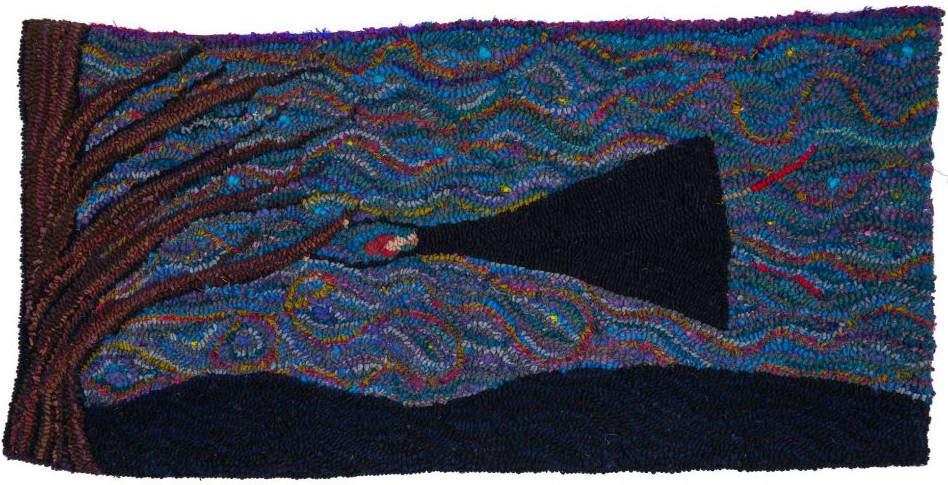


Holding On (hooked rug) by Laura Kenney


Looking after my parents was not only what I wanted to do, it was what I had been raised to do. In our Portuguese culture, it’s normal, it’s expected, it’s just the way it is.

Our situation was more complicated than most in that my parents didn’t speak English very well. They had immigrated at the age of fifty and their knowledge of English at the time was limited to a few words and sentences. Both of them had started their Canadian life working hard, each of them often juggling two or three labour-intensive jobs. Learning English dropped on the priority list—they had to house and feed their family. After nearly three decades, they could get by in their adopted country, but their English was still broken.

As my mother’s illness progressed, she lost all of her ability to speak English and could only communicate in Portuguese. To have put her in a home would mean that one more time in her life, she’d be unable to talk to anyone. I couldn’t fathom that. So Eric and I invited them to live with us. My sisters helped regularly and, later, there was support from the health system. Still, for a few years, my life was a whirr of caregiving. I remember taking my parents for coffee one day. It was their preferred outing: coffee and a biscotti in the afternoon. As we were walking from the car to the coffee shop, we took up the entire sidewalk. I was in the middle; my mother held on to my arm on my right, and my father, with his cane, held on to her. On my left, I held my son’s hand and he held on to his sister who was then about four years old. We must have made quite the scene. One woman walking toward us stopped and said to me, “Well, aren’t you the sandwich generation.”

Yes, yes I was. My days were full of caregiving from the moment I woke up until I laid my head on the pillow at bedtime. And sometimes I’d be called upon once or twice during the night too. My morning shower was the only time I could guarantee that I would be alone. Sometimes, when I took an extra long shower, there would be a knock on the door, “Mommm! Vóvó needs you!”

I remember crying in the shower one day, thinking, Oh my God, I am going to be looking after needy people for the rest of my life.

That night, in bed, I turned to Eric and said, “I’m going to need to look after you too, aren’t I?”

“Maybe. Or maybe I’ll have to look after you. You can’t always plan, sometimes you just have to live, isn’t that what your mother said?”

“Yes, you’re right. I mean, I could step off the curb one day and get hit by a truck. That would be horrible.” I remember laughing so hard after I said that. I was exhausted.

My mother died after living with us for two years. My father died nine months later. And then, two short years after that, when we were finally recovering from all the grief and were establishing a new normal in our extended family, my sister Maria was diagnosed with aggressive, terminal cancer, and died. She was fifty-six.

Today, I am the same age Maria was when she died. I have taken a leave from work and I have become a student again. So many people, friends and strangers alike, have said to me, “Wow, good for you. A student. I don’t think I could do that, not at my age.”

That baby I pushed out all those years ago has now finished university; his sister is halfway through. Both are adults with their own dreams. Eric will retire at the end of the year and soon after that I hope to get my degree. No part of our lives follows the expected trajectory. We seem to live life by the seat of our pants and, most of the time, I wouldn’t want it any other way.

Five Years Old

This entry was posted on by .


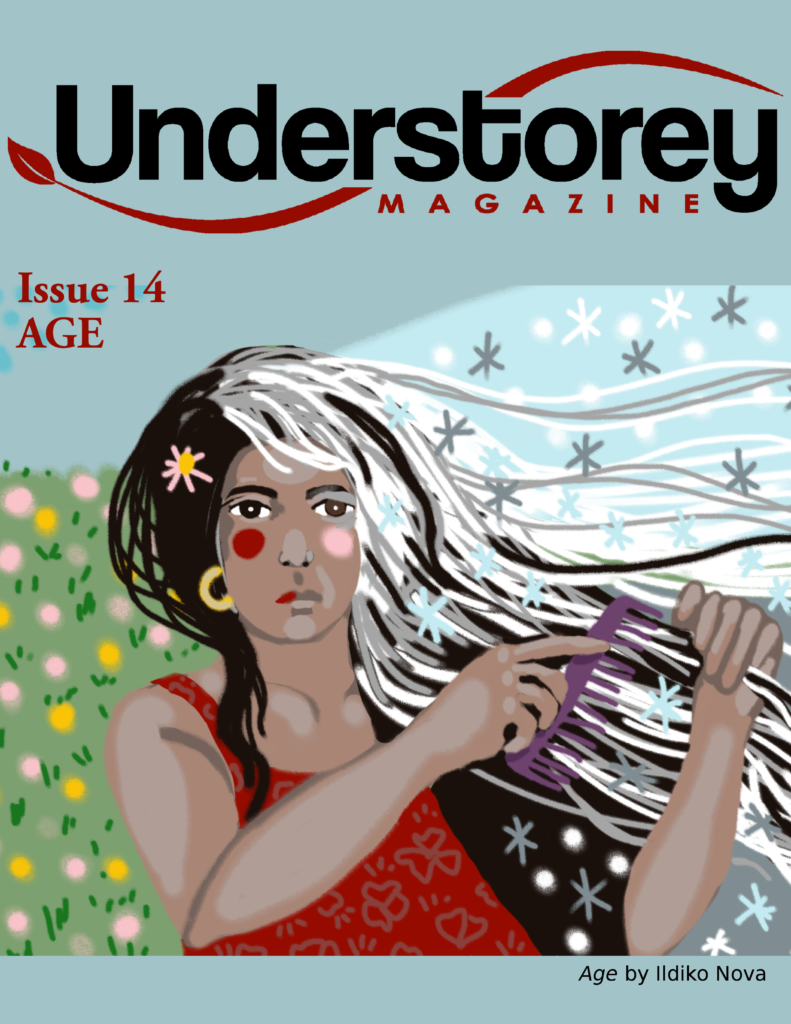
Understorey Magazine Issue 15 cover, with Age by Ildiko Nova


Age

Welcome to Understorey Magazine Issue 14, an exploration of women, age and ageing.

The idea for this issue grew from many roots. There were discussions among our illustrious editorial board, of course, reflections on our own experiences of ageing: Reconciling that new face in the mirror or that oh-so-familiar but now elusive word. Contemplating how to act your age and then contemplating why the hell you care. Learning, all over again, how to ask for help—and how to give help in whole new ways. Many of these themes unfold in the eloquent, candid work by the writers and artists of various ages published here.

Our Age issue marks a milestone for the magazine, too. This autumn, Understorey turns five. As editor-in-chief for those five years, I have learned a thing or two about the creative process, about art and time. These ideas also inspired this issue.

I have seen, for example, far too many lists, prizes and accolades for “new” and “emerging” writers that in fact mean new and young writers. As if you might only emerge as a creative talent while young—and then either fizzle out or mature into an old, established voice. For some extraordinary young people, this is in fact their literary path. But they are exceptions, I think: art derives from experience, and experience comes with age.

Creators of the website Bloom recognise this. The site is dedicated to authors who have published their first book after age forty. Many other websites list authors who “got a late start,” first publishing after thirty or forty or even—gasp!—fifty. This is progress but, honestly, who has the means to write a novel in their forties? Why not a prize for “new” writers over seventy? An award for “emerging” artists over eighty?

Art takes experience but it also takes mental space, pauses in the day, the wherewithal to stop earning or caregiving—or both—long enough to gather snippets of images, cultivate a thought, nurture an idea into a finished work. Midlife, those moments are rare. As author, teacher and contributor Tanis MacDonald says in her book Out of Line, “I don’t have a life where it is possible to write every day, and I’ll bet you don’t either.”

Over the past five years, some of the most intriguing work has come to Understorey partly formed. These pieces were truly borne of lived experience but perhaps not into circumstances that allowed extended and studious polishing. This work is—like so much art, like most of us—both young and old. It offers wisdom but might still benefit from the guidance and wisdom of others. It is beautiful right now but will only grow more so with time and care, that is, with age.

Thank you for reading Understorey Magazine‘s fifth anniversary issue on Age. Please share with others and, if you are so inclined, leave a comment for our contributors.