Archives

Fractures: An Adoption Story

This entry was posted on by .

I am holding the court papers in my hand. Never did I imagine it would come to this.

I think back to the first time I met him—he was seven, I was ten. It was at a Chinese restaurant on the main street of Fredericton, the kind that served sweet and sour fried chicken balls with the unholy orange sauce that was popular in the 1970s.

My mother’s colleague organized the meeting. Did he know that it was a de facto interview for a new family? Although it was done with the utmost of secrecy—an “accidental bumping into” at the restaurant—I suspect he realized in the recesses of his seven-year-old brain that he was on display for us.

He was boisterous and restless, what would probably be labelled ADHD today. Yet, behind the rambunctiousness, there lurked an unsettled, hostile force. Did my ten-year-old mind detect this or is it framed by adult hindsight?

He ate exuberantly although I am sure most of the tastes were completely foreign to him. Between mouthfuls, he showed off a toy he had received for Christmas. While my siblings and I technically had veto power, in reality we knew that there was no sense in raising any objection: he was about to become our younger brother.

*

I remember the day he came to live with us. He was just about to turn eight; I, eleven. It was something we had in common, birthdays in the same month. The green VW Beetle pulled into the driveway of our home, mid-afternoon. Out he tumbled with all his worldly possessions: one small yet sturdy suitcase and a giant stuffed animal, given to him as a parting gift, as if to say bon voyage.

My heart broke at the sight of his meagre possessions. I was humbled and guilt-ridden at the thought of the house behind me filled to the rafters with stuff, when he had so little.

At first, like a new pet, he was a novelty—entertaining with his jokes about kings on their “thrones” (I learned that boys never grow tired of poop jokes) and his energy, playing for hours on end with his new Tonka trucks in the backyard.

Then the legacy of his childhood began to rear its head. He was the product of teenage parents, at first shunted between relatives and then sent through an ever-revolving door of foster homes. His anger at being so unwanted in the world took on a more visceral, physical response as he grew older. His fists became a weapon of choice in expressing the rage he didn’t understand and I, three years older but not much bigger in size, a convenient punching bag.

In a household already filled with physical and emotional chaos, we were not equipped to deal with the fallout of his neglected childhood. I skim a memory off the percolating surface of my own childhood.

I am lying in a snowbank, red parka against a freshly powdered white backdrop. My brother, jeered on by his friends, has just beaten me up on the way to school. I wait until I hear the scrunch of their boots fade away, weighted by the shame and humiliation of what has just taken place, before I can pick myself up and make my solitary way to class. I am grateful no one asks questions about the bruises beginning to turn the sides of my face a molten purple.

Although the settings change, it’s a scene often repeated over the years. I am nineteen before I stop being afraid of his fists. I am home from university and although he still gets angry, I see he has learned to lash out with his voice instead. Still, I instinctively shrink from the words of wrath and livid face whenever he vents his anger.

Gradually though, the jagged peaks of rage soften and time smooths out the dark crevasses of fury. A genuine fondness for each other replaces the childhood yoke between tormentor and the tormented.

I am amazed by the culinary skills that he seems to have plucked from thin air. He is ever the “mechanical genius,” as my father likes to call him, a blessing in a family that can barely figure out how to operate a toaster. It becomes a family joke: a pitch for a new Martha-Stewart-style DIY show that highlights the range of my brother’s talents—from inventing household gadgets and building furniture to crafting recipes for tasty homemade confections and canning organic tomatoes.
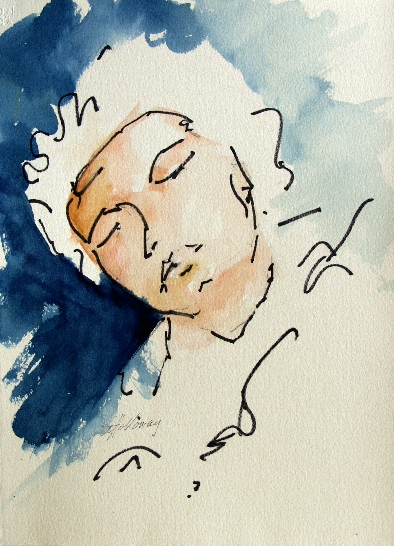
Essence by Anya Holloway

He is impressed by my career too, a whirlwind of airplanes and countries as I travel the world with the United Nations. I enjoy bringing him mementos from my travels: silk rugs from Iraq, handcrafted boxes from Sierra Leone.

It is now a relationship built on stabilizers, phone calls on birthdays and in the next port of call between trips home. He visits me in Ottawa many years later and presents me with a ticket to Phantom of the Opera at the National Arts Centre. I become teary-eyed at the thought that somehow we have managed to survive the upheavals of our early years and climb into a life raft together. It feels miraculous.

But then the miracle crumbles once again. I see that it is a mirage instead: shimmery, bathed in a golden glow, yet elusive and ultimately out of reach.

The cracks appear slowly at first, almost imperceptibly. We are standing on the stairs of our childhood home. He is yelling at me for some forgotten infraction. I am exhausted, having been up most of the night with our mother, who lies dying in a room below. I am not afraid that he will physically strike me, but his anger is real, palpable and directed at me. He is using his size and the chaos of the moment to put me in my place.  That moment passes but the sensation of his belligerence lingers for a while longer.

*

Our mother dies. The animosity that my brother had exhibited in his early years reappears toward the rest of the family, but not yet with me. The familial pressure valve begins to hiss in earnest when care for our father becomes an issue. Leaks, then ruptures appear in his relationships with my other siblings. Still, he invites me to visit him at his cottage to heal my wounds after a disastrous posting in Afghanistan. Is this his unspoken mea culpa to me for the years when his fury and his fists were his most memorable traits?

Our father is rushed to hospital suffering from pneumonia. My brother wants him to remain in hospital post-convalescence; I would like him to be cared for in his home with the same loving attention we provided to our mother during her dying process. But I know that underneath these disagreements over sick, ageing parents lurks the broken bones of a neglected childhood that have never properly mended. The peaks of anger and hostility re-emerge from the past. It’s as if he is the seven-year-old boy again, feeling unwanted and unloved, shoved into a family container that is already filled with strife and unhappiness. Though the wounds have now split open on all familial fronts, I cling to the mirage of the life raft we built together.

Then the doorbell rings. As if culled from the latest courtroom drama, I am served with papers from my brother’s lawyer. I feel the heft of the documents in my hand. He has used the courts to transmit his pain, demanding his siblings be ex-communicated from the care and welfare of our father. All contact between us abruptly stops. The legal system becomes a giant X-ray machine held up for the world to see, a portrait of a broken family unit—a messy web of ghostly breaks. Affidavits are the X-rays through which every crack, every splinter, of the family skeleton is captured. And even without a doctor’s diagnosis, I know the X-rays will confirm that the fractures can’t be healed.
Searching for Home

This entry was posted on by .

Enfolded in the hills of southern Vancouver Island, a two-storey house still stands in the center of a small acreage. When I dream of home, I dream of this house. I lived there until I was ten years old.

My dreams of the house are visceral. I feel the coarse loops of the carpet, I know the shape of light the dining room window casts on the far wall. When I awake, I am so full of longing that I feel as if I’m returning to dry land after breathing underwater.

Maya Angelou says, “I believe that one can never leave home. I believe that one carries the shadows, the dreams, the fears, and dragons of home under one’s skin.” I have not lived in that home for many years, and yet I feel as if I have carried a piece of it with me since I left.

*

Like the connections we form to our parents, the physical place in which we grow up—both the building and the surrounding geography—imprints itself on us as infants and helps to build a sense of security, what Alain de Botton calls a “psychological sanctuary.” Our childhood home is part of a powerful set of memories that goes to the very heart of who we are.

In my childhood, my home was the place from which all my feelings of belonging originated. Everything about it was magical to me—the crawl space where we stored Christmas decorations, the cookies that emerged from the kitchen—and the landscape, such as the ooze in the pond and the garden and its rows of corn and peas.

I once found a bunch of carrots growing in the unkempt grass on the edge of the lawn, several feet from the garden. When my father dug them up, out came perfectly formed, foot-long carrots, bigger than any we had harvested from the garden. “They must’ve grown from a seed packet I tossed away,” he mused. I thought of Jack and his beanstalk.

There were dragons at home, though. Divorce came, a bitter crisis that left us all shattered. My mother stayed at the house with my two sisters and I moved out with my father. I was ten.

My father told me I was lucky to be with him, I was better off away from my mother because she favoured my sisters. This seemed to make sense—my father was only trying to protect me. He assured me that the new house he was going to build would be good—better than the old one.

*

Simply living somewhere does not make it a home. That sanctuary that we all seek cannot be created instantaneously. It takes time. And familiarity. And so many unnamable things, individual to each inhabitant.

In the early twentieth century, the modernist architect Le Corbusier sought to strip away architectural affectation in favour of simpler forms. When he was commissioned to build homes for factory workers in France, he designed apartments that had bare concrete walls and naked light bulbs. Gradually, the tenants began to transform the apartments: “Unconcerned with spoiling the architect’s design,” explains de Botton, “the tenants added shutters, flowered wallpaper and picket fences.” Over time, the tenants were able to create a sanctuary away from the grimness of the factories by imbuing the apartments with their own identities.

Although I tried to convince myself that my new house was as good as the old one, in truth I looked for my old house everywhere—even the surrounding landscape was not beyond my scrutiny. Behind the new house was a small marsh and sometimes I would clamber through the brush to stand on the edge, breathe in the familiar smell of skunk cabbage and imagine that this was just like the pond at the old house. But it wasn’t.

Where before having friends over was as easy as a knock on a door, it now involved phone calls, conversations between parents, strict curfews. The new house fulfilled the criteria of Le Corbusier’s “machine for living in,” but I know that I never felt at home there. And I did not have the autonomy that the factory workers had to transform the house myself.

littleyellow

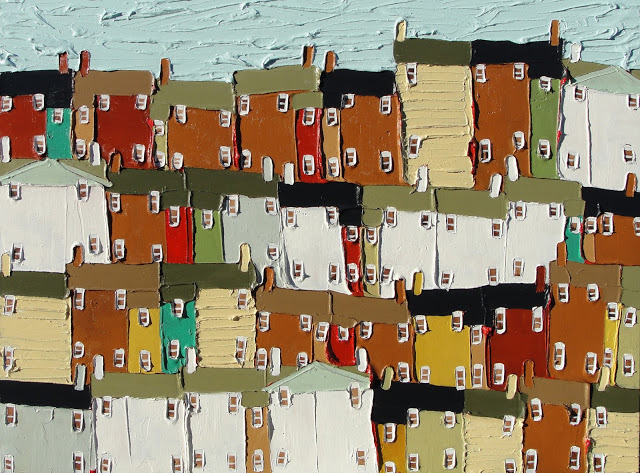
Five Yellow Houses by Jennifer Harrison

Nine years after my parents’ divorce, I moved out to attend university in Victoria. That same year, my father moved into a new house. My mother had long since left the old family house and so suddenly, I had no childhood home. It left me feeling adrift. So began my moving years.

Built around the school calendar, the moving cycle would start in the autumn: my regular roommates and I would find a place in September and disperse when classes ended in April. I stopped returning to my father’s house in the summers and so would move again. I could have found a cheap apartment and stayed put, but I didn’t. I just kept moving.

In September, my roommates and I would regroup and find a new place to live. We had become fast friends, four young women in our twenties and precocious to no end. We cooked, made wine, got robbed, fell in love but, eventually, each of them finished school and moved back to their hometowns. Except me. I stayed in Victoria, but kept moving.

I became an expert at it. I used every container available to avoid the hassle of finding new boxes: I packed blankets and sheets in laundry bins, knickknacks went into garbage cans. I never unpacked drawers but simply removed them from the dresser and brought them to the moving van just like that. I kept all the boxes I did have for the inevitability of the next move. Over five years, I moved eleven times.

I never questioned what I was doing. “Geography has little meaning to the child,” Angelou says. “Since the child cannot control that environment, she has to find her own place.” I moved through my geography in a blur. Finding my own place was something I didn’t know how to do.

*

I was twenty-eight and living in Vancouver when I met John. I didn’t realize it at the time, but he was the love of my life. After a year of dating, we moved in together. I flattened all my boxes and tucked them into the basement, sure that the time to leave would soon come.

A year went by. I began to feel restless, would grow irate at the sheer amount of stuff we had. John had so much stuff. In fact, he kept not only his own stuff in the basement but stuff that didn’t belong to him, including stuff that belonged to an old roommate of his, Mark.

“Get rid of it!” I insisted.

“I’m not throwing it away,” John said.

I hated Mark. I didn’t know Mark. “I’m not going to be the one who hauls it to the truck when we move!” I declared. I had drawn my line in the sand.

I wanted to move, I realized. Moving felt normal.

*

De Botton calls home a “guardian of identity…where we slowly resume contact with our most authentic self.” For years, I had kept the dragons of my first home buried beneath the preoccupation of moving. But now, I couldn’t move. What was I supposed to do with myself?

I put up coat hooks by the door. I found a coffee table for the living room. I hung up a poster from a museum in Scotland that John and I had visited together. Slowly, the apartment began to reflect my personality as much as John’s. My feelings of restlessness began to fade.

One day, John and I ventured down to the basement to do some reorganizing.

“Do you still need all these old boxes?” he asked.

“Well, if we move, I’ll have to find more,” I said.

“Yeah, but when exactly are you going to move?”

I put them all out with the recycling.

*

It happened when I was cooking dinner. When I was discussing Shakespeare with John over a bottle of wine. When I was washing the dishes. How did I get here? I’m home. My first home is still with me—all the dreams and dragons of it. I carry it close, but it no longer burdens me.

John and I still live in the same apartment. We replace washers in the taps, clean the windows, sweep away the dust that gathers in the corners as if by magic.

Sometimes, I fall asleep on the couch in the afternoon, dream of light shining green through maple leaves, of gravel roads. The furnace in the living room pings as it cools down and the sound follows me in my sleep. It will be the only noise I’ll hear until John opens the door and returns home.

References
Angelou, Maya. “Home.” Letters to My Daughter. New York: Random House, 2008. 5-7.
De Botton, Alain. The Architecture of Happiness. New York: Vintage Books, 2006.

Recipe Books / Colonial Guilt

This entry was posted on by .

Recipe Books

My mother pulls out a pink recipe book
from her Company’s Coming collection,
the spine spiralled,
turning in upon itself in a subdued imitation
of regret. I think of all the recipe books she gave me,
that I crammed into a water-stained cardboard box
and took to the Salvation Army
the year I moved from Sherbrooke to Québec.
She sits at the table, runs a finger
down the list of ingredients for rhubarb crumble,
flattens her lips in concentration, leans back
in her chrome kitchen chair.
“It’s too hot,” she says. I offer to do it,
to cut the rhubarb, boil the white sugar and water,
press the oatmeal-butter-brown-sugar mixture
into greased pans, as though this will compensate
for all the recipes I have not made
from those books she gave me,
those books I abandoned,
their spines now slanted anonymously
on the shelves of some used book store,
collecting dust, staring back at hungry strangers
whose mothers never baked for them
like mine did—current cookies, scones, ginger cake,
uncooked chocolate cookies, raisin pies,
date squares—hours and hours of her life
spent jackknifed over an oven.
My mother declines my offer. The moment
for baking is gone. There will be
no crumbs, no smear of sweetness
across my tongue. The recipe book is closed,
all its instructions for sharing moments of love
and happiness trapped
within its silenced pages.
I had no idea.

Retired

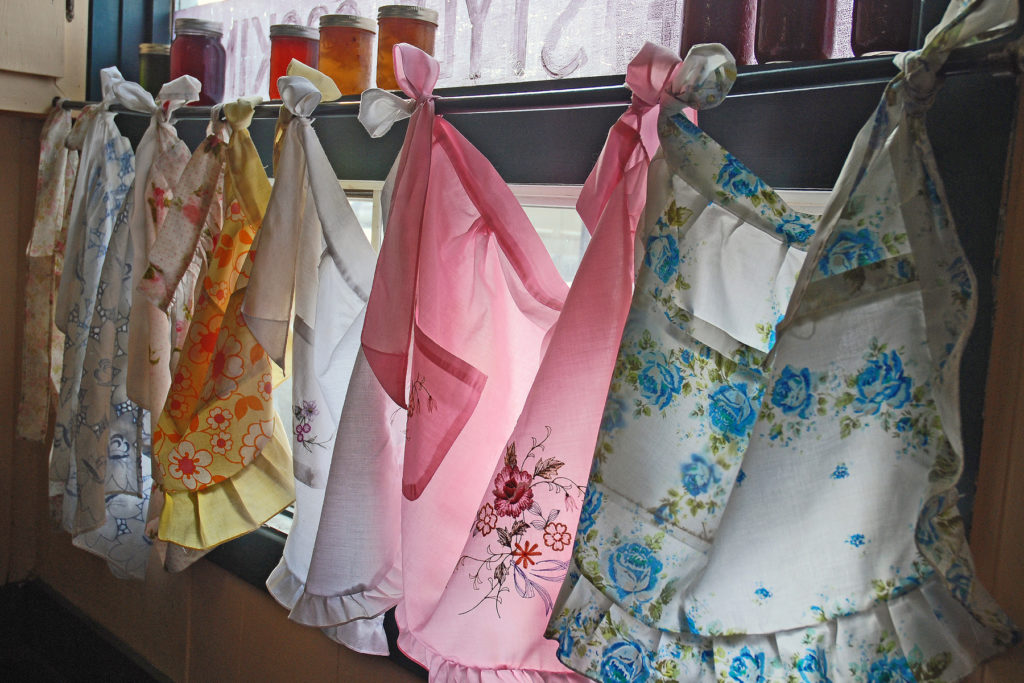
Retired by Sara Harley

Colonial Guilt (of a Nine-Year-Old Child)

It is true that I may have a great-great-
grandfather who stood among the willows and
tamarack and took your great-great-
grandfather’s furs and gave him muskets, beads,
brass kettles, flannel, knives, Hudson Bay blankets
and alcohol in exchange.

It is true that I may have a grandmother or great-aunt
who taught in residential schools, thinking to
help your mother integrate Canadian society,
teach her Christianity and how to read and write
a language different from the one that cradled her
in her mother’s womb.

And I suppose that, given my heritage—given
all these people who turned your ancestors’
world upside down, their upheaval trickling down
through their blood, despair, anger and tears to
leave you uprooted, displaced, disinherited,
broken-hearted—you might be entitled
to call me names (whiteman, honky),
pull my hair, chase me down on a
skidoo and hold my head
under the snow. I am, after all,
just a symbol—
empty but for the sins and
(occasionally misguided or ignorant,
perhaps well-intentioned but sometimes
simply cruel) mistakes
of my ancestors, written
out plain for all to see.

No scarlet letter this.
Simply white skin.

Imagined Dialogues with My Grandmother

This entry was posted on by .

Imagined Dialogues with My Grandmother

I am five, six, seven years old
standing in my grandmother’s bedroom
next to an ancient oak table while she sits on the bed.
Long ago widowed, she wears a black kerchief,
hands folded over a heavy brown dress.

We have established a treasured ritual.
She recounts epics from her expansive life
and I stage lengthy concerts comprised
entirely of improvised songs in “English.”
Taking great joy in each absurd performance,
I contort my mind, striving to summon
the most improbable sounds.

Trotting back home at sunset
through familial fields and orchards,
I do not detect the dark irony of our game
in light of approaching destinies.

Shortly, incoherence inverts reality
as all is whisked away by war,
and a few years later
I stumble through a foreign land,
fitting my mouth with a new tongue.

After she passes away
I start listening to old Russian ballads,
trying to imagine that she is singing back
the nonsensical chants from my childhood.
I cannot comprehend the language
but its similarities to Serbian yield
slow flows of faint echoes,
providing an inexplicable comfort.

Searching through past epochs of memory
for slivers that could rethread our dialogues,
I spend years trying to write her one small
poem in non-invented English to say:
I am sorry for leaving,
but you have gone forward
to an even further country
and must have learned
so many new words

surely now you can understand.

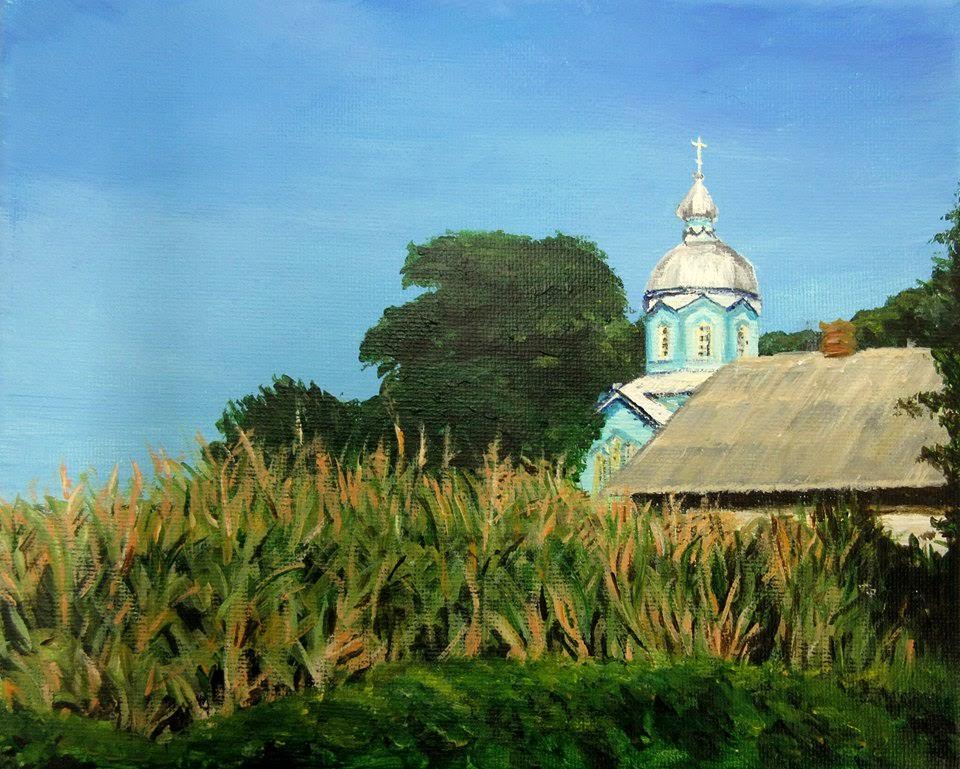
church

Church of Many Stories by Valentina Kenny

Collective Voices

This entry was posted on by .

Where Fear Meets Love

by Zainab Al-Habibi

When I was a child
I would to go to my mother’s bedroom
while she was asleep.
I’d touch her left side of her chest
to check her heartbeat,
to see if she was still alive.
I cannot recall a time when I thought of my family
without death also in my head.
Fear and love went hand in hand.
Ancient Egyptians embalmed the dead,
rituals to preserve the body and empower the soul.
It’s not so different now.
We are afraid of loss,
of disappearance.
As I grew and met more people to love,
fear became such a heavy burden.
But not very long ago,
I discovered fear will not prevent death,
it will only prevent me from living.
So now, when I wake up,
I don’t check my mother’s heartbeat.
I simply look outside my room,
I find my family,
I know they are close,
It is enough.

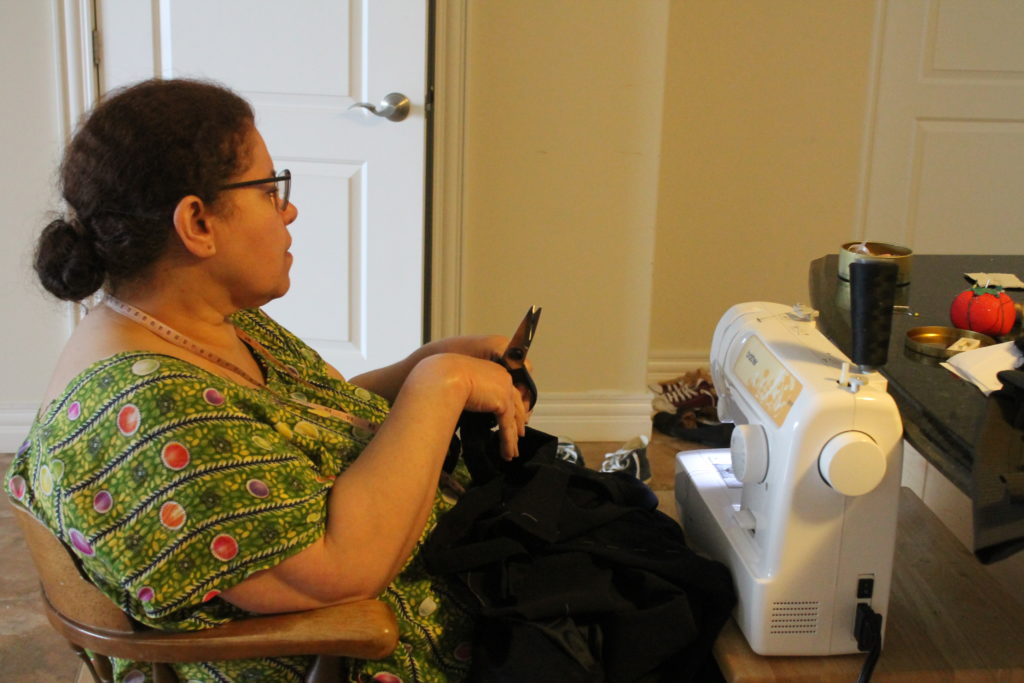
mum-sewing

Mum Sewing by Zainab Al-Habibi


Zainab Al-Habibi writes: “I am 22 years old. I am from Egypt but lived in Saudi Arabia for eight years during my childhood. I came to Canada five years ago and am currently in my third year in a Bachelor of Child and Youth Studies at Mount Saint Vincent University. My love for writing grew when writing was once the only way to survive oppression.”

Being a Girl

by Rebecca D

When I went to that school in the refugee camp,
we had no facilities
and being a girl,
you know,
it means so many different things.
We would study
and go home at noon
and wait
and return the next day.
Sometimes the teacher
would not show up.
I felt there was nothing to study
and no one to push me,
to make me think I have something important.
When I was in Grade 5
Angelina Jolie built a refugee school
and I went there.
She made a big difference in my life.
My mother, affected by war,
did not go to school.
Sometimes being raised by a parent who has not gone to school,
they don’t even know what it is,
they don’t even know the importance of it all.
Being a kid,
sometimes you need someone
to push you and tell you,
Oh, this is how it should be done.
A role model,
you know?

Rebecca D writes: “I am currently in my final semester at Mount Saint Vincent University pursuing a Bachelor of Science in Applied Human Nutrition. I am originally from South Sudan but have spent most of my life in Kakuma Refugee Camp in Kenya due to civil war in my home country. I went to elementary school in the camp and then my sister, who lives in Australia, sponsored me to complete my high school studies in one of the best schools outside the camp. I did well in my Grade 12 final exams and applied for World University Service of Canada (WUSC) sponsorship. I was very lucky to meet the qualifications. In 2013, Mount Saint Vincent University offered me a four-year scholarship and that is how I made it to Canada.

Shelter

by Fatima Al-Habibi

I grew up in a very hot country where everybody cursed the sun and sang of the moon and its beauty. People complained about the sun’s heat and how bad it is for food, cars, the human body—everything. I always thought of the sun as a mother, trying so hard to care for her children: they are tired of her constant watch and are very irritable. But in my mind, the sun was a mother’s hug and I allowed it to caress my skin as much as possible.

Now, years later, I am in a different land but with the same beliefs about the sun. When I first moved to Nova Scotia, I felt homesick all the time, but I came to realize that I have to let it go and carry on with my life. One on gloomy, wet day, I ran inside a café, ordered a drink and sat at a table next to the window. I let my mind wander as I stared at the tiny rivers made by heavy rain on the paved street. I looked at the sky for shelter but all I could see was greyness covering up my sun; my shelter on foreign ground. I sipped on my drink and tried to make its very weak heat count. I went home with the sun on my mind.

The next morning, I woke up to find a strong ray of sunshine shining on the wood floor. I took a few steps, opened the balcony door slightly, and sat on the floor in a mix of warmth and chilly breeze. I closed my eyes and thought about lights, shadows and home. A smile travelled across my face and stillness crawled through my mind. For a second, I felt at peace with belonging nowhere.

fatima-sun

Sun by Fatima Al-Habibi


Fatima Al-Habibi is a 22-year-old third-year student in the Bachelor of Commerce program at Saint Mary’s University in Halifax. She graduated last year with a diploma in accounting from the Nova Scotia Community College. She is a painter, nature-lover, and a proud immigrant and feminist.