Light jackknifes the Beaufort, pries open the mountain filling with snow.
From the rear of the bus; from the bottom rung; from her under-brow stare—
the girl in dark glasses hunches over last night’s dream:
underwater hands shelling peas, a hinged purse, a receipt for an exemption. .
High school kids shuffle down the boat ramp, laughing
and pointing. Beyond earshot, the girl looks over sea that carries her,
over the land that carries her through school bells and schedule.
Halfway between decibels and disappearance, she rolls down
the window, lets loose her hair. Combs white snow
from needling firs: the world’s cold evidence.
Tangerine between her hands as one who beholds a winter lake.
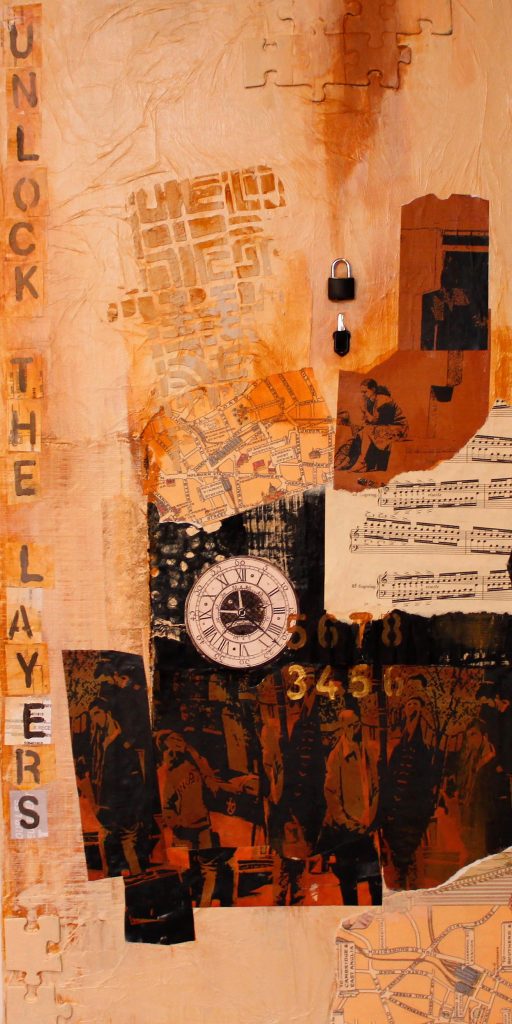
Girl with the Cranberry Earring by Judy Parsons
Listen to Cornelia Hoogland read “Light of Her White Hem.”
Q: How many feminists does it take to change a light bulb?
A: That’s not funny.
Which is funny, right? Or not. The relationship between women (and we mean all those who identify as women) and humour—as well as laughter and comedy and even smiling—is complicated. It grows out of life experience and personal taste but is also a product cultural expectations and gender norms.
Humour is highly individual but also deeply influenced by society.
There is, for example, that persistent societal notion that women are simply not as funny as men—hence, the feminist light-bulb joke and many, many variations of the punchline. This notion was recently explored in a (decidedly unfunny) systematic quantitative meta-analysis, with the finding that, indeed, men’s Humour Production Ability is higher than women’s.
Consistent with this stereotype is the caution that women—because they aren’t funny—probably shouldn’t try too hard. It might go very badly. Another recent study suggests that telling jokes in work presentations increases the perceived status of men presenters, but lowers that of women presenters. Why? Because a joke told by a man is interpreted as helping him get the work-related message across; the same joke told by a woman is interpreted as disruptive or as compensating for her poor work skills. Same joke: funny, not funny.
The women-aren’t-funny idea appears to be further supported by the gender gap in stand-up comedy. Men get far more bookings, more stage time, and more pay than women or gender-diverse performers (see #onewomanonthelineup).
But we know it’s not that simple. Of course. Laughter, humour, comedy: not that simple.
Laughter. Photography by Heidi Jirotka with assistance from Dante Jirotka.
To start, the comedy gender gap stems in part from the fact that most producers, the people who book the shows, are men. It may also be related to the very interesting finding that while women tend to appreciate funny men, men tend to appreciate women who find men funny. In other words, there’s evidence that women generally appreciate humour production (funny people) whereas men generally appreciate humour reception (people who find them funny). So, yeah, landing a booking in comedy can be tough indeed.
Then there’s being brave enough to tell our own stories in our own way, place, and time. The authors of meta-analysis cited above acknowledge they did not look at cultural differences (how humour is created and received in non-Western cultures) or differences in types of humour (the snappy one-liner versus the longer, more complex story). They also note—and this point is crucial—that women interacting with other women may create a completely different scenario, humour-wise.
Women may find other women funny.
Given that women-identifying folks comprise roughly 50 percent of the population, this statement should be enough to book a woman headliner and fill a venue with laughter. And it’s true, the stories told in that venue may not resonate with all audiences—stories about motherhood, bodies, anger, loss, that ever-present gender gap, feminism, #metoo, and, yes, even menopause. Stories that might be jarring or scary or subversive or sad, as well as very funny.
As Fazila Nurani writes, and as our cover art also suggests, laughter is always shifting to fill many different spaces. Especially in difficult times, like this past year, laughter is therefore powerful and emancipatory. It can bring us together not simply in reaction—the end to a funny joke—but as action. An astonishing twist. A new beginning.
Thank you to all of our contributors for sharing their stories and their visual art. Thanks also Heidi Jirotka and her two children for collaborating on our wonderful cover image.
Enjoy and share!
About Katherine Barrett
Katherine Barrett is the founder and editor of Understorey Magazine.
About Natalie Meisner
Natalie Meisner is a writer from Lockeport, Nova Scotia, and an Understorey advisory board member. Natalie’s plays have been produced across the country and have won numerous awards. She is the current poet laureate for Calgary.
About Heidi Jirotka
Heidi Jirotka is a natural light photographer with over 25 years experience. Although her initial focus was on newborn and child photography, her portfolio is now diverse. She has worked with Chapman’s Ice Cream since 2012 and is now their official, commercial photographer. Heidi lives in Bridgewater, Nova Scotia, with her husband and their two children. See more of her work on her website, Facebook, and Instagram.
I am eleven and standing in the hallway of my apartment in Block 545 in Singapore. From inside, I hear the horrible sounds of cats being tortured. The only problem is that we don’t own cats. In a panic, I fling the door open and I see my mummy sitting in front of her brand-new musical instrument, a table-sized pump organ. A harmonium that was screeching and bellowing. Mummy looked up at me and laughed; genuine happiness radiated from her. Her eyebrows danced and her lips parted as melodious sounds emerged from her belly. I had never seen mummy look like that. Something was different.
“I have decided that I am going to be the best harmonium player and temple singer in Singapore!” she said.
“But Mummy,” I screamed, “you don’t know any music! You cannot sing. Where did you even get that thing?”
She winked at me. “Meeta, my friend from temple, bought a new harmonium. I grabbed the chance to buy her old one. She even came in her car and dropped it off this morning.”
Then, Mum put her right hand up to silence me. She raised her chin in defiance. “Cannot? Why not? Just watch me. Everything is possible, beti, if you believe it in your heart. Whenever I go to the temple, I watch the priests play beautiful music on the harmonium. I feel happy from inside. It was fated when Meeta said she was getting rid of her old harmonium. The universe is showing me the way. Now, go and eat your cheese bread I made for you.”
My mom was thirty years old at that time. She had been a child bride at sixteen, shipped from Delhi to Singapore, and had lived in a prison of tradition and patriarchal rules. Always silenced. How on earth could she learn music when she was not allowed to go out, talk on the phone, have friends, work, drive, or go anywhere without my father? There was no chance of even getting a music teacher.
As a young girl, I was worried about my mom’s rebellion. I decided that I would keep a close eye on her. Secretly, I spied on her. I was puzzled by the nonsensical diagrams that she scratched in her palm-sized notebook. With intense scrutiny, her nose scrunched, she pounded each key on the harmonium, listened intently and repeated the sound. Then, she drew more secret diagrams with arrows. This went on for hours. She tried to copy English songs from the radio that blasted in the background and the harmonium bleated her Frankentunes.
She practised her music every day when my father went out. She cleaned. She cooked. She prayed. She played on her harmonium. My brother and sister learned to tune her out. We ignored her command to join her when she practised. We shook our heads and burst out laughing; then we ran for our dear lives.
There was more and more laughter in the house from everyone it seemed, thanks to mummy. Absorbed in her self-taught music lessons, she laughed and it filled the house with calm and peace. Papa was a strict man and he expected all of us to follow his rules, especially mummy. I recoiled when Papa’s angry voice boomed through the house if the TV was loud or mummy disagreed with him. Now, this innocent laughter from mum overshadowed the air of dread and smoothed my fears, at least when Papa wasn’t home.
But one day, Papa came home early while Mum was practising. The scowl on his face worried me. I knew that mom’s rebellion would fetch a price. He thundered in the door and bellowed, “You are wasting your time. You will never be a singer or play that thing. Now go and make my dinner.”
Mom laughed sweetly, so as not to provoke him, and said, “Why not?”
I followed her into the kitchen. She hummed her tunes and swayed her head. She winked at me and I swear she put extra chilies in Papa’s portion of chicken curry. Then, she hugged me and giggled like a teenager. Her quiet laughter reverberated round the apartment and cocooned me. The tension slowly dissolved. I even heard Papa chuckle.
And so this madness from my mummy went on. Music. Laughter. Singing. Two months later, I came home from school and heard a familiar tune I could not place. My mom looked up at me with her smile and said, “I am playing ‘Like Virginia.’” She played the tune again. Suddenly, it hit me. “You mean, ‘Like a Virgin’? By Madonna?” My mom threw her head back and the sounds of pure joy gurgled from her belly. The red dot on her forehead between her dancing brown eyes bobbed up and down. “Yes! The one with the pointy….” Her hands waved around her breasts. “Moooommmm,” I screamed and danced like Madonna while she played her bizarre Indian version of “Like a Virgin.”
Eventually, mummy joined the women’s singing group at the temple on Wednesday afternoons. The temple was the only place she was allowed to go alone, and my father dropped her off and picked her up. I heard such raucous laughter and music erupting from these gatherings on the rare occasions that mummy succeeded in dragging me with her. The women sat in assorted groups, cross-legged on the carpeted floor, enthusiastically discussing new tunes to play. Some would beat the tablas. Others grabbed finger cymbals. Together, each group created harmonious new hymns. They laughed without worry or censure, safe in their collective space. They clucked like hens when they disliked a new tune. They guffawed in approval when they perfected a tune. Even I picked up the finger cymbals and joined in with mummy’s group.
Today, mummy has sung in temples in Indonesia, India, Australia, and Calgary. No one can stop that five-foot-tall woman. With her megawatt smile and infectious laughter, she brazenly invites herself to any temple podium that she can, anywhere in the world. She has even played for the Prime Minister of Singapore at the Singapore National Theatre!
Growing up in that house, I learned the meaning of passion. Within the confines of her tradition, mummy created music and laughter—she created harmony. She permeated the walls with mirth. And as a young girl, I too started to believe in possibilities. I began to learn how to manoeuvre those restricted wings, quietly and covertly. Now I toss my head back and laugh from the depths of my soul whenever I think of my mummy. Because that’s how she now laughs. Eyes twinkling. Cheeks dancing. Unrestrained music that rises to the sky.
Listen to Kelly Kaur read “The Music of Laughter.”
Take a spoonful of sugar for the hiccups
Dash his brains into his mouth
Map the stretch marks on your thighs
Stay grounded by looking up
Inhale the sky
Avoid long speeches
Call your mother, talk about the day you were born
Admit to nothing
Open the window and roll the sun between your fingers
Laugh until it hurts
Until you cry
Cry
Measure your comfort in crow miles,
the distance between your life and honour
Wear your jewels to bed
Don’t make or ask for promises
Slice open the underbelly of every cloud
Let it rain
Let them drown.
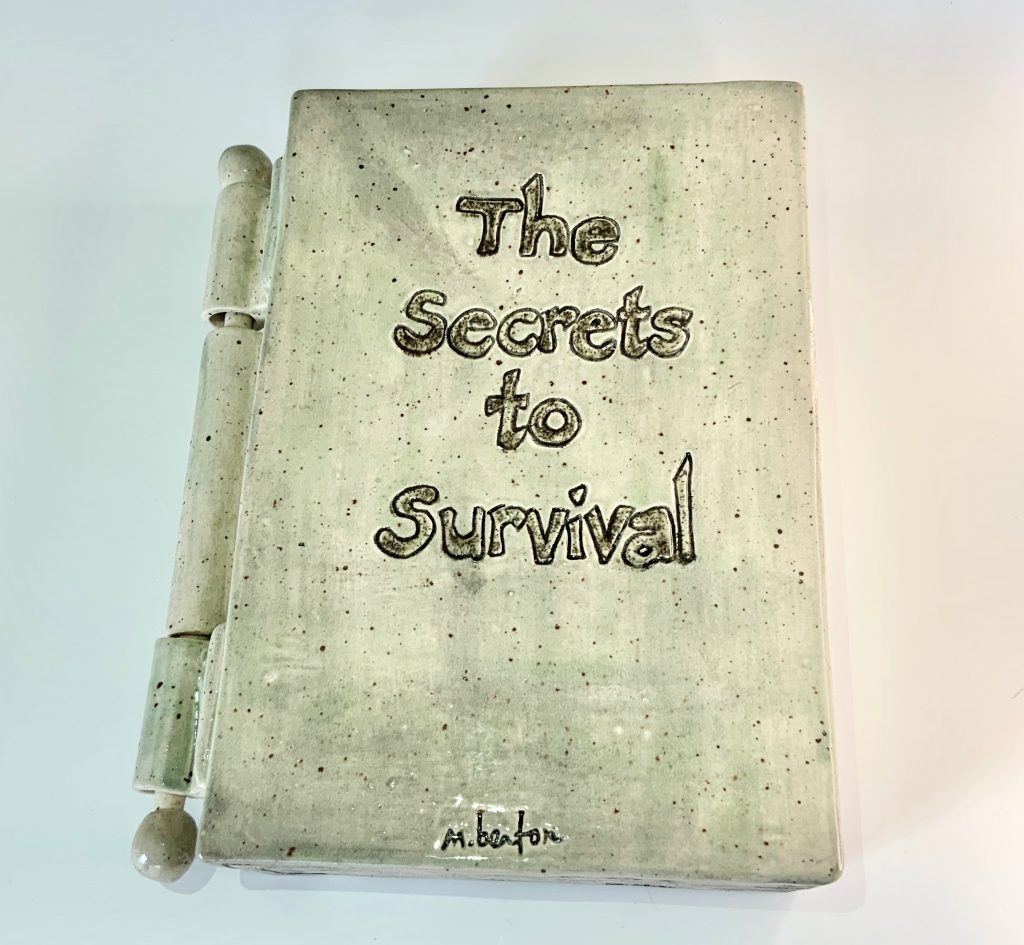
The Secrets to Survival by Marla Benton (ceramic)
Listen to Hollay Ghadery read “Instructions for Lucretia.”
To the author of the fiction craft book who wrote this prompt for beginners: “Write a short story from the point of view of a young girl being pursued through a dark park by a crazed man with a knife,” fuck off.
To the same author who followed up with “Now rewrite it from the point of view of the man with a knife,” please continue to fuck off.
You dropped “crazed” from the second description. Aaah, he’s just a guy, you know, who could be having a bad day, you know, he needs our understanding, you know, why don’t we look at this from his point of view?
Comparisons are amphibious, odiferous, odalisque.
Right now I have all the words. But you don’t have to accept that. You can revise at your leisure, as soon as I leave the room. I’ll send in a woman with a knife.



 About Katherine Barrett
 About Natalie Meisner
 About Heidi Jirotka