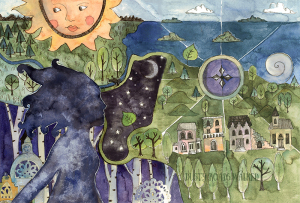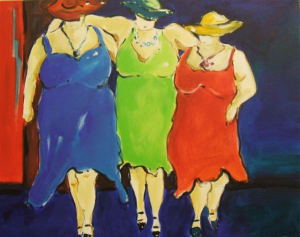
Archives

The Alder Bed

This entry was posted on by .

Annette Martin’s novel-in-progress is set in outport Newfoundland and spans five decades. As a headstrong teenager, Lexie Fisher marries wayward Dan and quickly has three daughters, Iris, Rose, and Daisy. Newfoundland winters, poverty, and Dan’s drinking slowly fray Lexie’s mind. Her young daughters must assume adult roles—of one sort or another. Understorey Magazine is pleased to present an excerpt from The Alder Bed.

The Alder Bed: Chapter Twenty

By the spring of ’31, Mother’s behavior was becoming worrisome. Rose was nine years old, she was seeing that her mother was not well in some way. At times Mother was very childlike, she’d try to join in with Rose and Daisy and the Miller girls when they were playing Snakes-and-Ladders, or push she’d herself into line when they were jumping rope. And worse, she was slipping out of the house and wandering aimlessly around the community.

“People are talking about her, Rose,” Daisy grumbled. “I heard some boys making jokes about her.”

One cold, windy March day, Mother jumped out of her chair and headed for the door. Rose and Daisy followed to make sure she was alright. They’d given up trying to make her stay home, she’d get hysterical and fight them.

As they went up over the hill past Aunt Molly’s house, Molly called out from the doorway. “Daisy, Rose, it’s freezing, couldn’t you keep her home?” The answer to that became clear when Mother walked on past without a word, her face grim. “Hang on, then,” Molly said, running back into the house. She came out with an old black coat, caught up with Mother and somehow managed to get the coat around her.

A parade of lost souls, they straggled up the hill past Martin’s Medder and on down into the Cove. They’d just passed Howley’s Pond when Mother stopped dead in her tracks and turned around. “Thank God,” Daisy said, “I was afraid we were gonna end up in Heart’s Content.”

As they started back, a gust of wind caught the tail of Mother’s black coat, pushing it up like a cape. She began to flap her arms up and down. “Caw, caw. I’m a crow, a big, black crow. Caw, caw.”

Alarmed, Rose looked to Daisy for help. “Let’s just get her home before anyone sees her,” Daisy said. They had just made it to the Five Roads when Daisy groaned, “Oh, God, there’s a woman coming up the road. And a man coming from the Square.”

Caw, caw,” Mother squealed, flapping her arms energetically.

Raven Mug 2 revised

Raven Mug by Mariko Paterson


“They’ll think she’s crazy,” Daisy whispered. “Pretend we’re doing it for fun.”

So they joined in, caw-cawing themselves, pointing at Mother and each other and laughing. Rose felt miserable, she knew she shouldn’t be making fun of her mother. She wished she was safe at home, away from the stares.

At that moment, Mother’s friend Dora Miller stepped out of Follett’s shop. Without a second’s hesitation, she put her arm around Mother. “Hello, Lexie,” she said calmly. “It’s Dora, m’dear, can I walk along with you?” Mother relaxed and Dora led her home, got her a cup of tea and sat with her for an hour before she got up to leave. “I think she’s settled now,” Dora whispered, running her hand over Rose’s hair. “Don’t worry, Pet, I’m always close by if you need me.”

That night, as she lay in bed fretting about her mother, Rose said a little prayer of thanks for Dora Miller. Thank you God for Miz Miller helping us, and that she lives close by. I hope you’ll make Mother better, and make Dad stop drinking. Amen. It had been a while since she’d said her prayers, but at that moment she thought it was proper.

*

Sometimes, Mother was a handful even for Dora Miller. The girls had just gathered around the rag mat in the Millers’ kitchen to play marbles when Mother barged in the door and sat down. “Marbles,” she said, excitedly. Rose and Daisy exchanged looks. They’d left her napping in the bedroom, thought it was safe to leave for a little while.

Four questioning faces turned to Miz Miller. “It’s alright, let her play. I’ll watch her.” Blanche and Lucy, the Millers’ daughters, rolled their eyes at their mother. Rose sighed. Wasn’t there one place where she could get away? Even as the thought occurred, she felt her cheeks burn with guilt.

“Huh!” grumped Blanche, disgruntled at her mother’s ruling. She was chewing on a wad of frankum, cracking and smacking and tonguing it around her mouth. She picked up the five marbles and tossed them into the air, pushing the gum out between her teeth as she did so.

Mother’s hand darted out, grabbed the gum and stuffed it into her own mouth. There was a sharp intake of breath from around the circle. Blanche looked stunned. “Give that back!” she squealed, sticking her finger into Mother’s mouth to hook the gum. Mother bit down hard. Blanche screamed. Lucy ran upstairs crying. Mother howled with laughter.

“Come on, let’s go,” Daisy muttered. “I’m getting sick of this.” As they started down the path, Mother struck up a chorus of Abide with Me.

Counting Underwear

This entry was posted on by .

Julie, my youngest daughter, runs in laughing and forgetting to close the front door.

“Nanny says you got lots of panties in the wash.” She skips around the table.

My husband has been unemployed. Money is tight. We don’t have a washer or dryer so my mother, who lives next door, has offered to help. She washes and hangs our clothes on the line and I let her, though it reminds me of being watched as a child. I am shocked that she discussed my underwear with my eight year old.

Julie continues, “She wants to know what you’ve been doing. Seven pairs! Mom! That’s a lot!”

“Really? I wouldn’t know. I don’t count my underwear.”

I speak these words to my daughter, knowing the conversation is really between me and my mother. Julie shrugs and runs back outside to play.

I think about laundry day when I was a child, my mother in the kitchen sorting whites with whites, darks with darks, the muddiest and dirtiest together. Our underwear could land in any heap, depending on what the crotch looked like. Mother carefully inspected every pair, determining its rightful place. I feared the rounded womanly body of the washing machine with the wringers on top: the mouth of a hungry monster waiting to be fed, demanding, prying, never satisfied—like my mother.

She would fill a galvanized tub with bucket after bucket of rain water collected in metal barrels lining the back of our house. I’d watch her send our clothing through the wringers. She’d let them drop into the tub of rinse water, swish them around until they took shape then feed them back through the wringers. She would grip those clothes with both hands and shake them hard before dropping them into the laundry basket, as if trying to shake out the truth.

Mother issued warnings of what happened to children who didn’t listen. She said if our fingers got caught in the wringers our arm would be pulled in. She told us bad things happened to children who touched things they weren’t supposed to touch. She had a long list: the stove, knives, razor blades, hot mugs of tea, stuff in stores, but most of all our private parts, or the private parts of other people.

I wasn’t sure what she looked for in the crotch of our underwear or if she could tell what we’d done or hadn’t done, just as I wasn’t sure if the wringers would stop at the shoulder, or if our whole body could be pulled in. Our clothes came out hard, crushed, and wrinkled. I wondered if a person could come out like they did on the Bugs Bunny Show, flattened.

I stand now at my window, watching my mother pin dresses, towels, socks and panties on the line. She’s never liked the dryer my father bought for her. She complained that it doesn’t make the clothes smell as good as fresh air, that it uses too much electricity, so she draped a cloth over it and uses it as a plant stand. It was something my parents would fight about when they couldn’t find any other reason. With so many environmental concerns these days, lots of people would be on my Mother’s side, but in the 1970s she seemed simply stubborn and resistant to change.

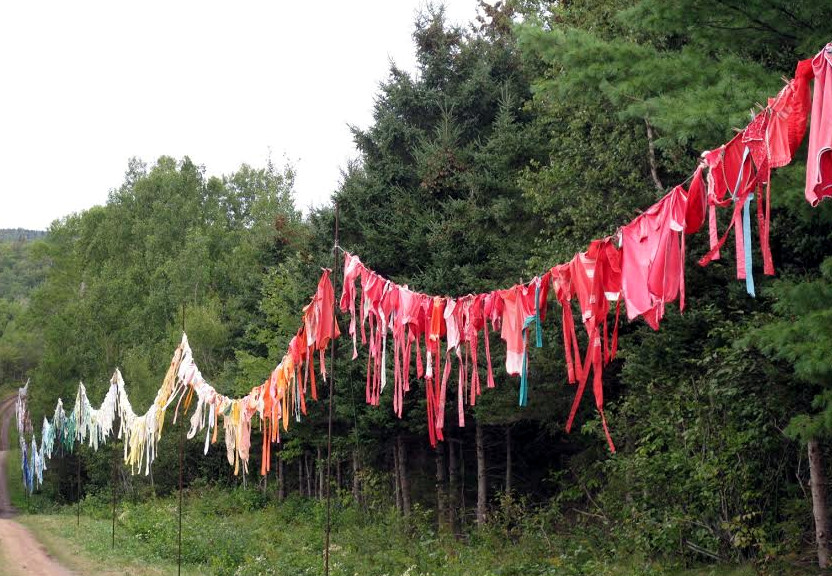
1,000 Aprons by Margaret Nicholson

1,000 Aprons by Margaret Nicholson. Photo: Bruce Sparks


“At least get a pulley line,” my father had said.

Her clotheslines still make the backyard an obstacle course: lines stretching from tree to tree, tree to pole, pole to pole. You have to be careful when walking, the place is a minefield. Mother has held firm all these years, stuck to her ways and those of her mother before her.

I wonder when her counting of underwear began. Was it also something her mother would do? In my early years she bought me those panties with the days of the week embroidered on a little lacy patch on the upper left-hand corner. How difficult it was to keep them straight! I could no longer pull on any pair. It didn’t seem right to wear the name of a day when it wasn’t that day. Was this my mother’s way of keeping tabs on me? And what on earth did she think during my teen years when I stopped wearing anything at all under my jeans? I haven’t asked any of these questions and neither has she.

Now I watch her lift a hand toward the clothesline, one finger extended, counting. I imagine what she must be saying: “One, two, three… My God, six pairs. No friggin’ need of that!”

Last Christmas she gave me the typical new package of panties. I hand-washed them and hung them in my shower to dry so they wouldn’t freeze stiff on the clothesline. I wasn’t surprised to receive panicked phone call: “Where are your new underwear? They’re not in the wash!” I smiled. She feared I’d gone all wild again.

That evening, after watching my mother hang all the clothes, I come up with a plan. I go through my underwear drawer and pull out all my panties. With a black permanent marker I draw large numbers on each pair—just like the days of the week from my childhood—and put them back in the drawer. I will wear them in order. She will have to say something and I have my answer ready: “All the easier for you to count.”

The next laundry day, Julie comes running into the house. “Nanny asked why you have numbers on your panties.”

“Really?” I smirk.

“Why do you, Mommy?”

“I’m playing a game with Nanny. I want to see if she’ll say something to me about it.”

“Silly,” she says and runs back outside.

When I go across the road to bring home my dry laundry, my mother says nothing about the numbers on my panties. I say nothing either and I know my young daughter is right. This is silly but I can’t break through that wall of protection I built as a child, the wall that keeps me safe from my mother’s criticism, her constant counting.

I go home to greet Julie from her day at school. We will talk about all the things we have done today.

To the Teenagers in My Writing Circle, Psychiatric Ward

This entry was posted on by .

To the delicate girl who kept getting thinner—
thin as smoke from a cigarette,
a fault line in her green eyes.
To the young man
whose father slipped into his bed,
his fury trapped, a coiled cobra.
It was hot,
sun pounded windows that couldn’t open.
But
something opened
when one girl said to another.
You wrote that? Wow.

To M who said, I can write about cutting,
but I don’t want to upset
anyone
.
Kids with piercings, scars, tattoos,
boys with tangled curls,
shaven-headed girls—the staff unlocked the doors
and marched you through.
Though the world had twisted,
like a chicken’s neck, your anger,
I believed, uncensored,
you could begin to discover who you were.
You’re making me happy, D said.

You love poetry, don’t you?
D said one morning.
Don’t come back
was the message the red-haired nurse
left on my phone that night. She was tired.
I made more work for her. How else explain
why she was annoyed each week I showed up.
If she treats you that way,
the psychiatrist said, imagine how she treats the kids. Like wrecks that skid
when the brakes fail.

It was tough in that place
where nothing was savoured and No
was the word.
But you know that.
You whose words were rough and frail,
and so often out of favour.

Anticipate by Anya Holloway

Anticipate by Anya Holloway

Recalibrating

This entry was posted on by .

1.
When my mother flew
across the Atlantic, in autumn 1979,
the flight attendant served her a croissant
like two conch shells
placed open-end-together
on the breakfast tray.
When my mother, pointing, asked,
what is it?
the word, croissant
which she could not have spelled—
curled unfamiliar
in her lexicon. She left the bread uneaten.
Alarmed by its flaking texture,
she thought it had come from the sea.

2.
Because she’d leapt in cotton sari
on the left side of the road to
catch moving busses
on Kerala hills, had
ridden rickshaws, paid a fist
of rupees to a stubbled haggling driver
who spat tobacco at her Bata shoes,
driving down the 404 felt like adjusting
an overhead transparency,
slightly left and slightly right,
recalibrating.

3.
I can’t speak the language
that she dreams in.
At Winners
we pass statues of decorated
elephants, in her eyes that recognition
like opening a box of winter clothes
from last year,
that touch of joy—

oh, I remember you.

Dusty Roads Walked by Tia Mushka

Dusty Roads Walked by Tia Mushka

A Life in Eight Bras

This entry was posted on by .

My house is filled with hot spots. Not the warm, cozy kind, but the little storms of matter and memories that amass when one woman, one man and three little boys live together under one roof.

Take my bra drawer for example. It’s the middle drawer of my night table; not a typical place for bra storage, but just the right width to hold a collection. They sit, facing forward, one behind the other, like measuring cups stacked together on their sides. I flick through them like I’m scrolling through a recipe box, each bra evoking a stage in my pre- and post-baby life. I’ve tried to purge the collection; over the years I’ve whittled it down to eight bras, even though I wear only two. That’s as far as I will go because those cups hold memories. I used to keep a journal before I had children. Now, three boys later, the bra collection is my way of remembering.

In the back of the drawer sits a soft, cotton, turquoise bra from Elle MacPherson intimates. I bought it at Selfridges when I lived in London, shortly after spotting Elle herself on the Portobello road. A little Australian colour was exactly what I needed in grey London. I was twenty-eight at the time, freshly married, without children, and one year into what would be a four-year stint in London. I worked at a cookbook shop off the Portobello road while my husband was an investment banker in “the city.” We rarely saw each other; he worked all the time. But I had faith that a splash of colour would do wonders if our ships collided in the night. I grabbed the bra from the rack and tried it on behind a heavy velvet, boudoir-inspired curtain. It fit my one criterion: loose enough to avoid back fat. In just a few years my criteria would change and back fat would become a necessary by-product of a bra tight enough to “lift the girls.” Ignorance is bliss.

Next in my bra drawer is an amber-coloured, super-firm strapless job I purchased at a little shop on All Saints Road in Notting Hill. The cookbook shop granted us a 60-minute lunch break, not long enough with streets to explore, bakeries to visit and more shops to browse. I say browse because most stores in Notting Hill catered to the Elle MacPhersons, the American ex-pats, and the wealthy London ladies with posh children on scooters. I was none of those. I was a white, middle class Nova Scotian, wedged between selling cookbooks and dreams of writing them. I preferred the grittier All Saints Road that cut right through Notting Hill bringing memories of ’70s race riots and ’90s crackheads. The bright young chefs and soon-to-be discovered designers were just starting to move in, however, and that’s where I found a fabulous and affordable strapless dress for my sister’s wedding. I didn’t own a strapless bra, of course; TopShop t-shirts don’t require such a thing. But I had 26 minutes left on my lunch break that day and spotted a lingerie store right across from the dress shop. I rushed behind the curtain with bra in hand, paused briefly at my reflection—were those my breasts, suspended in air?—paid with plastic and returned to my fledgling career.

Absolutely Fabulous by Anya Holloway

Absolutely Fabulous by Anya Holloway


In my drawer, between that strapless All-Saints-Road bra and a stunning silky number with Chinese dragons dancing over the cups, lie the ghosts of nursing bras past. I’ve thrown them away now, but I remember when my frazzled husband ran out to find them, two 36ZZs, after our first son was born. He’d described my size to the sales lady with just two outstretched hands. Those nursing bras, and the breast pads within them, informed my outfits, my confidence—and indirectly, my career—during the early days of motherhood. I’d always expressed myself through clothes but now jeans squished my post-baby stomach, tight tops emphasized that squished stomach, and fitted blouses and dresses that required unzipping or unbuttoning to breastfeed seemed scandalous. A black stretchy top with matching skirt seemed the only, boring solution.

It was a Mâitre D at the Ritz who brought my groove back. I was having tea with my mother-in-law, trying to sip, smile and simultaneously juggle a fussy baby. I bounced my son over to the Mâitre D and asked if I could breastfeed at the table.

“I rather see breasts than hear that baby cry,” he said.

Strangely, I felt set free, not just to feed my baby at the Ritz but to wear whatever I wanted. To thrive in a big city like London, you have to stick out your elbows and make a space for yourself. This goes for mothers and aspiring cookbook writers, too. So I wore those 36ZZs with jeans and blouses and dresses. I wore them again after my second son was born. And again after my third.

Of course it wasn’t just my bra that landed me a publishing deal. My shop-mate, New Zealander Pippa Cuthbert, and I stuck our elbows out far and wide. We realized there were a few titles lacking amongst the ten thousand or so in our store. We pitched ideas to twenty publishers and were rejected by nineteen. (I started opening letters over the garbage can for sake of efficiency.) But the twentieth letter was positive. We wrote one cookbook, which turned into a series of seven and sold worldwide.

Back in my bra drawer, somewhere in the midst of those first cookbooks, we arrive at the Chinese dragons. My husband, son and I moved back to Canada when my son was four months old, but I had to return to London twice a year to work on the photography for our cookbooks. On one particular trip, I weaned my son cold turkey. In just two weeks, my breasts morphed from huge globes of nutrition to two small sport socks. Fortunately, Rigby and Peller, the Corsetiers to the Queen, were holding a sale at their Heathrow airport location. A bra-fitter followed me into the changing room, shoved my armpits into the cups, smoothed the straps with her practical hands and spun me around with her eyes at breast level. I walked out looking like a 16-year-old.

A beautiful bra not only lifts the breasts, it lifts the spirits. The puke down your back, the unfinished deadline, the greasy hair? It’s all going to be fine because you have a purple bra peeking through your old, white t-shirt, confidently saying, I’m beautiful.

It was this yearning for beauty and a desire for quality that explains the next bra in my collection: a black lace French Lejaby. It was purchased, sadly, before I weaned my third baby. I knew the rules—never invest when the globes are still full—but I had no choice. I was hired to host a food segment for television and needed serious infrastructure to hold myself in place. Crossing the threshold of Lily’s, a Halifax lingerie institution where you’re fitted English-style, meant I’d be transformed and I needed transformation. Standing in front of a camera requires confidence. In a 2012 TED Talk, Harvard associate professor Amy Cuddy explained that “power posing”—standing like Wonder Woman—not only makes you appear more confident, it changes your brain chemistry. You become more confident and courageous. I’d say a good bra does the same thing. I stayed intact on camera and felt fabulous, even though the bra wasn’t leak-proof. Thankfully, hair and make-up were happy to blow-dry my shirt between takes when milk spots emerged.

The collection ends with me, today. I am the average of my past and future life, suspended comfortably in the middle with two simple staples, one black, one white, both from Wacoal. The bra-fitter at Mills in Halifax sold them to me after staring, furrowed brow, at my post, post, post baby breasts in the changing room. She vanished into the storefront and returned with two curvy, thick-strapped bras with firm cups that automatically point to heaven. They’re not as luxurious as a Lily’s bra, but they do make me look like a sweater girl from my mother’s 1963 Dalhousie University year book. That will do.

Eventually, my bra collection will spill into the drawers above or below. This will mean purging belts, books, creams, nail clippers and other random and less sentimental items. But I look forward to what the future holds. I am a writer, a cooking show host, a stylist and most importantly, a wife and mother of three boys. I am surrounded by Playmobil, dirty socks, tangled iPad chargers and water guns. The toys will evolve, and so will my career. Through it all, I’ll remain the only woman in the family, standing tall like Wonder Woman and wearing a beautiful bra.