
Archives

Dilemma

This entry was posted on by .

Can a woman be a serious poet if laughter keeps invading her lines? I write poems about death, fear, and madness, as serious poets do. And I also write the humour of the human condition:

The Pie

Illustration by Sarah Christie showing many kinds of pie

Mile High Pie by Sarah Christie

A lemon pie calls its tart appeal
across the dining hall,
a glowing meringue with toasted tips
spotlit on the buffet table.
The best of the dessert parade, uncut as yet,
it tests a dieter’s resolve.

A pie you can almost taste,
sliced into now by a stick of a woman.
Her thin arm lifts a perfect wedge
and sets it on her plate.
Oh god, she takes a second piece.
You will get her later.

She lifts a forkful, swallows shamelessly.
You know why she smiles.
She could be hit by a bus tomorrow.
Good thing she had the pie tonight then.

You could be hit by a bus tomorrow.
Unlikely – two pie-lovers flattened in a day – but possible,
You could die, pieless.

Here, then, is the dilemma in a pie-shell:
have another coffee, or go get some pie?

*

I write poems about my time in Rwanda, the women and children, their lives of struggle and joy. I write about genocide memorials, prisoners in pink jumpsuits, and murderers who now sell tomatoes in the market.

But I also wrote a spoken word poem about emotional support animals in air travel:

Rarefied Air

Attention passengers for Rarefied Air flight 2019.
Those of you with emotional support animals please line up to the left of the check-in desk.
Yes, madame. You with the peacock.
End of the line, please, behind the little old lady with the pit bull.

Welcome to Rarefied Air flight 2019.
Sir, man in the green jacket, your goat is eating your boarding pass.
Welcome to Rarefied Air, we hope your journey today will …
Madame, could you quiet your gibbon while I read the flight protocols?

I will now read the No-Fly list, some of your critters will not be boarding the plane:

Tasmanian devil.
Vampire bat, good-bye sir.
South American condor,
any snake from Australia.
Porcupines, hippos, crocs, and gators, of course.
Big cats, really big cats: cougars, tigers, lions, cheetahs.
I shouldn’t have to tell you this.
In fact, ALL African animals, you’re out of luck. Migrate now. Serengeti out of here.
Oh, OK , madame, meerkats can come, they’re cute.

Mollusks, invertebrates, bugs and slugs must travel in a solid container.
Sold here starting at $200 US. Twin scorpions will cost you, sir.

No skunks, honey badgers, boa constrictors or tarantulas.

If your emotional support animal is on the no-fly list you have a decision to make:
stay home, or – if you choose to fly – release it in a designated area, (now called The Pit).
In that event you may rent an emotional support puppy or kitten if you simply cannot fly alone. $200 US per flight.

Pet poop bags are located in the seat pocket next to the in-flight menu. Please be quick enough to use them. Read the bag for a list of fines, if you are not.

Consider your fellow travelers. Is your pet disturbing a seatmate, growling at a defenseless old man, lapping from a stranger’s wine glass, or crotch diving a young woman in a mini skirt?
Be aware fellow passengers may not see the need for an emotional support ferret, and may strike it with their book or tablet.

Please sign the waiver absolving Rarefied Air from all liability.
Note the option to tranquilize your emotional support animal during the flight.
Still a comfort, even if comatose.

Any questions? Lady with the Vietnamese pot-bellied pig.
Yes, certainly Madame, pigs can fly.

*

Some now expect a humorous piece from me; are they disappointed when I read a serious poem? Lyricism and depth of thought elicit mellow hums, nods of understanding, while humour evokes laughter, whistles, and hugs. So I like to lighten an evening of dead spouses, sexual abuse, and cancer poems with an off-the-wall funny-peculiar poem. I write about creatures and wilderness, nature and natural disasters. I have a manuscript of poems on bodies of water where I learned how to live and think. But I also wrote “Dildos of the Sea”:

Dildos of the Sea

O erotic ocean
O seductive seas
More than just the tide goes in and out, in and out
under the waves in the sea bed.
Pyrosomes drift and bob in the current,
a bioluminescent multitude of sea dildos
glowing pale blue-green,
tubular immigrants to the north Pacific.

O pelagic sea squirt
O colonial zooid
Sea pickles are human penis-sized and bumpy,
but some, twelve metres long, are the stallion phalluses of the open sea.
Held in a gelatinous tunic they stick together,
flush seawater through their lubricant sheath,
suck and blow themselves forward.

O constant filter feeders
O asexual reproducers
Leave your California coastlines for Canadian waters.
Come north, migrant creatures.
Let warmer currents of the Pacific be your new route
to an off-shore home-away-from-tropical home.
Let beachcombers and fishermen smile at your form,
your abundance.

*

I love to see an audience of poets chuckling and hooting. I love to see the look on newcomers’ faces: “Poetry has sure changed since high school.” But humorous poems need just as many revisions as sonnets, sestinas, or free verse. Humour, like insight, has to be cultivated through observation, through artistry with words and images. When polished into a form that works well, humour illuminates our universal human foibles:

To the Ends of the Earth

—a dramatic monologue, (apologies to the entire Hillary family)

Welcome to the Gertrude and Edmund Hillary Museum, Auckland, New Zealand.
It is my pleasure to present these photographs that show the close, close mother and son bond between Edmund and myself. Follow me.

Let us enter the first room: Gertrude, and Edmund as a child.
Oh he was a lovely baby, his nurse said so many times,
and an energetic boy, oh-ho-oh, always in motion,
always climbing things.
I think he wore out four or five nannies in the hills around the ranch.

Here is a photo of us kissing goodnight.
In the few moments I saw Edmund each day we formed a close mother and son bond.
You can tell by the way he teases me: pulling away,
making a comical face as if smelling a pungent odor.

And this room contains the photographs of Edmund’s time at boarding school.
Although separated by two oceans,
we remained close through correspondence.
Here is Edmund’s letter telling of his broken arm from falling off a cliff.
He only wrote one letter, but it is treasured.
And this series of photos is me, his loving mother, writing to Edmund.
See how the seasons change in the window behind my desk.
Notice my hairstyle altered over the six years he was away.
I have never felt closer to Edmund than when writing to him long distance.

The War Room is next.
At first Edmund was a conscientious objector.
Yes, unwilling to kill.
Oh dear.
But, after many long and arduous talks with me
he ran from the house straight to the enlistment office.
Here is Edmund in his air force uniform.
That’s my finger covering half the lens.
Even war could not sever our close mother and son bond.

This next is a small room, containing photos of Edmund’s married life
and the birth of his children. Moving on!

Here we arrive at the main salon: Gertrude and Edmund in Nepal and Everest.
As Edmund packed to leave New Zealand, he begged me to remain at home in comfort, (such a loving son) but of course I could not.
I followed him to Nepal, I followed him to Everest.
I am awfully proud he made it all the way up and down the mountain.
And a man does need his mother when he’s been on top of the world, doesn’t he?
Even fame could not diminish our close mother and son bond.

This final room shows Edmund at the north and south poles,
the barren ice stretching for miles in all directions.
Look at the lovely smile on his face.
He did say he would go to the ends of the earth because of me.

*

Choices, choices: read a funny poem and lift everyone’s spirits, or read a serious poem with an insightful message? Women take risks every day and I’ll take mine on the page. But this is a predicament I can’t resolve. Instead I’ll enjoy the challenge of writing both funny and insightful poems—and often in a single verse—then I’ll laugh at myself for being such a ninny. Ninny—great word—but not for a serious poet.
Good Game

This entry was posted on by .

Second Half. The Cunts are down two-nothing against their rivals, the I’m Not Letting You Merges. Number twelve, center-forward, has the ball wedged beneath her fancy Nike cleat, laces grey and unwieldy as her pubic hair. The ref is a teenaged boy, pudding-faced and porn-addicted with a whistle-leash draped around his neck. He hates reffing the over forty, division-three women’s league. The players scare him. They are emotional and in constant pain. Braces are scaffolded to their legs, and tensor bandages cut off their circulation, cut off their feelings. They run on gluten and wine and animals they can’t stop eating. And then there are the players that flirt: number three on the blue team, number sixteen on the white. Ref scans to make sure they’re on the field. To make sure they’re not on the field. He adjusts himself.

“Keeper ready?” Ref asks, eyeing the goalie guarding the net on the west end of the field. She is familiar to him. She is every woman in an ad for life insurance, except with a youthful high ponytail and thick white socks. The keeper waves, or gives the finger. Ref can’t discern which.

He turns to view the opposite end of the field and repeats the question. Keeper is not ready. Keeper will make everyone wait while she takes a parting sip of vodka-water from her stainless steel Marshalls-purchased bottle with BORN READY written in gold meme script across the rim. Her power is making people wait: contractors, customers, her husband when he comes home for dinner with fish and chips and someone else’s titties wafting from his moustache. Keeper sets down her bottle. “I’m always ready,” she shouts. Ref blows his whistle.

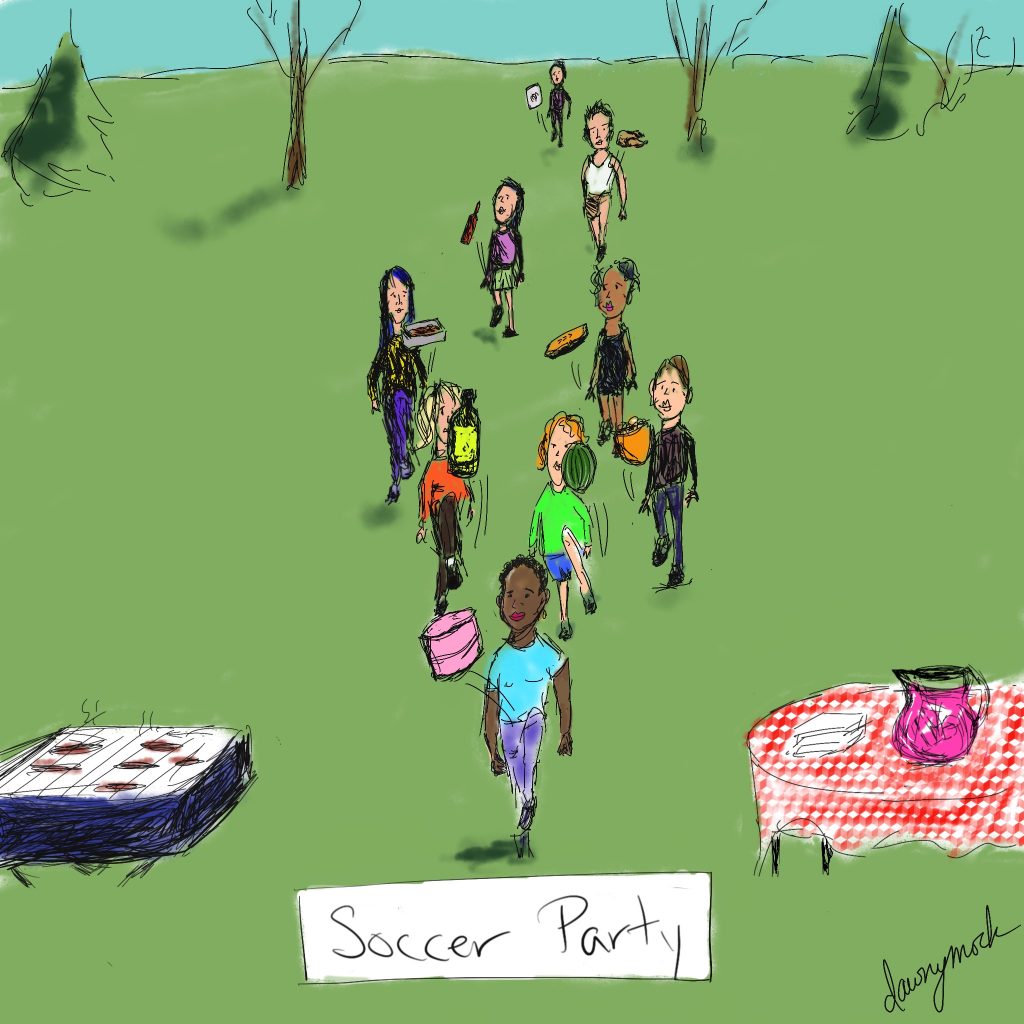
cartoon by Dawn Mockler showing women's soccer team attending an outdoor party and knee-bouncing the food

Soccer Party Dawn Mockler

Twelve passes back to Three. Three is distracted. She is contemplating whether she could ever go down on a woman. Specifically Barb, from accounting, possibly even Fourteen on the Cunts. Why would Twelve pass back? It’s indoor soccer. The field is short. Three chases the ball, tries to get a touch. She only knows a few lesbians, and certainly none well enough to ask what it’s like to get it on with a woman. Maybe if she got high first. A blue jersey is in front of her. Fifteen from the other team. Where the hell did she come from? Twelve yells, “Man on!” Man on? Three thinks. Man already gone. It’s why she’s thinking about Barb’s spreadsheet. Three wants to yell at Twelve, ask her what she was thinking passing the ball back. Instead, she complains to Four.

“Offside!” Four wheezes. There’s no offside in Indoors, everyone thinks, everyone knows, but Four insists. Four believes. She storms down the field, a petulant child with fallen arches and roots that need touching up. Someone will pay for Fifteen’s offsidedness. Her credit rating, her cholesterol. Her husband, the next time he tries to cop a feel when she’s watching Dead to Me on Netflix. She’ll slap his fucking hand. Tell him to change the friggin’ light bulb in the closet so he’ll stop asking her if the pants he’s chosen to wear are navy blue or black.

“Play on,” the ref calls. Fifteen hasn’t stopped playing. She always has the ball because she’s faster than everyone else. Younger too. She likes to surprise her opponents. Sneak up on them like a credit card balance, like age. She likes to remind them that they are closer to death than they think. Closer to death than they’ve already come to accept. That they graduated from high school forty years ago, and that there’s no time left for them to write a memoir unless it’s a cancer one because nothing interesting has happened in their life.

Ten races toward Fifteen. Fifteen is getting cocky and loses the ball. Good riddance, Ten thinks. You should’ve passed it when you could. You should’ve had children when you could. Ten feels good that she has the ball. She feels good that she has four kids. She feels good that right now she doesn’t want to knife anyone. She smiles. A teammate cheers her on because she’s dethroned the infallible Fifteen who just sits home all day. In her effort, Ten loses her balance. She steps on the ball, a wonky circus bear, and falls flat on her back.

“Ah, come on!” Seventeen yells.

“Foul,” Four echoes. “She tripped her.”

“She stepped on the ball,” Fifteen retaliates, pacing against the boards.

Thirty steps onto the field, a middleweight Jesus with mahogany hair. No make-up. She’s in the medical profession. No one really knows what that means. Physiotherapist? X-ray tech? Hospital clerk?

Ref can see his reflection in the glass boards surrounding the playing field. He fixes his hair. He wants to check his phone to see if Adelaide snapped him back. He wonders if she’s the kind of girl who sends nudes.

Thirty hovers over Ten. “Breathe,” she commands. Then she waves a trio of fingers in front of Ten’s face. “How many fingers am I holding up?” She says it loud enough for her husband, who is watching in the stands, to hear. He will praise her later because she is important and very valuable.

“Three,” Ten replies.

“Did you check her pupils?” Twenty wants to know. She’s heard others ask this in similar situations.

Thirty pulls out her glasses for effect, says that Ten’s pupils are good, and then turns back to her patient. “Any nausea?” she asks. All the players reply yes.

Miraculously, Ten is okay, and she gets to her feet by herself. Nothing too serious. Just that same hamstring she tore in Gettysburg. She is replaced by Five.

“Drop ball,” Ref says.

Newly-arrived Five squares up with childless-by-choice Fifteen. Ref leans away expecting to be breathed on, or whacked by an inadvertent fist, a rogue knee. A sexual assault. He drops the ball between the players.

Five and Fifteen miss the ball and punt each other. Four sees this as her chance. She barrels forward and takes both players out, including her teammate. Having been bitten by an unsuspecting midfielder on the I’m Not Letting You Merges, the Ref doesn’t see who’s at fault, and therefore doesn’t blow the whistle. Instead, he cradles his cheek.

Four kicks the ball too far ahead of her. Always, thinks Seventeen, always too far. Four tries hard to recover the ball but gases out and has a heart attack on the field. At least I’ve landed on the ball, she thinks in her dying moment. They’ll have to move my cold dead body to get it now.

The players move Four’s hot dead body to the bench, noting the smudge of moustache on her upper lip. She smells like garlic, but no one lets on.

Back on the field, a fistfight is underway. Keeper-with-juvenile-ponytail and Seventeen have suggested the Ref just call the game, given Four’s death and all, but Fifteen and Three still want to play. Both argue they might die if the game doesn’t continue.

“It’s just a game,” Twenty chirps.

“Everything’s a game to you,” Five replies.

Five isn’t wrong. Twenty does believe that life is just that—a game. It’s what motivated her to embezzle a hundred grand from her daughter’s private school. It’s why she sleeps with her financial advisor. It’s why she sleeps with his wife.

Ref presents yellow cards to the fighting players. Keeper-with-juvenile-ponytail and Seventeen leave the field peacefully, but foam pours from Three’s mouth, and Fifteen has wrapped a piece of orange net cordage around her own neck. Her face turns the blue of her jersey. Ref sighs, stuffs the yellow card back in his pocket and whips out a red card instead.

Adelaide sends nudes!

Three combusts, blackening the turf. Fifteen loses consciousness. Ref shakes his head as the ball sails by him into the rafters. The remaining players on the field have decided to continue the game on their own, even though Ref never blew the whistle. Even though he never said, “Play on.”

Ref follows the ball as it arcs beneath the dangling fluorescent lights and lands inside the pub beside the spectator’s lounge.

“It’s still in!” Thirty hollers.

“My ball,” Ten replies, charging by. She kicks the air, and the air goes into the top right corner. Nothing but net.

“Nice shot,” Five whoops.

“Whoo hoo,” Twelve adds. “Perfect angle.”

“It was your pass,” Ten replies, jovially punching Twelve’s arm.

Ref looks at the clock. Seconds count down. There’s no time for another kick-off. He looks at the Away bench. The players appear to be eating Four. A head rolls onto the field and stops at Center, where the ball should be.

Ref points to the scoreboard and blows his whistle three times to signify the end of the game. The teams spill onto the field, collapse into each other and shake hands.

“Good game,” they say.

Number Three sends nudes.
 

Listen to Ali Bryan read “Good Game.”

Covid Stories: April-May 2020

This entry was posted on by .

The personal essays and poems published here were written and submitted during the spring of 2020, just after a global pandemic was declared and the first lockdowns began across Canada. We collected and published these stories quickly, without our usual in-depth vetting and editing process, because we wanted to capture the immediate experiences of women and non-binary writers—their initial, visceral responses to such extraordinary circumstances.

This collection reflects a moment in history. Anxiety, shock, gratitude, fear, restlessness, determination. Reading these stories even a few months later, we realize how much we didn’t know, how we made things up—figured things out—as we went along. But that’s always the case, isn’t it? The Covid pandemic was “unprecedented” but, in many ways, so is every day. The poems and essays here show resilience in the face of uncertainty and a surprising yet reassuring togetherness as expressed through the power of literary writing.

Grandparenting in Covid-19

This entry was posted on by .

Grandparenting in Covid-19

Precious days lost
Will I miss her first steps?
Daily photos and videos help
But I can’t touch her soft skin
Pat her round belly
Inhale her baby scent

FaceTime becomes “Story Time with Grandma”
She reaches out to touch my face
Opens and shuts the iPad for Peek-a-boo
And giggles as I feign surprise
I read her favourite books
Make animal noises,
Delight her with pop-ups

When she fusses I sing “Skinnamarink”
Her face relaxes, tears dry
I sign off and she searches the room
No fears, dear Josie
Grandma will be back.

(Original link with readers’ comments here.)

Falling in a Pandemic

This entry was posted on by .

Yesterday, I saw a woman fall and everything changed.

I decided to go for a drive with my dog, Bella. Roll the windows down so she could take in the scents of another neighbourhood. I just wanted to drive. No music, no inspirational podcasts, just silence and the cool air, the bright sun and us, just driving.

I set off east on Queen street. No decided direction. What rare moment in a day is this? To do something without aim or task to check off the list. To meander in a kind of illusion of freedom. Reminds me of being a kid when the days seemed so long and we could hang out in trees or wander through the woods aimlessly, spontaneously, joy-fully. Inventing each moment as it arrived. I miss that kind of presence that seemed to flow in us so effortlessly. Now, we have to make time for it. Set a schedule so you can “fit in” the meditation, the journaling, the exercise…reading.

Maybe I set out in the car looking for that sort of presence within myself but also, around me. To trust in the accuracy of each moment drawing my attention; each red light, each stop sign, a cardinal that flew by, a little girl walking her dog, all those CLOSED signs in the window, my own breath.

And then I saw her fall as she tried to run to catch her bus.
Full frontal whole body fall down.
I gasped. Hit the brakes.

I rolled my window, calling to her.
“Are you okay?”
She pushed herself up onto her knees. She seemed a bit stunned.
I called again, “Are you okay?”
She looked (sort of) in my direction. Nodded.
I guessed she was in her 70s.

She stayed there, kneeling in the middle of the street.
A forced genuflection. To whom? To what?

The car behind me pulled out and drove around me. Same with the next car.
“Are you sure you’re okay?” I called again.

She shook her head “no” looking at her hand, still kneeling on the cement.
She started to crawl. On her knees.
Holding her wrist, crawling to try and get off the street.

“Okay hold on, hold on, don’t move,” I called out as I quickly scanned the traffic around me and oncoming, pulled off Queen street and pulled onto a side street.

I scanned my car for what? Gloves? There were none. A mask? Nothing.
What the fuck has happened to me that I would even THINK to look for these things?
The palpability of everything about the world (these days) had penetrated and I loathed that these thoughts were in me at all.

“Fuck this,” I remember thinking as I pulled the parking brake into place, turned off the car and hit the hazards.

She was still there. On her knees. Looking at her hand. Still stunned.

As I approached her, I said, “You’re okay. I’m going to help you. We won’t take each other’s hands but I will take your arm and help you stand, okay?”

She looked up at me, “Oh, right…that…Okay. My hand….” She lifted it toward me to show me the gravel coated cut and bit of blood.
“Yes, that.” I thought to myself. That.

We looked each other in the eyes and oh, my heart. My heart. Her eyes were aged. Red ringed and so utterly tired. I must have looked the same to her for I felt in my body what I saw in her.

“You’re okay, I got you,” I said and as put my left arm under her right arm, bracing my legs to support my back (as they teach—and we somehow never forget—in those How To Lift Properly lessons), I wrapped my left hand around her forearm and cupped my right hand onto her elbow and….it seemed like time stopped moving.

My small hand
a gentle firm grasp around the thin bone of her right arm through her navy winter coat.
My mind notes what seems fragile.
And so thin.
My bicep muscle pressed into the bone of her upper arm. Careful, Jenn.
Bone and muscle.
Fabric and grey gravel cement.
Hands not touching.
Arms linked. Bracing. Cupping. Holding.
Knees bruised and pebble pressed, no doubt a bit of blood under her black pants.
A glimpse down at her catfish-grey-coloured rainboots.
I blame the boots. Who can run in those?
Faces close, sharing breath.

I got you. You’re okay. Here we go and…

Up she goes. We stand.
She’s still stunned. Still looking at her hands.
A leather glove drops. I didn’t know she had gloves. How did I miss that detail?

I pick up the glove…I pick up the glove.

I hand it to her as I see the bus driver crossing the street towards us.

“I don’t know what happened,” she said. Still stunned.

“We’re all a bit dazed these days, it’s okay. Were you trying to get this bus?”

She nods. She’s wants to cry but she won’t let it happen. Oh, I know this place, lady.

As the bus driver approaches, I say, “She’s trying to get to your bus.” He nods, he takes her arm.
He takes her arm.
And off they go.

“Thank you,” she says to me.

I can’t even remember what I said then. If I said anything.
I know I smiled at them. I think I did.

As I stood there, watching her go, watching her walk, I choked my own tears back as I realized this was the first human touch I’d experienced in…I don’t know how long.

I hoped that was not the case for her.

(Original link with readers’ comments here.)