Archives

This Day

This entry was posted on by .

We have a mouse in the house this morning. It found the bread I’d left out to thaw for the boys’ toast. Spring is a strange time of year to be invaded by mice. Maybe her food source ran out. Maybe she has a litter. Too bad. I take some butter and smear it on the trap. This is a day for killing. The mouse may as well go too.

I wonder how many laboratory mice are dying in the fight against COVID-19. Hundreds, if not millions, I guess. Not to mention the ferrets, and cats and chickens and maybe a dog or two. At least they are dying for a purpose.

Ian comes in for breakfast as I’m hiding the trap behind the stove. Levi is with him of course. He follows his father everywhere—to the barn to help with the pigs, to the shed, to the fields. I keep telling him he has do well in school if he wants to be a farmer some day. He tells me he just has to watch Dad.

I send Levi back to wash his hands again and I look at Ian. “Not today,” I tell my husband.

He doesn’t look at me, just sits down, reaches for the milk and pours it onto his oatmeal. “He has to learn some day. It’s not like he hasn’t seen it before.”

“Levi’s only nine. He’s staying in the house. It’ll be hard enough without having him watching.”

“It doesn’t matter who’s watching. Anyway, he can help.”

“Don’t be like this.”

No reply. Just the sound of the spoon scraping the empty bowl.

Of course, the fight doesn’t change anything. We raise pigs. Right now, there’s no place for them to go. There’s no place for them to stay even if we had the money to feed them. There’s no relief in sight. There’s only one humane answer.

My cousin’s son is a chemical researcher in the US. He had to scale back his mouse colony because his students are not allowed to come to the lab. Scale back. That’s a nice term. We’ve all had to scale back at one time or another, haven’t we? Nothing to get upset about. Maybe that’s what I’ll call it.

Breakfast is over. Ian tells Brian to put down his phone and get going. He tells Levi to stay in the house. I try to thank him with my eyes, but he’s not looking at me.

As the three of us walk to the barn, I wonder what my older son is thinking. I wonder what my husband is thinking. I wonder what I’m supposed to be thinking right now.
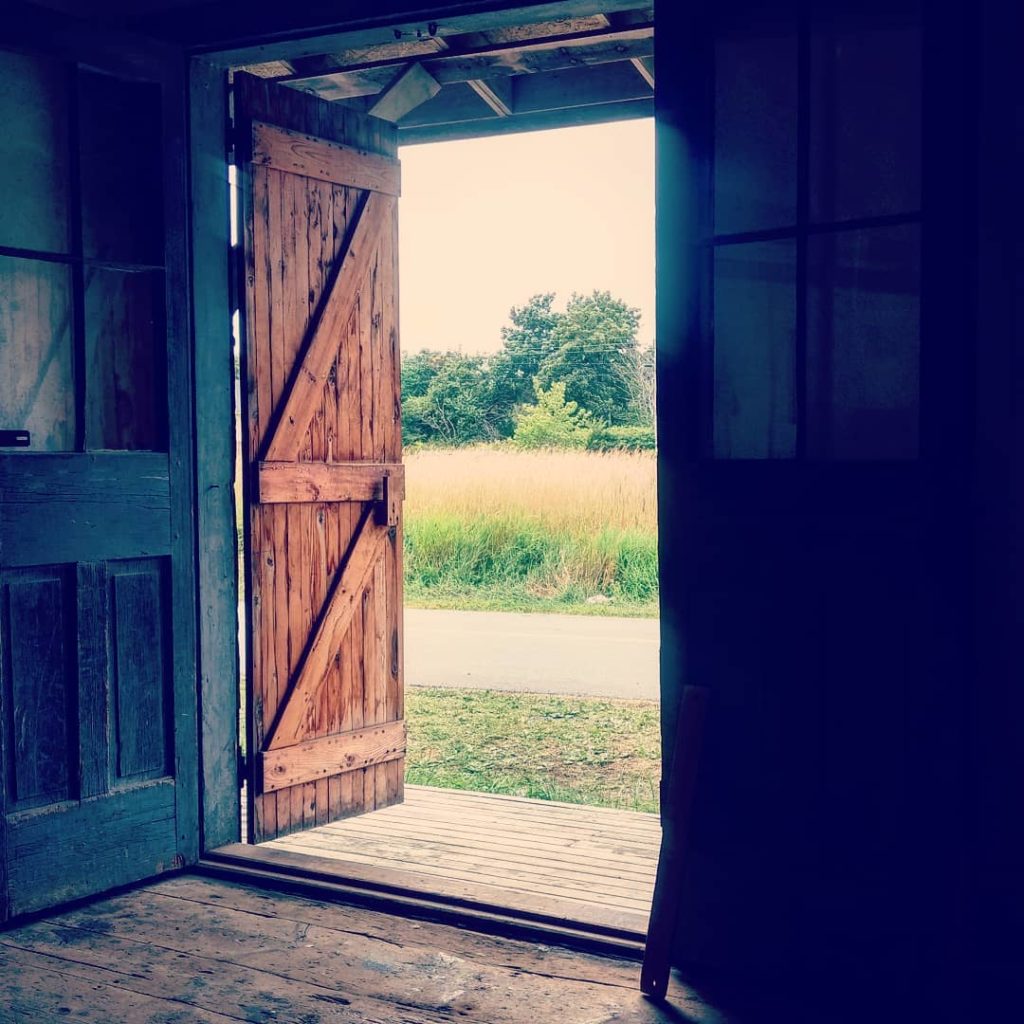
 

photograph showing a rustic, barn door looking out to a field

My View for the Afternoon by Anne Macleod Weeks


According to our On-Farm Written Euthanasia plan, veterinary approved and meeting all the requirements of our national standards of care, we humanely euthanize very young pigs using blunt trauma. In other words, we pick them up by their hind legs and crack their heads against the edge of the concrete pen. It takes force and determination to do it right, but it’s quick. When an animal is sick or suffering, it’s only right.

Today is not right. That’s what I’m thinking.

“How can you?” they ask. My non-farming friends, the students in my grade 11 class, the anonymous voices on Facebook and Instagram where I share information about our farm, trying to educate the consumer as we’ve been told to do by the experts. Sometimes the question comes from genuine curiosity. More often it’s from horror and disgust. “How can you kill those creatures you are charged with protecting?”

I used to try and explain that farmers accept death as a part of life. That we believe the animals have a purpose and are there to be used. That there’s tremendous satisfaction in knowing you’ve given your animals the best care possible and in knowing they are going to feed others. Now I just say lots of animals eat other animals and we take pride in making sure our pigs are well looked after. Neither answer seems to make much difference.

The warmth hits me as I walk into the barn. Quickly we change into our coveralls and boots and pull on our facemasks. Then we head down the hall to the nursery.

Brian is lagging behind a bit. He’s fourteen. So far, he’s been all bravado about this. I wonder if it’s starting to sink in. “You doing okay?” I call back.

“What? Yes.” He catches up. He’s grown again and his coveralls are short. I tell myself to pick him up some new ones the next time I’m in town.

Brian wants to take over the farm someday. He’ll need to learn many things. About animal care. About business. About running machinery and leading people and whether to plant today or hope the rain holds off so the field can dry just a little bit more.

And he’ll have to learn there are times when you are revolted or even terrified by what you will need to do. Times when, no matter how much you want to walk away, the voice in your head will remind you there’s no other choice and no one else is coming to help so you might as well get on with it. Times like now.

What will this day do to him, I wonder? To my husband? To husbands and children across the country, all who are in the very same situation? According to the rumours, tens of thousands of pigs will be destroyed. Pigs that were raised for a purpose, but in the end had none. We are at the door now. I look over my shoulder to see if Ian is ready. He nods. His face is hidden by the mask but I can see his eyes. He looks tired. No. For the first time, he looks old.

I reach for the door handle. From the other side, I can hear soft grunts and movement of the pigs. There’s a tiny squeal. My hand drops. I start to shake. I clench my hands and close my eyes. Through the roaring in my ears, I hear Ian. “Are you okay?”

“Give me a minute.” I reach for air.

“I’ll do it. You go back to the house.” His voice is brusque.

“Go ahead, Mom. Dad and I can handle it.”

My son sounds like his father. I look at him and see worry in his eyes. I will not. I will not make a day none of us will forget worse for my son or my husband. I will not make them doubt. We are looking after these animals in the best way we know how. We will not fail. I will not fail.

I make my eyes smile. “I’m fine.” I say. And I open the door.

Later, I head to the house while Ian and Brian finish cleaning up. I pull out the mousetrap and put it away. Just for her. Just for today.
Bubble Waffle on Xie Road

This entry was posted on by .

Bubble Waffle on Xie Road

thirteen years ago she stood beside him
in a ponytail and simple T-shirt
eyes steady on the nimble hands
that rested on the handle of the hot iron
heat against heat  a quick catch
his wrist jerks and the platter flips
onto its stomach  flames slowly roasting
into the milky batter across the bumps and crevices
of each drop
                       and
                               now she stands in a short buzz cut 
                               with quick swift strokes  dabs the thick mix
                               into each shell  one  two  three
                               before a quick snatch of the handle
                               heat against heat  flips the griddle onto its back
                               then calls         thirteen dollars apiece
                                               thirteen dollars apiece
                               while a surge of coins twinkle into
                               the rusted can

under the partial awning
half tucked away from the blistering orb
the wheels of the cart
               lock into step
of when a small child and her father
once stood        side by side 


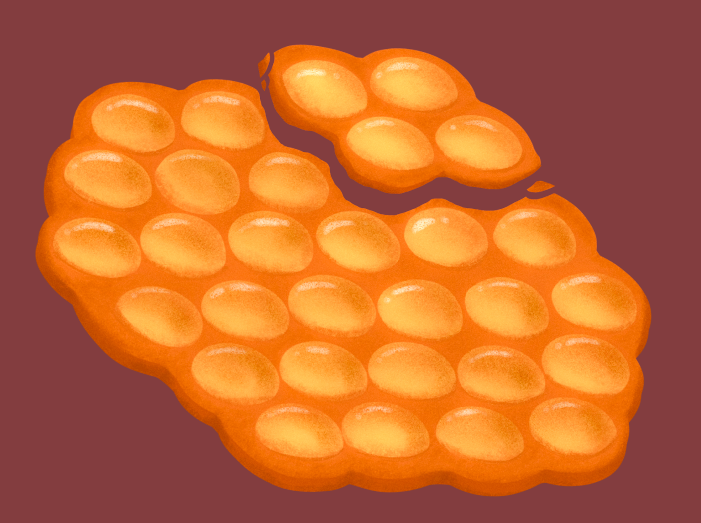
digital illustration of a bubble waffle

Bubble Waffle by BeanSandBun

It’s Not My Childhood

This entry was posted on by .

It’s Not My Childhood


But I’ll remember it for you.
You gorged yourself on wild pears
Scarred apples picked from gnarled trees
Snakes lurked underfoot among the tall grasses
But you learned to eat your fear with screams,
Transformed it into ecstasy.
You had no use for quiet.
From brambly bushes you plucked the berries
that snapped sweet and tart in the mouth
staining the tongue, the teeth.
What you didn’t eat right there
Beneath the hungry yellow sky
You carried home in the loose hammock of your skirt
For your mother to cook down into jam.


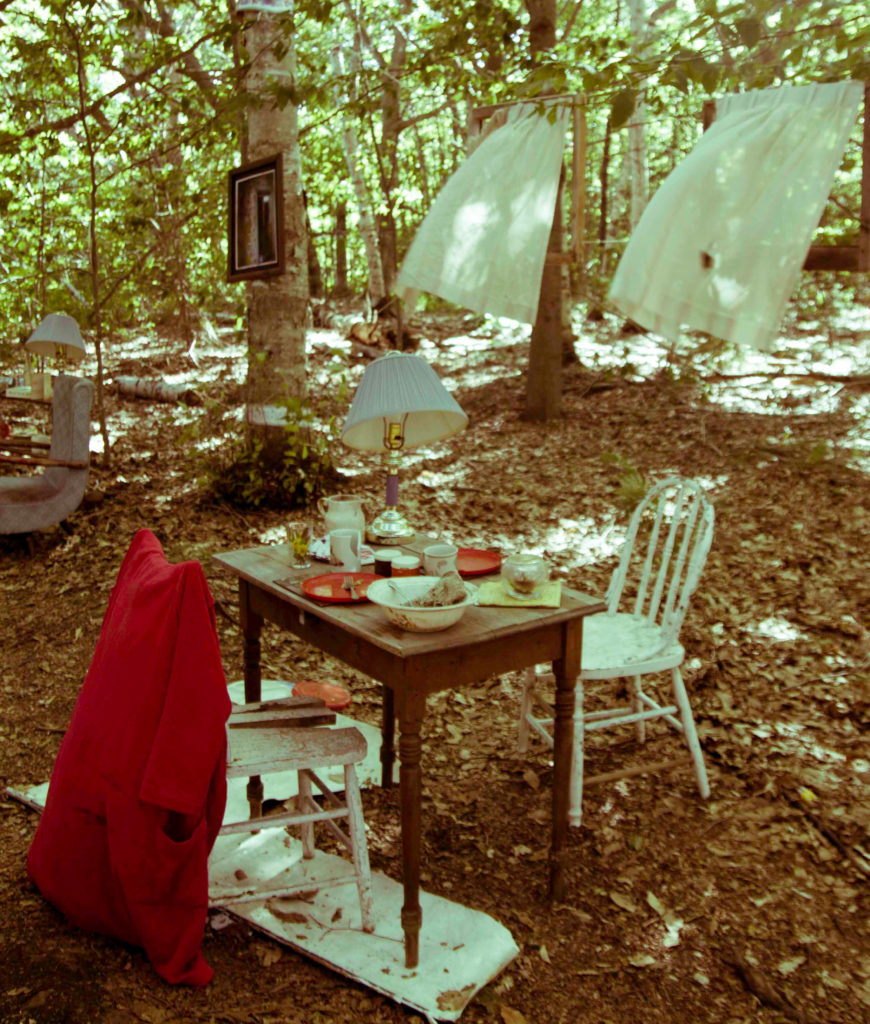
photo showing artifacts from an abandoned house displayed in a forest

Curiosity: A love letter to abandoned houses by Monica Lacey


On Two-Eyed Seeing:
An Interview with Chelsey Purdy

This entry was posted on by .


Chelsey Purdy is the Coordinator for the NSERC PromoScience Two-Eyed Seeing Camp, a summer camp for Indigenous youth that integrates Indigenous Knowledge and Western science, now in its third year. Chelsey is a recent graduate of the Applied Human Nutrition program at Mount Saint Vincent University. She is currently living in Halifax and recently started a MSc in Nutrition at the Mount. Chelsey grew up on the South Shore of Nova Scotia and is a member of Acadia First Nation. In her role as coordinator of the Two-Eyed Seeing Camp, Chelsey works with three Mi’kmaq communities in Nova Scotia, including her home community of Acadia First Nation.

Chelsey spoke with Understorey Magazine about Two-Eyed Seeing, the summer camps, and her experiences in a university science program.

Understorey Magazine: Can you tell us about Two-Eyed Seeing or Etuaptmumk?

Chelsey Purdy: In short, Two-Eyed Seeing (Etuaptmumk in Mi’kmaw) is viewing the world through one eye with the strengths of Indigenous ways of knowing and the other eye with the strengths of Western ways of knowing. Navigating both perspectives can be tricky at times, due to the extroverted nature of Western approaches to communication. Western perspectives have a tendency to dominate or override Indigenous perspectives in many forums. Indigenous scholars have described this as a modern form of colonization. In addition to this, Western science historically separates and categorizes things in an effort to understand the world. This approach makes it difficult to combine things that don’t fit in a predetermined or accepted scientific category. Those who are guided by Two-Eyed Seeing strongly believe that, to get the whole picture, we must draw from both Western and Indigenous perspectives, with deep respect for what each one offers.

Based upon the teachings of Albert Marshall, I have come to understand that Two-Eyed Seeing is inherent to many Indigenous people, and especially Mi’kmaw people, who have had to weave between both perspectives since the arrival of Europeans. However, navigating spaces that are Western dominated is still a difficult feat for many Indigenous people, as their values and perspectives are sometimes not appreciated in Western-dominated settings. Two-Eyed Seeing offers a framework where these values and perspectives can be integrated with Western views, creating opportunity for new ideas, co-learning, and reconciliation.

UM: How is Two-Eyed Seeing part of the process of the summer camps?

CP: The Two-Eyed Seeing Camp is a partnership between Sipekne’katik First Nation, Pictou Landing First Nation, Acadia First Nation, Mount Saint Vincent University, and Mi’kmaw Kina’matnewey. The camp is funded by the Natural Sciences and Engineering Research Council (NSERC) PromoScience Program, Canadian Roots Exchange, and (most recently) Medavie, due to an active partnership with their Breakfast and Beyond Program.

We are guided by Two-Eyed Seeing in the development, implementation, and evaluation of the curriculum. Two-Eyed Seeing informs everything from how we approach our relationships to the content that we create.

For me, the most important part of my role as coordinator is finding balance between community needs and institutional regulation. Much of this involves facilitating communication between outcome-oriented procedures and the relationship/process-oriented community. Finding this balance, as well as building reciprocal relationships, is at the core of Two-Eyed Seeing and the camp program.

When it comes to camp activities, we integrate both Indigenous Cultural Knowledge and Western science into curricula. In one of our activities called Mijipjewey na Pisun or “Food is Medicine,” we explore fish as a traditional food, how to fillet a fish, and the nutritional science behind fish and other traditional foods. In another activity, we explore the physics behind the sounds of different hand drums by recording and analyzing the sound waves of drumbeats.

UM: Is there something that surprised you during the camps? A reaction or realization or process that you didn’t expect?

I have been involved with the Two-Eyed Seeing Camp for three years now (as a student employee, intern, and now coordinator) and I learn something new each day. Much of this learning comes from working with people, including Elders or Knowledge Keepers, community members, academics, and university staff. While I learned things like grant writing, program administration, and how to do presentations when I was a student, this program is teaching me how to apply these teachings in the community and learn new life skills that connect me deeper to my Indigeneity. Some of our main partners include Mi’kmaw Kina’matnewey and the community education directors. Working with these partners, and with my supervisor, I have also learned a significant amount about curricula and education.

UM: You have a science-based university degree. Were you able to integrate Two-Eyed Seeing into earning that degree and/or can you foresee integrating it into your career?

As Mi’kmaw woman who has been taught and brought up with a predominately Western perspective, I did struggle with learning about Two-Eyed Seeing in a university setting. As I had more opportunities to learn with and from communities, I learned how both perspectives could be brought together. As part of my undergraduate degree, I completed the internship education program (a requirement for becoming a registered dietitian) and was able to complete my community nutrition placement with the Two-Eyed Seeing Camp. I also completed my honours thesis on examining and understanding how collaboration in science outreach programing for Indigenous communities has been applied. In these ways, I was able to bring Two-Eyed Seeing into my university degree. I have recently started a Master of Science in Nutrition Degree at Mount Saint Vincent University, and plan to continue my involvement with the Two-Eyed Seeing Camp during my studies. I also know that I’ll bring Two-Eyed Seeing to whatever career I end up in.

UM: How do you think Two-Eyed Seeing could/should change the way our federal government and other decision-makers deal with complex issues like climate change and ecological collapse?

Actually, I recently had the pleasure of interviewing Elder Albert Marshall on the topic of Two-Eyed Seeing in my role as Two-Eyed Seeing Camp Project Coordinator. During the interview, Albert touched on biodiversity, climate, and more. We will be sharing this interview through social media and other websites and I believe that some of his wisdom can be used to answer this question.

From my perspective, inclusion of Indigenous communities, people, and perspectives in decision-making processes is a must. To do this, inclusion has to be discussed, as it may mean different things to different people. Many decision-makers are currently non-Indigenous people, who historically have not effectively consulted with communities about things that ultimately affect them. This is seen across Turtle Island (including Canada). Google “environmental racism” and you will have more than enough examples. In the same vein, I will highlight the work of some amazing African Nova Scotians and Mi’kmaw people as shown in There’s Something in the Water. This film gets at the very heart of what I am trying to describe.

I cannot stress enough the importance of including Indigenous communities and people in the planning, execution, and evaluation of programs and policy. Exclusion or inclusion effects the environment, education, food security, and health. Indigenous communities/groups/people need to have a voice in decision-making, not only about the environment, but about our health, access to food, education, and beyond.

One of the many reasons I have stayed with the Two-eyed Seeing Camp Program and Mount Saint Vincent University for my graduate studies is the program’s devotion to answering the Truth and Reconciliation Calls to Action and the space they have given me to develop the voice I share with you today.

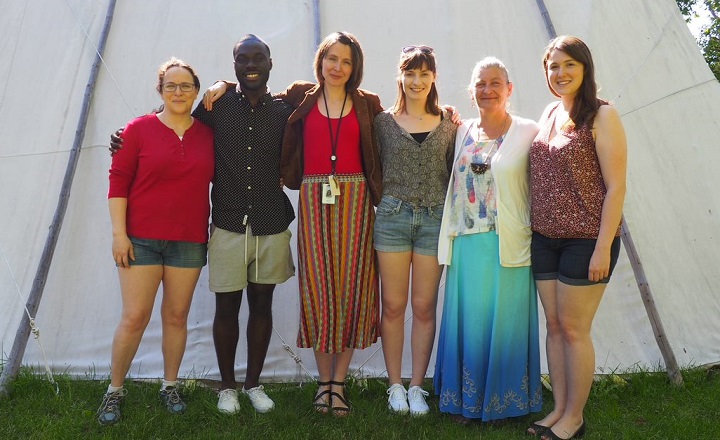
photo of 2019 team for the Two-Eyed Seeing Camp

Two-Eyed Seeing Camp team (2019). From left to right: Shannon Ledger, Kwaku Agyare, Dr. Shannan Grant, Jaclyn MacNeil, Florence Blackett (Millbrook First Nation), Chelsey Purdy (Acadia First Nation).

Learn more about the Two-Eyed Seeing Camp on Facebook, Twitter, and Instagram. In Understorey Magazine, read more about Two-Eyed Seeing and Indigenous Knowledge in Etuaptmumk by Rebecca Thomas and Elapultiek by Shalan Joudry.

On Science and Storytelling:
An Interview with Maryam Heba

This entry was posted on by .


Maryam Heba describes herself as a Muslim woman from the Middle East, a first-generation immigrant to Canada, a graduate from the Honours Life Sciences Program at McMaster University, an advocate for women in science, and someone who is passionate about combining science, art, and storytelling. Naturally, we wanted to speak with Maryam and learn more about her experiences!

The following conversation took place virtually in September 2020.

Understorey Magazine: You recently graduated from a university science program. During your studies, did you experience any difficulties or challenges related to being a woman and/or a woman of colour?

Maryam Heba: I would say it’s more complex than that. During my studies at university, I did not notice any major challenges as a result of being a Muslim woman. I do have stories from when I was younger. During my first year in a Canadian school, when I was ten, no one could believe that someone from the Middle East could speak English so well. Another time, a classmate insisted that I could not speak “Egyptian” because I could not understand the Ancient Egyptian hieroglyphs in a Social Studies documentary.

Silly childhood stories aside, I have to say that being the child of first-generation immigrants is an incredibly complex position to be in. The sacrifices that were made by my parents are immeasurable: family and friends, decades of career achievements, and lots and lots of money. Add to that the discomfort of moving to a country where they could not connect with the language, religion, culture, or even the food. They made these sacrifices just to make sure that I have a better life.

My father insisted that I become a doctor so that I would have a successful future—the reason he came to this country. I took the responsibility to make my parents proud very seriously. It truly felt like a loan that I had to repay. This repayment, however, came at the expense of my mental health and independence.

My life became fully focused on school. I participated in very few extracurriculars. When I scored 95 on a science quiz, I was told I needed to work harder. And so, I placed unattainable expectations on myself and fully believed that if I did not ace that next test, my future was over. At one point in second year of university, I hyperventilated in the shower hoping to pass out so I wouldn’t have to take a test. Everyone knew me as the intelligent kid who would make a great doctor someday. But the further I walked in life, the less I wanted to become a doctor. I knew I wanted to genuinely help people and do something that I truly enjoyed, but being a doctor checked only one of those boxes.

As my father would not take no for an answer, I signed up for the MCAT. Twice. The first year, I cancelled my appointment because I could not get myself to study. Keep in mind, I graduated from a Life Sciences program, where I had already studied a lot of this material. I am no stranger to spending hours on end preparing for a test. Yet I was immensely stressed about the MCAT and my brain just kept rejecting the material. I am not a person who gives up easily, though, and I signed up for the following year of testing. Again, I could not study and I was not ready. But I wrote the test to show that I went, and I voided my test results. At that point, I realized that I would not go to medical school anytime soon and I had zero plans for after I graduated from my degree. I felt pressure to continue school in any type of Masters program, but this did not feel right. So, I took a leap of faith and a gap year. God was it thrilling!

UM: How did you spend your gap year?

MH: The gap year went against every single value my father had drilled into me for the previous twelve years. I was in uncharted territory: school-free. Looking back, I used my time wisely. I got my first official job (I was not allowed to work while I was in school), which helped me pay off my student loans and develop a lot of soft skills that I had missed out on. I was also fortunate enough to start therapy and had the privilege of travelling to Amsterdam. This was the first time I had travelled since I had landed in Canada thirteen years prior and I was able to bond with my extended family there.

I also started volunteering for Lotus STEMM. This organization was founded by Dr. Roopali Chaudhary and provides mentoring and networking opportunities for South Asian women in science, technology, engineering, math, and medicine. Lotus STEMM is run by a team of scientists, healthcare professionals, engineers, and educators. They currently offer a wonderful one-on-one mentorship program where youth (at least 16 years of age) and women can find guidance on professional skills and personal goals as well as meet other mentees. They also started a Lotus STEMM-CAGIS chapter for South Asian girls (ages 9-16) for hands-on STEM outreach.

So, in other words, during my gap year, I went on a journey to find myself. Throughout this journey, I realized that I do not need to become exactly what my father wanted me to become. I still greatly respect his sacrifices to bring me to Canada. But, I also know that no one can live my life except me. I have faith in a future where my father sees me fulfilled and successful, in my own way, and knows that his sacrifices were worth it.

Now I am in my second gap year after my undergrad degree and I am continuing my work in science communication. In addition to Lotus STEMM, I have participated in the Global Science Show on Twitter and have recently started volunteering with Art The Science, a non-profit organization founded by Julia Krolik, which just so happens to be fully run by women! We host residencies in which artists can immerse themselves in a science research lab and then create beautiful artwork that we feature on our platform. We also feature many Canadian and international science-art creators on our amazing blog (#5 blog in Canada via Feedspot!) and on our online SciArt gallery.

I am also looking into pursuing teaching in the long run. I’ve always had a passion for teaching. I see it as perfect career where I can communicate science and directly help people as well. I am so excited to see what the future brings!

UM: Most of your work these days focuses on science communication. Is there a point when you realised this is what you want to do?

MH: I’ve always had an inclination towards science and art. In high school I maintained my creative outlet through communication technology classes, where I learned video-making, design, photography, and so on. However, I did not directly connect science and art until my last year of undergrad, when I took a wonderful class at McMaster called Science & Storytelling. There, my professors encouraged us to let go of rigid scientific rules. They led us into a creative journey of translating hard-cold scientific evidence into intriguing, creative, and human stories. That class was truly an epiphany in my career. From there, I took it upon myself to fill my last semesters with science communication classes—and I finally felt like I was taking these classes for me, not anyone else.

UM: Why do you think this field is important, especially for women and women of colour?

MH: It is important for women and women of colour to engage in science communication because they provide a diverse representation of science, thus making it accessible to underrepresented populations. A project I’m working on with Lotus STEMM improves the accessibility to science by tackling a health equity barrier: language. Due to language barriers, some communities may not connect as well with information from a local English news source as they would from a WhatsApp chain message in their native language. We tackled this issue by translating scientific knowledge about COVID-19 into over ten South Asian languages, along with other minority languages like Arabic. We then presented this information in an engaging video series. I created mixed media clips for these videos, and produced the Arabic version of the scripts. Our videos received positive reception from South Asian communities and the media. With science communication, we give a voice to underrepresented populations, including women and women of colour. Whether by telling their stories or by delivering scientifically accurate information, we help create a more equitable life for all.