Archives

I Am Black History

This entry was posted on by .


My name is Donna Paris
And I am Black History

The story, I am told, is that my great-great-grandfather came to Nova Scotia from Ireland once slavery was abolished in Great Britain. Despite the many hardships he faced, he managed to send his three sons to university and dream into the future so I can have the life I now live.

I am Black History

The story, I am told, is that my white great-grandmother came to Nova Scotia from France. She met and fell in love with a Black man. Her family said, “You can have him or you can have us.” Their union produced my grandfather, who produced my mother, who produced me.

I am Black History

The story, I am told, is that my paternal grandfather was a member of the No. 2 Construction Battalion–one of over six hundred Black men from Ontario, New Brunswick and Nova Scotia who fought for the right to fight alongside their countrymen despite the prevailing sentiment that Canada didn’t want a “checkerboard” army.

I am Black History

The story, I am told, is that my family was the first Black family to live in the now closed armed forces base Cornwallis in Nova Scotia. When my father was posted there the commanders of the base went around and asked the families how they would feel about having a Black family live next door to them. Then they called my father in and said, “We don’t want any trouble from your children!” The five of us ranged in age from six years to six months.

I am Black History

The story, I am telling, is that when my Grade One teacher gave me a piece to sing and I couldn’t do it very well she said, “What’s wrong with you? Don’t you know your people can sing?”

I am Black History

The story, I am telling, is that my Grade Five teacher accused me of cheating when I got a ninety-seven percent on a history test because “How could a little Black girl really be that smart?”

I am Black History

And the story, I am telling, is that there was a time and place when Black people were not allowed to learn how to read and I now teach children how to read.

My name is Donna Paris
And I am Black History

Service Works

This entry was posted on by .

People used to tell me that giving was more rewarding than receiving. But once I started using alcohol and drugs in my early teens, my vocabulary reduced to “Gimme, gimme.” I started on a road to nowhere and no one cared. Not even me. I wanted more and more but ended up with nothing.

The seeds of my addictive behaviours were planted early, though I had no idea it was happening. By the time I was twelve, my home life in Montreal was dysfunctional. My mother had been a single parent for eight years by that time. For the first six years, we had our ups and downs, but she managed to hold things together for my two brothers and me. Then, literally and figuratively, she was all over the place. She couldn’t pay the rent so we stayed in an apartment only long enough for the eviction notice to be enforced, usually about three months. We moved so often we barely had time to unpack. There was no food in the house, no new clothes or shoes or school supplies. I remember coming home one day after school, so hungry. I opened the fridge and found only a dried up piece of ginger. Yet Mom always had wine and weed; she stopped caring about anyone or anything else. I just wanted stability—and food. I got it by leaving.

Remnants/Survivors by Sarah Mosher

I stayed with friends at first and often met my basic needs—food, clothes, toiletries—by shoplifting. Soon needs became wants. I wanted more clothes, better clothes, name brands, the best brands. I thought these things would make me an achiever. I wanted all the time—and I got what I wanted without paying for it. I didn’t end up on the streets, at least not until I was about forty years old. I found an apartment with a young couple and continued to go to high school often enough to keep the authorities off my back. I was six months pregnant at graduation.

After I had my daughter, we moved to Toronto as I knew my French would be an asset in finding work. I’d left my baby’s father and so, like my own mother, I was a single parent. I found work in Toronto—but I also found crack/cocaine and developed a habit I would keep for twenty-eight years. During those years, I travelled around the country and the world, wreaking havoc in all my relationships and committing crimes on an ever larger scale. I needed money for the poison I inhaled into my bloodstream and shoplifting would no longer cut it. I started importing. I threw in a bit of fraud. I felt shame and regret only when I got caught, which I often did. During my twenties, I also gave birth to three boys. I then had four children, all of whom I neglected on a regular basis to make ends meet and to have my substances. My daughter suffered the most. She was old enough to witness, if not understand, my bizarre behaviour. I would often leave my kids with my mother when I went off to import and when I was incarcerated. I knew it wasn’t a healthy environment for them but thought it was better than being with me.

I tried to slow down after my boys were born and actually managed seven good years. I moved to Jamaica with the kids. It felt like home and I found the man of my dreams. The children did well. I got married. Things were stable. But even though I wasn’t using crack/cocaine, my addictive behaviour was still very present. It lingered in the background of our lives and in the back of my mind. Every once in a while, I would allow it to come forward and go off for a weekend to smoke crack. But mostly, as always, I chased the money. I got involved in telemarketing scams and travelled back and forth to Canada many times. A rift formed in my relationship with my husband, and when we eventually split apart, drugs took over my life again. I did not want to feel. I would not return to reality for fourteen years.

During this time, I did so many things—and so many things were done to me—that I could never list all of them here. When my money ran out and I had nothing left to sell, I sold myself. I lived and worked as a prostitute on the streets of Jamaica and went to jail there several times. One night, I refused to have sex with a man because he couldn’t pay. He tried to kill me by stabbing me in the head.

But the worst, the most excruciating pain, was yet to come.

My kids had moved back to Canada and were living with my brother. Eventually, I moved back too but I didn’t see them much; I didn’t want to see anyone. I served time for crimes I’d committed before leaving the country and then went back to shoplifting to pay for more drugs. When my boys started to get into trouble, I felt guilty about being such a worthless mother—but only when I wasn’t high. Like me, the boys were drawn to fast money like magnets. My second son, Devon, started a street gang when he was sixteen. He handled guns; sold drugs. When he was eighteen, he was shot dead by drug dealers.

I would love to tell you that my son’s death woke me up, that I stopped using, got clean. But that would be a lie. He was murdered in 2008. My recovery came six years later.

In late April of 2014, I found myself back in jail. My lawyer, the crown, and the judge recommended that I go to rehab. It would be my third stint. I figured I had nothing to lose but I also sensed some sort of shift or awakening—my “moment,” as I would later learn in the 12-step fellowship. I had been to AA meetings in the past and found they held no interest for me but I knew I had to try again. I had to open my mind to possibilities. I started going to 12-step meetings at the rehab facility—Alcoholics Anonymous, Cocaine Anonymous, and Narcotics Anonymous—and started to take their suggestions seriously. Service was one of their first recommendations. It made sense. Most of the people I knew who’d remained abstinent were involved in service. Some had even started within a day of being clean. So when I got home from rehab, I volunteered to help within my 12-step groups.

Soon afterwards, I was invited by the NA Hospitals and Institution Committee to share my story at another rehab in Montreal. The residents were so enthralled, so inspired, that when a volunteer coordinator position at that rehab facility opened up, I was nominated. The position involved organising weekly speakers. I knew other addicts at the facility depended on me. I couldn’t mess up. Finally, I felt accountable. And that’s how it started for me: I realised I could help others.

I have been clean since May 1, 2014. The 12-step literature says that once we are on a solid road of recovery, we should also do service in our communities; we should give back to society for the help we have received and for the damage we have caused. I’ve had my share of both so for the past few years I’ve shared my story at 12-step meetings, rehab facilities, and outreach programs. I’ve encouraged people to seek out 12-step fellowships; some do and stay; others don’t. I’ve also taken a volunteer position at the local Y in Montreal where I greet guests, swipe their pass, and direct them to various locations and activities. Mostly, I’ve been available to support addicts as they find a new way of life.

I remember when a young woman contacted me early one Saturday morning. She had been to my talk and reached out because she was having suicidal thoughts. I talked her through things; told her there is always hope. She asked me to be her 12-step sponsor and she’s over nine months clean today. I am so proud of her.

I now sponsor six women in the fellowship and support many others who call or text me daily. I never say no to speaking engagements and hope to one day do this work for a living. My biggest dream for the future is to offer community service in Devon’s name. I’d like to open “Devon’s Place,” a house for women who want to stop using drugs and have nowhere to go after leaving jail or rehab. This would be the ultimate service position for me: giving women a chance leave the deepest, darkest place and start a new life.

Service

This entry was posted on by .

Our cover art, a spraypaint mural of a woman among ferns and flowers and trees, may not be the first image that comes to mind when considering our theme: service. But it’s an old word with a long history and many variations.

Service originated from the Latin servitium, which relates to slaves and slavery. Several of the prose and poetry pieces we publish here, our eleventh issue of Understorey Magazine, carry this sense of service as being bound by contract or duty or societal expectations.

Spray paint mural by Shalak Attack, Montreal, 2007

Susan Brigham tells of her mother who, at fifteen years old, travelled far from her home of St. Helena to become a servant in England. Other pieces consider a more subtle form of service as servitude, particularly the unspoken roles of women. Julia Florek Turcan looks at how service roles are passed down through generations of mothers. Dorothy Nielsen creates a fictional “Marie,” a wife and mother who always and unquestioningly puts the needs of others first.

Many of the stories in this issue invoke a more complex definition of service, one in which roles are taken on willingly but a deep sense of obligation, allegiance, and sacrifice remains. Often such forms of service involve tending to the direct needs others. Gayle Mavor tells of becoming wound into a web of caregivers for an elderly woman. Sara Jewell writes about caring for her father, who suffered from early-onset dementia, and how this experience compares with her becoming a lay worship leader. And Savannah Sidle touches gently but deeply on the unceasing service of mothers to their children.

Of course service often extends beyond personal relationships—out into the community, the country, the world. Emily Bowers writes of working abroad for many years and then returning to rural Nova Scotia to become a volunteer fire fighter. Several of our pieces look at military service, but none through the usual lens. Sheila Firth-Warlund offers three poems about her role as a military chaplain serving in Afghanistan. Wanda R. Graham tells of caring for a woman released from Canadian military prison:

she’s made mistakes
I look at her in wonder
she’s one of the country’s finest
what can she mean, what has she done?

Like Graham, collaborators Maya Eichler and Jessica Lynn Wiebe both honour and question military service. Their visual art and dialogue examines the red poppies often worn on Remembrance Day and asks readers to consider what—and whom—this symbol might exclude.

There is yet a further, broader sense of service represented in this issue, that of commitment to a cause rather than to a specific role. Liane Berry shares her story of addiction and recovery and how, through service, she now devotes her life to helping other addicts. And in Hannah Renglich’s work, service veers into the realm of stewardship, caring for the long-term vitality of the land and its diverse communities.

Despite differences in interpretation, the work published here invokes two enduring elements of service. There is commitment (willing or less so), hard work, sacrifice. But there is also growth.

All of the women represented in these stories are changed through acts of service.

Some find a voice. Some redemption. Many find community and belonging. Even those exhausted and undervalued are stronger in some way: a small salary sent home, a single friend, a self-made bed. Service roles are rarely linear, simply giving. They start from self, change many, and circle back to self.

In this sense, our cover art perfectly captures the theme of service. The mural was created by Shalak Attack, a Canadian-Chilean artist dedicated to creativity, community, and activism. It covers a wall in north Montreal, a public space available to everyone. And although the woman in the mural is rooted to the earth, she extends out into the world. She is engaged and essential. As she supports others around her, she becomes stronger herself.

Also in this sense, we present the Service Issue of Understorey Magazine as an act of service in itself. We work hard to bring stories of women’s lives to a wider audience. Many of the authors and artists published here are new to their craft. For some, this is their first publication. Yet all have vital stories of giving and growing as women among often conflicting obligations, desires, and communities.

We invite you read, contemplate, share. As always, we’d love to hear what you think. Leave a comment for an author or artist in the comment box at the end of the articles, on Facebook or Twitter, or through our contact page.

Thank you and enjoy!

Cardboard

This entry was posted on by .

Firefly is falling apart. “Firefly” is what Marie’s older daughter named the bed when it was brand new thirty years ago. On Sammy’s limited salary, buying the two girls sturdy army cots with strong wire flats and not-too-thin mattresses had seemed the best idea.

They’d worked fine, and then Sammy got a raise around the same time the girls had growth spurts. Marie pored over the Sears catalogue for weeks until she finally settled on beautiful maple-look bunk beds. Then Firefly and Nightmare (their younger daughter had thought of that name for her own cot) spent time folded up in the basement behind the water heater, and later in the crawl space under the roof.

Two years ago, when Sammy had his first heart attack, Marie asked her son-in-law to bring Firefly down to the mudroom where she unfolded it next to a space heater from Canadian Tire. Marie wanted to be close enough to Sammy’s bedroom door, but not in the bedroom. Sammy needed his sleep and the girls’ room—now the guest room—is always made up in case the girls come home for a visit. It was just easier to be here off the kitchen; she doesn’t disturb Sammy when she wakes up at night to read with a flashlight or gets up early in the morning to make tea in her “Best Mom” mug.

But now Firefly’s mattress is leaking through the wires. Whenever Marie manages a proper cleaning, she collects tiny swaths of cotton from under her cot—sometimes even from beneath the girls’ bunk and behind Sammy’s recliner. And the wires themselves have been letting her down. She can’t get comfortable on her right side because she feels her hip sagging towards the floor, which makes her feel off-balance and causes dreams of falling from airplanes or towers. If she turns over, a small but persistent mound of mattress thrusts itself into the right side of her lower back. If she inches to the left, her arm or leg drops off the edge.

Still, the idea of calling either girl and asking them to drive all the way to Cedar Springs and then take her to one of those massive furniture stores at the edge of town, well, it’s just too much to think about. Besides, according to the flyers, even small beds cost hundreds of dollars nowadays.

One morning, a huge truck delivers a new stove to Jerry and Susan next door. Late that evening, Marie drags the empty stove box from the curb into her backyard and covers it with garbage bags held down by stones and a big stick. She spends the next afternoon with her kitchen scissors making small cuts in the tough side seams until she can flatten one side of the box. Then she scores the bottom seam with her biggest knife and cuts the side off completely. She stomps on the leftover flaps so she can fit them into her recycling bin. That part takes the most time. Sammy is watching the sports channel and enjoying the low-fat chips and dip Marie brings in. He doesn’t even ask what’s keeping her busy in the backyard.

Marie takes the flattened side of the box and pushes it under the upper two-thirds of Firefly’s mattress. A little line of cardboard is showing; she adjusts the blanket to hide it. She lies down on her right side, sighing deeply, feeling supported, almost falling asleep.

And her daughters are just plain wrong to say she’s not coping any more.

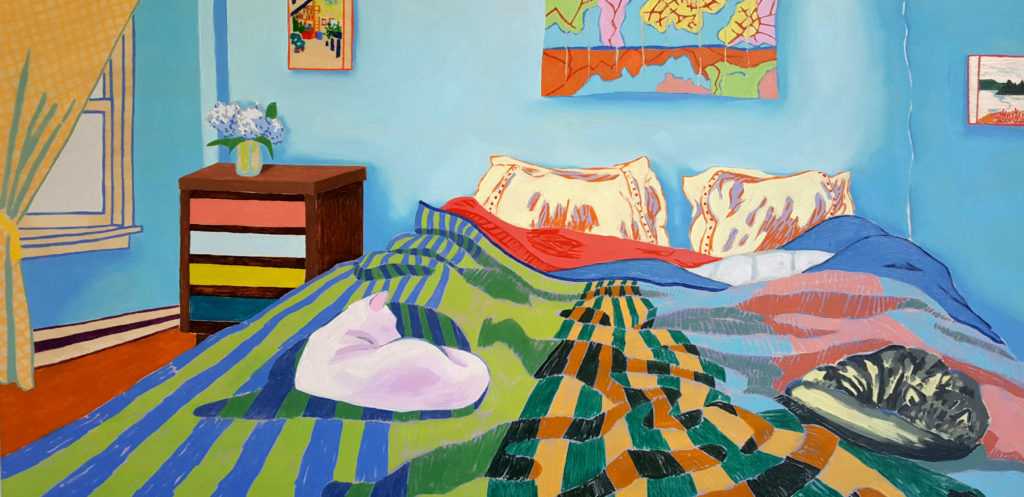
Let Sleeping Cats Lie by Caitlin McGuire

The Trouble with Margaret

This entry was posted on by .

In my forty-eighth year, in exchange for free rent, I chose to become an overnight caregiver to eighty-five-year-old Margaret, survivor of one broken hip and a stroke that transformed her speech into a restricted language of gravelly utterances.

My move from Vancouver to Salt Spring Island the year before meant work was hard to come by, though I did find a part-time job at the island’s employment centre. One morning, I answered a call from a woman seeking a caregiver for her mother. I toyed with the idea. I’d just finished caring for my own mother: midnight trips to emergency, regular visiting, and lending a hand as she struggled with kidney failure. I wondered if my willingness to consider this new arrangement had something to do with missing a mother figure. I accepted the role—and became one of Margaret’s seven caregivers in an around-the-clock caregiving relay.

I am not a patient person. I do not suffer fools gladly. But with Margaret I was patient because she was no fool and I’d made a choice. So, four nights a week, I climbed the steps from my tiny suite, surfacing in her living room at eight o’clock. All that winter, we travelled through India, courtesy of Knowledge Network. When Margaret tired of a program, there was no asking my opinion. Click. She was onto the next. I remained quiet and tended the fire. The least I could do, given her lack of privacy, was leave her be with her thoughts. Every evening at nine, she clicked off the TV and her burgundy La-Z-Boy propelled her behind upwards until her feet touched the floor: bed time. I squeezed past her like security clearing a path for royalty. I picked up crumpled Kleenex, ensuring path from world-of-chair to bedroom remained obstacle-free. My fingers, hints at her elbow, guided her.

When I helped Margaret change into her nightgown to ready for bed, I snuck glances at her naked flesh. Her white breasts reminded me of cake decorating bags emptied of icing. After her flannel nightie had been slipped over her head, and she lay back down, I’d ensure the bulky material was not bunched underneath her. Sometimes it required all her strength to lift her small bottom millimeters off the bed as I reached up mimicking an obstetrician preparing to yank out a breach baby. I’d whip down the material in a most unceremonious fashion and my maneuver never failed to make her laugh.

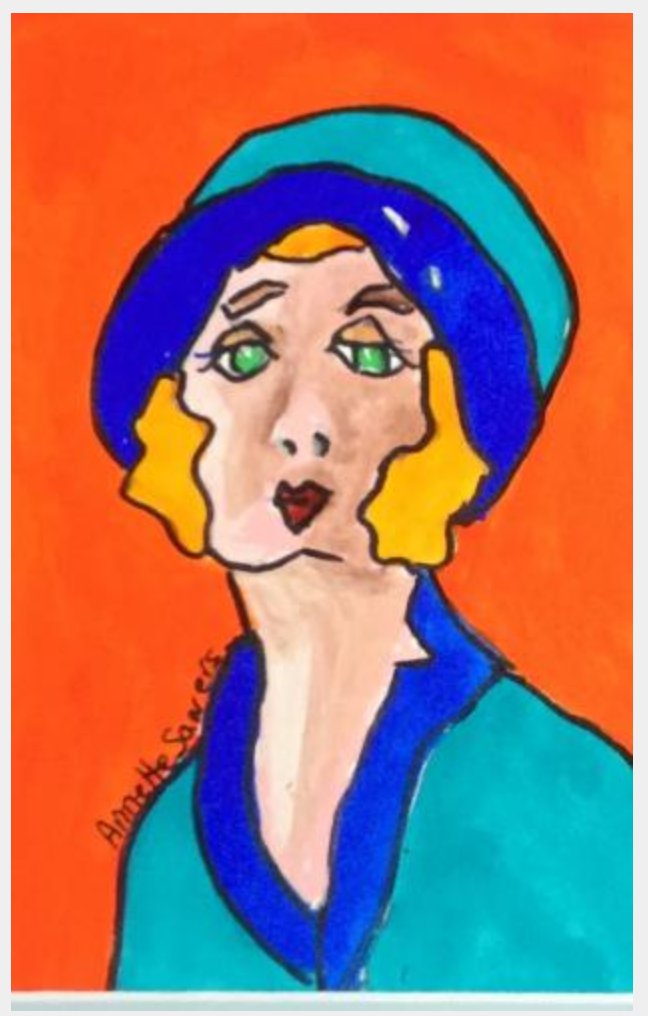
Timeless by Annette Sawers

Once she was settled into bed, I moved about the house, apparition-like. I set the table for the next morning and stared at photos, younger versions of my elderly charge. There she was leaning up against a wall in a dusty back street in a hot foreign country. What had her adventures been? I’d then go to sleep in the adjoining upstairs bedroom where I stayed the four nights I was “on duty.” At seven the next morning, I’d pad quietly towards the kitchen. I’d stare outside while stirring the porridge, watching timid deer tiptoe down the road. I’d gather ingredients for Margaret’s special shake: flax, hemp hearts, blueberries, yogurt, soy milk, and chia. The whir of the blender signalled that breakfast was ready. Everything was timed. Shake. Porridge. Fair Trade coffee. Toast. Margaret definitely liked her routines.

*

I became nun-like in my service to Sister Margaret. Small acts of repetition measure out a lifespan. It didn’t seem that long ago that I’d been a child, listening to the cacophony of my own mother’s placement of cutlery on our family’s breakfast table, rarely time made for social intimacies with her children. I began to wonder about myself at eighty-five. Where would I be? Who would care for me? Would I still be at all?

*

Sometimes I couldn’t predict what would make Margaret laugh, like the day she pushed the button on her Life Force alarm. “My head. My head doesn’t feel right,” she said. I thought she might be having another stroke. When I returned from calling the ambulance she was chuckling.

“Why are you laughing?” I asked, annoyance in my voice.

“The look on your face,” she said, laughing more softly.

On a good night, it was what I didn’t hear that mattered. I didn’t hear that brass bell beside her bed jarring me awake. I didn’t hear my name being called out in darkness, though if I did, I could pounce through the adjoining bathroom in under a minute. I’d arrive tense and bleary-eyed upon a half-lit scene. The water glass had toppled. She’d be splayed on the carpet, as flexible as Gumby, that childhood toy.

Before her latest fall, I’d drive her the ten minutes to St. Mark’s Anglican Parish for morning meditation. The short, steep road leading to the church cast me as a reluctant character in a Margaret Laurence novel. I’d park the car and hover, moth to flame. She’d push her walker, its metal parts jangling across the gravel parking lot. Inside the musty museum of Christianity, a handful of others at the front of the sanctuary would greet us. I’d sink into the brilliant collage of light twirling through stained glass and inhale the whiff of polished mahogany. The red rug transported me back to my own Sunday school days. I’m beside my grandpa there. His cane taps its Presbyterian way, braille-like, towards his pew. Halfway through the sermon, he unwraps a Lifesaver and hands me one. Our very own religious ceremony. Following childhood, I rarely found myself in a church—until, that is, I returned with Margaret. The calm and the quiet. The feeling of being close to an elderly person and yet with others nearby, not solely responsible for Margaret’s well-being. St. Mark’s engulfed me like a reprieve.

*

When I agreed to my new living arrangement, there was no indication of the battle brewing between Margaret’s three adult children, her doctor, and her bevy of caregivers, a battle every bit as contentious as a child custody dispute. The disagreement centred on Margaret being moved off her beloved Salt Spring Island into a Victoria care facility. Margaret preferred to stay. Her caregivers needed their jobs. Her daughters were bent on a mission of removal.

Initially, I’d emailed her eldest with updates. I hadn’t even considered Margaret’s privacy. Only natural, I thought. Kids should know. Within months I felt like an informant. Who else was seeing my words? Secret meetings among the other caregivers reached epic levels. Whispers everywhere.

As Margaret’s condition deteriorated, her middle daughter scoured Victoria for the perfect care facility. “Best for her,” she told me. The eldest daughter agreed: “She hands over six thousand a month in caregiving!” I tried to imagine what it would feel like to have to pay people to care.

One rainy morning in March, I awoke to footsteps and muffled voices overhead. A short time later, there was a knock at my suite’s door. “They’ve gone,” said the middle daughter, meaning Margaret and the eldest were enroute to Victoria. Her husband got busy changing the locks. I wondered whose access, specifically, they were barring. They handed me the new keys in keeping with a verbal arrangement we’d had from day one: “Regardless of what happens with mom, you can stay in the house.” For insurance purposes, I’d assumed.

I felt queasy after Margaret left. Had she agreed or had she gone under duress? We never spoke of these matters: caregivers overstepping boundaries; middle-aged children kidnapping elderly parents to deposit them in places where others got paid to do what they couldn’t or didn’t want to do. Margaret didn’t talk very much, and when she did I found her hard to understand, so we kept communication to a minimum. But all by myself in her house, Margaret’s presence loomed in her empty La-Z-Boy, in the absence of our morning routine, and in her lingering personal scent. I moved out within the month.

*

Throughout my ten months with Margaret, I often thought back to my former life in Vancouver where I’d spent a few hours a week volunteering at the cardiac wards at St. Paul’s Hospital. I delivered warm blankets, filled water glasses, got ice, and diverted minds from upcoming operations. My first shift was nerve-wracking. Instinct told me when to go and when to stay by the bedside. Patients surveyed me with curiosity. Tubes snaked out of blankets and slithered down bare legs. There was no predicting which patients would inexplicably delight in showing me their serger-line scars.

“I’m not a nurse,” I’d said, urgently, the beeping of their heart monitors the white flags of fragile reassurance between us. “Just a volunteer.”

After a few hours, I’d lock my red smock away and head down Robson Street. My heart felt lighter. It was as if, patient by patient, loving angel hands had woven fuzzy threads around my own heartbreaks. I was the baby in a family that didn’t know lovey-dovey loving. Except with my closest friends, I’ve always held my connections at an orchestrated distance; independence has meant separate, in control. Before I volunteered at the hospital, before I cared for my mother and cared for Margaret, I would not have called myself a caregiver. I was a caring person, but never had responsibility for anyone. I didn’t even babysit as a child.

But somehow, by putting myself into these situations, just the simplest form of responding to people’s needs, being there for ten minutes or an evening, I realized it was something I craved. It felt good. It felt like I belonged. Despite my single, childless status, my unheralded acts of service have added me to an evolutionary line of caregivers eternal. Small ceremonies. Daily life. Heart open.