Archives

Thomas and May

This entry was posted on by .

I was lost for a moment, phone in hand. Who is this woman? A mother? Oh, a mother of May’s classmate. Why are we talking about her home renovations? A … birthday … party…. May is invited to a birthday party!

May, whose inaugural school year was spent in a classroom for students with “special needs,” had just a month before entered a general kindergarten class. No social invitations as yet, though.

“We’re doing over our kitchen,” the woman explained. “Our son, Thomas, who’s turning five, asked the contractor if he could throw in a wheelchair ramp so that May could come to his party.”

Tears welling up now. Thomas’s mother wouldn’t, couldn’t, have known how breath-taking this was for me to hear. After sucking in some of the air that had fled, I attempted to  switch my tone from stunned to appreciative.

“Not a problem,” I almost gushed. “We have a fold-up stroller. I can carry May up the stairs.” Then softening, “By the way, that’s just about the sweetest thing … I can’t wait to meet this boy.”

There are a few things that I remember about Thomas’s party — I met some of the mothers from the school neighbourhood, which was not our own. And I remember a classmate, a little boy named Leonard, crying in the foyer because he didn’t want to stay without his mother.

Later that year, May and her friend Josh, who has Down syndrome, were at the centre of the social whirl, at least in part due to the tone set by their knowing teacher. Thomas came to some parties at our house, but he and May weren’t particularly close, less so as time passed. A few years on, as the Mother Who Always Stayed (at parties and everywhere else), I had had the opportunity not only to eat more cake than a person should, but also to observe May’s peers as they grew into eight- and nine-year-olds.

Grade Three was the year that nine-year-old May excelled at spelling tests. In early spring, she attended a joint birthday party for Leonard and Josh and their friends. It was at a gym at a local university, with a few students to direct the fun. When organizing for a game of floor hockey, the birthday boys were asked to captain two teams. Leonard, having overcome some of his kindergarten shyness, stepped up. Josh, a reticent one himself, declined the role of captain and by some means Thomas came to take his place.

Now, one thing I had noted about Tom was his keen interest in sports and his competitive nature, a jock in the making I was sure. When another class mother, a flight nurse, spoke of her job in medical transport, I heard Thomas try to outdo her: “My mother jumps out of planes to save people.”

So when Thomas was lucky enough to have first pick for the hockey game, I had every expectation that he would choose one of his larger, more athletic buddies. But he picked May … my little May, who, while fiercely competitive herself, could barely hold the stick, never mind hit anything with it. I turned away so as not to embarrass anyone with my tears.

Many of May’s typically developing friends fell away on the long march to high school, with its clubs and teams and career paths. Thomas became a hockey player. That’s about all I knew of him. I’d like to say that he asked May to the prom. She didn’t go. Or that he took her for a ride in his first car, lifting her gently into the passenger seat. She never dated. Still, I believe that Thomas is a different man because May was in his kindergarten class, because his teachers and parents encouraged and normalized his enjoyment of a unique friend.

Thomas, May, and the other students lived inclusion until it became second nature. Team work and creative problem-solving were abundant when these kids were in charge. They expressed and acknowledged the special in themselves and each other. May’s classmates attained a level of comfort and empathy that those who were driven or bussed from the neighbourhood to less inclusive private schools or French immersion programs missed out on. I have ached for those young people in their awkwardness as I have for the times that May was left out. And now, when the impulse arises to apologize for expecting more, I think of Thomas and I know what’s been won.
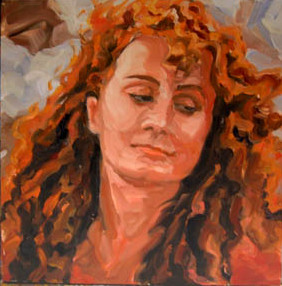
Kathleen by Carol Morrison

Kathleen by Carol Morrison

Psychiatric Protocol

This entry was posted on by .

andrea_nickiPatient reports suicidal ideation.

How often does the patient think of suicide?

1. If every day, go to question 2.

2. Does the patient have a suicide plan? If no, go to question 3. Test for personality disorder.

3. Does the patient exhibit impulsive behaviour, such as spending large sums of money? If patient says no, continue with other questions. Patient must have at least # _ of symptoms in order to be diagnosed as having a personality disorder.

4. Ask patient about sexual orientation? Is the patient sometimes confused about this?

Doctor writes: Patient says no, but is upset about this question. Complains about being compulsively drawn to bad situations “like a broken compass.” Unclear.

5. Does the patient fear abandonment?

Doctor writes: Patient starts to cry. I repeat the question. Patient is very angry. Says family abandoned her. Glares and stops talking, says doesn’t like being tested for a personality disorder,  doesn’t believe in personality disorders, finds them “demeaning and disrespectful.” Patient very uncooperative and angry. Borderline personality disorder.

From Noble Orphan (Demeter Press, 2012).

Shuffle Forward

This entry was posted on by .

Shuffle Forward

 
The child is suddenly silent,
Unresponsive
His face — pasty white and expressionless,
his skin feels cold and moist.
His grey ball cap has been pulled down
so far over his forehead
you can’t see his eyes.
His breathing is shallow and quick.
His pulse is strong, but rapid —
the vein in his neck distended and
pulsating with increasing purpose.

Everyone shuffles forward.

He shuffles, too,
moving in closer to you,
securing a safe place,
moored into the harbour of your back.
His slender body is rigid and still.
You place your arms behind you
and around him,
hugging him closer.

Shuffle forward.

You can feel his heartbeat pounding through you.
You can feel your own body reacting;
You pull your lips in,
pressing them tighter and tighter —
eyelids blinking,
trying desperately to
fight back your own tears.
You close your eyes for a moment and
take a deep breath.
Am I doing the right thing?
Should we leave?
He said that he didn’t want to go,
yet,
here you are.

Everyone shuffles forward.

Your arms wrapped around his rigid body, you shuffle forward,
bringing him along with you.
“Next in line!” you hear a young man
sing out from behind the counter.
You shuffle forward,
“Two adults, two children for Toy Story 3,” you say.

Pathways by Paula Follett-Comeau

Pathways by Paula Follett-Comeau

A Conversation with Carol Bruneau

This entry was posted on by .

bruneauThese Good Hands is Carol Bruneau’s sixth novel. Published in May 2015 by Cormorant Books, These Good Hands is a fictionalized biography of nineteenth-century French artist Camille Claudel. The book explores mental illness, misogyny, compassion, and the enduring power of art. It focuses in part on the strained relationship Claudel had with her mother — a relationship tempered by social attitudes about women’s “proper” behaviour.

Understorey Magazine spoke with Carol about her inspiration for These Good Hands, what she learned about Claudel, motherhood, and illness, and how she kept writing through the ten years required to create this book.

Understorey Magazine: What inspired you to write about Camille Claudel?

Carol Bruneau: I first heard of Claudel ten years ago through a tiny display, part of a Rodin exhibition, at the Art Gallery of Nova Scotia. Rodin was Claudel’s teacher. He was forty-two and she eighteen when they first met in Paris in the early 1880s and began their affair. Imagine, a middle-aged instructor hitting on a talented teenage student who was keen to get ahead in a tough career. Sex was an assumed perk of artistic “collaboration” — this at a time when women artists had to get government dispensations to wear pants. The Rodin display told little about Claudel other than that she was Rodin’s student/model/muse and mistress and that she died after spending thirty years in an asylum. The fact that she was a brilliant sculptor was mentioned, but more or less in passing.

UM: Motherhood shaped Claudel’s life, even though she was never a mother herself. How does motherhood figure in your novel?

CB: Claudel’s mother felt that her sexual behaviour — her relationship with Rodin — was an unforgivable disgrace to the family. When Claudel was in her twenties, symptoms of mental illness began to manifest and her mother thought her even more of a social liability. In 1913, Claudel was committed to a French asylum and diagnosed with what we might call schizophrenia. Her mother never visited, although she corresponded with her occasionally by sending small care packages to the asylum, mostly food.

Even more heartbreaking, on several occasions Claudel’s doctors found her well enough to be released into the care of her family, and each time Claudel’s mother absolutely refused to allow it. In letters, she wrote that Claudel had “caused them enough suffering” and under no circumstances would she accept responsibility for her daughter.

Social stigmas regarding mental illness and standards of “moral” behaviour certainly played into this, but even so, the mother’s lack of compassion is striking, and certainly seems, from our perspective today, to be unusually harsh.

My novel uses key pieces of Claudel’s artwork as touchstones in her narrative. I’ve also invented a work-in-progress called “Maman et Enfant” that Claudel creates and hopes her mother will appreciate as a token of their “natural” affection.

There have also been suggestions that Claudel and Rodin had at least one child together and it’s easy to assume that she had an abortion at some point; this is another motherhood-related plot point in my novel. Claudel’s inability to become a mother herself may have caused her further grief, especially given her difficult relationship with her own mother.

UM: How is this book and its themes of motherhood, misogyny, and mental illness, related to your previous novels?

CB: These Good Hands revisits themes explored in my previous novels, but considers them from more extreme, even radical, perspectives.
My 2005 novel Berth likely predisposed me to Claudel’s situation. Berth is set in the 1980s and explores the limits of maternal selflessness; how an otherwise “good” mother risks compromising her child’s interests to act in her own largely sexual interests. The central character in Berth suffers the psychological effects of social isolation and ever-present misogyny, acting in ways that I think shed light on persistent double standards regarding “proper” female versus male behaviour. Berth was a bit like getting my feet wet, preparation for diving into the more intense, more exacting challenge of writing about a clinical case of mental illness and the research that necessitated.

My last novel, Glass Voices, revolves around a mother who loses a child in the Halifax Explosion, and how trying to reconcile herself to this loss — and the accompanying guilt she feels over surviving when her child apparently hasn’t — prevents her from seizing life’s possibilities. In a way, These Good Hands revisits the kind of longing that this character feels, but looks instead at the severed mother-daughter connection from the child’s perspective.

As for the theme of motherhood, it’s like oxygen in just about all of my writing. A mother of three, I lost my own mother while in my mid-twenties and before I had my children. So motherhood is a theme that continually intrigues me with its endless variations to explore. Of all the things one can write about, in all its permutations motherhood is one of the most interesting, timeless, and universal.

UM: What is Camille Claudel’s legacy?

CB: Because she destroyed much of her later work — and because during her long incarceration, pieces went missing — her oeuvre only comprises ninety pieces or so, including originals and copies. A good deal of her work done as Rodin’s apprentice was incorporated into his famous pieces. She was expert at sculpting hands and feet, for instance, and made many of the figures for his Gate of Hell, yet art historians balk at ascribing her authorship of specific pieces.

As far as I’ve determined, at that time, no other European sculptor with skills of Claudel’s calibre used the medium to explore themes so directly related to women, and in ways that refuted — subverted — the romantic, self-serving representations her male peers created. In works such as Clotho (1893), Claudel focused on telling the truth about women’s lives. Eschewing any traditional ideas of beauty in art, pieces like this must have blindsided her contemporaries, and attest to her courage and fiercely distinctive vision.

As an inspiration to artists generally, her legacy is huge. It is revered in France. In North America, sadly, it’s barely recognized but this is already changing, I think, as more people discover her. Better late than never. The fact that her art transcends and truly outshines the tragic circumstances of its creation is inspiration to all.

UM: These Good Hands took ten years to write. How do you maintain commitment to and enthusiasm for a project over such a period?

CB: I take inspiration from my subjects themselves. Glass Voices took eight years to write, and in that case I’d think about the perseverance required of Halifax Explosion survivors any time I felt whiny. With this book, the tragedy of Claudel herself made me determined to persevere — although on several occasions I almost despaired because of a perceived disinterest in its subject, and filed the thing away “for good” in a drawer. It would have become the permanent elephant-in-the-room if several friends and family members hadn’t pestered me about it. And a couple of trips to France — after the initial trip to do research — fanned the flames. Then, in 2012, I saw the world’s only permanent collection of Claudel’s work in the Musee Ste. Croix in Poitiers, which is also the home of my ancestors and, well, that was the nudge I needed — that and a timely note from a friend about rejecting rejection.

UM: Now that the book is out, how will you spend your summer?

CB: Well, having just finished a new collection of short stories, I’m presently trying to pick up the threads of a novel I started in 2010. I’ll be doing some readings in Toronto, and then, I hope, hiding out on my deck, writing.

For a chance to win a copy of These Good Hands leave a comment below! Courtesy of Cormorant Books.

Review: The Brief Reincarnation of a Girl

This entry was posted on by .

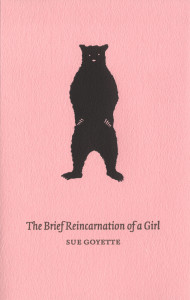
sueIn The Brief Reincarnation of a Girl (Gaspereau Press, 2015), Nova Scotia poet Sue Goyette delivers a long form poem about a four-year-old Massachusetts girl who died after prolonged exposure to a cocktail of drugs prescribed for bipolar disorder and ADHD. Her parents were subsequently convicted for the murder.

The book is set mainly in the court room during the trial and includes the conversations, thoughts, and actions of the parents, lawyers, doctor, judge, jury, and witnesses — as well as the ghost of the girl.

Goyette does not simply reiterate this story for empathetic purposes. Through surreal language and metaphor, she shows the reader an alternate reality, asks questions, and looks for answers as to how a tragedy like this can occur. Readers watch the human characters interact, but much like stepping through the looking glass, we also see societal actors at play: poverty, childhood, mental health, technology, and the social, education, and health systems — to name a few.

Of these characters, poverty feels most prominent. It is a school yard bully we all recognize, whether as victims or as witnesses who stand back to watch. In The Brief Reincarnation of a Girl, poverty swoops around the courtroom and is partially deflected by gavels and prescriptions pads. Yet poverty, Goyette shows, can eat you alive: “No one ever thinks / of the edge being so close. Or the drop so sudden.”

In Goyette’s hallmark style, seemingly nonsensical language and tangential references layer the poems with meaning and challenge readers to absorb each word and scene. While logic tells me, for example, that a kitchen colander cannot strain heartbeats and a bear cannot keep this girl alive, through Goyette’s language, I understand more than ever what is happening at this trial. Goyette’s words are a terrifying reminder of how children are often at the mercy of adult lives and how complacency can make us oblivious to an upside-down world where a preschooler can be failed by so many people.

Indeed, the presence of the girl as a ghost throughout the trial needles both readers and the living characters in the narrative: “The ghost of the girl hoisted the shovel to show / the jury what had been prescribed to her. She tried / telling them that all she could do with this shovel / was to dig holes she kept falling into….” The image is haunting, the girl’s reality so far down, so clouded by medication and a mental illness that might or might not have existed. Through this powerful and counter-logical portrayal of a tragic reality, the girl is given body and voice and a piece of her, as well as lingering questions about illness, authority, and social structures, are placed in us all.